


Car engine overhaul Hyundai Elantra 1

General information about major repairs
This section includes descriptions of the basic repair procedures for the cylinder head, engine block and its internal components. The information provided ranges from...
This section includes descriptions of the basic repair procedures for the cylinder head, engine block and its internal components. The information provided ranges from...
Engine Overhaul — General Information
Determining whether and when to completely overhaul an engine is not always easy, as there are many different factors to consider. High mileage is not always an...
Determining whether and when to completely overhaul an engine is not always easy, as there are many different factors to consider. High mileage is not always an...

Checking the compression in the cylinders
Checking the compression in the cylinders will show what condition the upper part of the engine is in (i.e. pistons, rings, valves, head gasket). Specifically, this test...
Checking the compression in the cylinders will show what condition the upper part of the engine is in (i.e. pistons, rings, valves, head gasket). Specifically, this test...
Checks with a vacuum meter
Connect a vacuum gauge directly to the exhaust manifold. Warm up the engine before starting measurements. Apply the parking brake and block the wheels. Start the engine...
Connect a vacuum gauge directly to the exhaust manifold. Warm up the engine before starting measurements. Apply the parking brake and block the wheels. Start the engine...

Engine Removal — General Information
Before removing the engine, it is necessary to clean the engine compartment from dirt and traces of oil. A winch or lift is required. Prepare all necessary tools and...
Before removing the engine, it is necessary to clean the engine compartment from dirt and traces of oil. A winch or lift is required. Prepare all necessary tools and...

Engine — removal and installation
Caution: Gasoline is extremely flammable, so extreme caution must be exercised when working on any part of the fuel system. Do not smoke or allow open flames in the work...
Caution: Gasoline is extremely flammable, so extreme caution must be exercised when working on any part of the fuel system. Do not smoke or allow open flames in the work...
Engine Overhaul Options
A home handyman who intends to carry out engine repairs will be faced with the need to make a certain choice. The decision to replace the cylinder block, piston group...
A home handyman who intends to carry out engine repairs will be faced with the need to make a certain choice. The decision to replace the cylinder block, piston group...

Engine overhaul — disassembly sequence
It is much easier to disassemble and work on an engine if it is mounted on a portable stand. Such a stand can be rented for a very reasonable fee. Before installing the...
It is much easier to disassemble and work on an engine if it is mounted on a portable stand. Such a stand can be rented for a very reasonable fee. Before installing the...
Cylinder head — repair
New cylinder heads can be purchased at specialized auto stores. Due to the fact that specialized equipment is required for the disassembly and inspection processes, and...
New cylinder heads can be purchased at specialized auto stores. Due to the fact that specialized equipment is required for the disassembly and inspection processes, and...

Cylinder Head — Removal (All Engines)
Caution: The following is the procedure for removing the cylinder head on an engine that has been removed from the vehicle. If they have not been removed, remove the...
Caution: The following is the procedure for removing the cylinder head on an engine that has been removed from the vehicle. If they have not been removed, remove the...

Cylinder head — disassembly (1.6 and 1.8 liter engines)
Disassembling the cylinder head involves removing all elements. Label all parts and store them separately so that they can be returned to their original positions when...
Disassembling the cylinder head involves removing all elements. Label all parts and store them separately so that they can be returned to their original positions when...

Cylinder Head — Disassembly (2.0L Engines)
Label all parts and store them separately so that they can be returned to their original positions when installed. Place the cylinder head on a table or in a vice. If...
Label all parts and store them separately so that they can be returned to their original positions when installed. Place the cylinder head on a table or in a vice. If...

Cylinder Head Components — Cleaning and Checking
A thorough cleaning of the cylinder head and associated valve train, followed by a detailed inspection, will help you decide what work needs to be done to the valves...
A thorough cleaning of the cylinder head and associated valve train, followed by a detailed inspection, will help you decide what work needs to be done to the valves...

Cylinder head — assembly
Whether the head has been shop reconditioned or not, make sure it is completely clean before reassembling. If you received it from repair after valve maintenance, then...
Whether the head has been shop reconditioned or not, make sure it is completely clean before reassembling. If you received it from repair after valve maintenance, then...

Camshaft — Checking and Replacing
The camshaft rotates in aluminum cylinder head bearings. Check the clearance between the shaft journals and the bearing head and housing beds. If it is higher than the...
The camshaft rotates in aluminum cylinder head bearings. Check the clearance between the shaft journals and the bearing head and housing beds. If it is higher than the...

Valves, valve seats and guides — inspection and repair
Check the valve plates (especially graduation), whether they are burnt or have pitting corrosion. At the same time, inspect the saddles. If the damage is minor, the...
Check the valve plates (especially graduation), whether they are burnt or have pitting corrosion. At the same time, inspect the saddles. If the damage is minor, the...

Lapping valves
The valve grinding is performed as follows. Place the cylinder head on a workbench with two pieces of wood underneath. Clean all valves from carbon deposits. Apply...
The valve grinding is performed as follows. Place the cylinder head on a workbench with two pieces of wood underneath. Clean all valves from carbon deposits. Apply...

Valves — Checking for leaks
The tightness of the valves is checked using kerosene, which must be poured into the combustion chambers. At the same time, kerosene leaks through the seal (valves -...
The tightness of the valves is checked using kerosene, which must be poured into the combustion chambers. At the same time, kerosene leaks through the seal (valves -...

Valve guides — checking and replacing
The clearance between the guide bushings and the valve stem is checked with an indicator or the diameters of the valve stem and the guide bushing hole are measured (see...
The clearance between the guide bushings and the valve stem is checked with an indicator or the diameters of the valve stem and the guide bushing hole are measured (see...

Cylinder head — carbon removal
Usually, with modern types of fuel and oils, carbon deposits need to be removed after a mileage of over 120 thousand km. This operation can be performed either with the...
Usually, with modern types of fuel and oils, carbon deposits need to be removed after a mileage of over 120 thousand km. This operation can be performed either with the...

Flywheel and starter ring gear — inspection and repair
The flywheel is carefully balanced and there is little that can be done to it in a normal workshop. After removing the flywheel from the engine, check its mating surface...
The flywheel is carefully balanced and there is little that can be done to it in a normal workshop. After removing the flywheel from the engine, check its mating surface...

Front Engine Cover/Balance Shafts — Removal, Installation, Repair
Front Engine Cover/Balance Shafts (1.6L and 1.8L engines) 1 - Oil filter mounting bracket; 2 - oil pressure sensor; 3 - oil filter; 4 - front cover; 5 - leading gear; 6...
Front Engine Cover/Balance Shafts (1.6L and 1.8L engines) 1 - Oil filter mounting bracket; 2 - oil pressure sensor; 3 - oil filter; 4 - front cover; 5 - leading gear; 6...

Pistons and connecting rods — removal
Caution: Before removing the pistons and connecting rods, remove the cylinder head. Check with your fingernail to see if a bead has formed at the upper limit of the...
Caution: Before removing the pistons and connecting rods, remove the cylinder head. Check with your fingernail to see if a bead has formed at the upper limit of the...

Crankshaft — Removal
Elements of the crank mechanism (CRM) 1 - crankshaft; 2 - connecting rod; 3 - piston; 4 - piston rings; 5 - flywheel ring gear; 6 - flywheel; 7 - bolts; 8 - rear...
Elements of the crank mechanism (CRM) 1 - crankshaft; 2 - connecting rod; 3 - piston; 4 - piston rings; 5 - flywheel ring gear; 6 - flywheel; 7 - bolts; 8 - rear...
Cylinder Block — Cleaning and Checking
Most of the plugs in the engine were heavily corroded during the engine's operation. Place a small chisel on one end of the plug and hammer it in until the other end of...
Most of the plugs in the engine were heavily corroded during the engine's operation. Place a small chisel on one end of the plug and hammer it in until the other end of...

Cylinders — Check
Before checking, the cylinder block must be cleaned. Check the cylinder block bores for damage, wear or scratches. Measure the diameter of each cylinder hole just below...
Before checking, the cylinder block must be cleaned. Check the cylinder block bores for damage, wear or scratches. Measure the diameter of each cylinder hole just below...

Pistons and connecting rods — check
Before checking, the pistons and connecting rods must be cleaned and the old rings removed from the pistons. Caution: Install new piston rings whenever the engine is...
Before checking, the pistons and connecting rods must be cleaned and the old rings removed from the pistons. Caution: Install new piston rings whenever the engine is...

Crankshaft — Check
Clean the crankshaft with solvent and dry it. Clean the oil holes with a stiff brush and rinse them with solvent. Check the main (arrows) and connecting rod (arrows)...
Clean the crankshaft with solvent and dry it. Clean the oil holes with a stiff brush and rinse them with solvent. Check the main (arrows) and connecting rod (arrows)...

Main and connecting rod bearings — inspection
Although the connecting rod and main bearings are replaced with new ones during reconditioning, the old bearings should be left for detailed examination, as they can...
Although the connecting rod and main bearings are replaced with new ones during reconditioning, the old bearings should be left for detailed examination, as they can...

General instructions for engine assembly
If the work has been done carefully and all components have been repaired or replaced, the engine is ready for assembly. This is the most enjoyable part of the job....
If the work has been done carefully and all components have been repaired or replaced, the engine is ready for assembly. This is the most enjoyable part of the job....

Crankshaft — installation
Regardless of how the bearing size was determined, to determine the clearance size, use plastic to measure the clearance. Clean the backs of the new main bearing inserts...
Regardless of how the bearing size was determined, to determine the clearance size, use plastic to measure the clearance. Clean the backs of the new main bearing inserts...
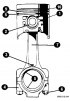
Connecting rod and piston group — assembly
Piston assembly with connecting rod 1 - piston; 2 - piston pin; 3 - connecting rod; 4 - connecting rod cover; 5 - inserts; 6 - connecting rod cap nut; 7 - location of...
Piston assembly with connecting rod 1 - piston; 2 - piston pin; 3 - connecting rod; 4 - connecting rod cover; 5 - inserts; 6 - connecting rod cap nut; 7 - location of...

Piston Rings — Inspection/Assembly Recommendations
Before installing piston rings, it is necessary to check the gaps between the ends of the rings. (It is assumed that the piston ring lateral clearance has already been...
Before installing piston rings, it is necessary to check the gaps between the ends of the rings. (It is assumed that the piston ring lateral clearance has already been...

Pistons with connecting rods — installation
Place the pistons and connecting rods in the correct order. The numbers on the connecting rods correspond to the cylinder number. Remember that the mark (arrow) on the...
Place the pistons and connecting rods in the correct order. The numbers on the connecting rods correspond to the cylinder number. Remember that the mark (arrow) on the...

First engine start after repair
Attention: The most critical moments in the "life" of a newly repaired engine are the first few seconds of operation. Preparation makes the difference between a smooth...
Attention: The most critical moments in the "life" of a newly repaired engine are the first few seconds of operation. Preparation makes the difference between a smooth...

The engine won't start — what to do?
If the motor shaft does not rotate or rotates slowly Cars with automatic transmission Make sure the control lever is in position N or P. Check that the clamps at the...
If the motor shaft does not rotate or rotates slowly Cars with automatic transmission Make sure the control lever is in position N or P. Check that the clamps at the...
Engine diagnostics performed during operation
Increased content of harmful substances in exhaust gases Measurements show high concentrations of harmful substances; a rotten egg smell may occur. The appearance of an...
Increased content of harmful substances in exhaust gases Measurements show high concentrations of harmful substances; a rotten egg smell may occur. The appearance of an...
This section is available on russian, bulgarian, belarusian, ukrainian, serbian, croatian, romanian, polish, slovak, hungarian
We recommend other sections on the topic of Hyundai manuals:
Power unit: Engine overhaul Hyundai Sonata 4 (2001-2012, petrol)
Link in different formats to this section
TextHTMLBB Code
- User manual
- Control devices
- Audio system
- Starting the engine and driving
- Faults en route
- Maintenance and care
- Technical information
- Power unit
- Gasoline engines
- Diesel engines
- Lubrication system
- Cooling system
- Fuel system (gasoline)
- Fuel system (diesel)
- Decreased toxicity
- Ignition system
- Transmission
- Clutch
- Mechanical gearbox
- Automatic gearbox
- Drive shafts and axles
- Chassis
- Car suspension
- Steering
- Brake system
- Body
- Exterior (external elements)
- Interior (internal elements)
- Air conditioning system
- Electrical equipment
- Equipment and devices
- Headlights and lighting
- Power devices
- Electrical circuits
- General information
- Maintenance
- Power unit
- Engine repair
- Cooling system
- Intake and exhaust system
- Fuel system
- Transmission
- Clutch
- Manual gearbox
- Automatic gearbox
- Drive shafts and axles
- Chassis
- Front suspension
- Rear suspension
- Steering
- Brake system
- Body
- Body elements
- Electrical equipment
- Equipment and devices
- Electrical diagrams
- General information
- Introduction to the guide
- Maintenance
- Power unit
- Minor engine repair
- Engine overhaul
- Lubrication system
- Cooling system
- Fuel injection system
- Ignition system
- Exhaust system
- Transmission
- Clutch
- Manual gearbox
- Automatic gearbox
- Drive shafts
- Chassis
- Front suspension
- Rear suspension
- Steering
- Wheels and tires
- Troubleshooting
- Brake system
- Body
- Body elements
- Electrical equipment
- Equipment and devices
- Power devices
- Heating and air conditioning
- Electrical circuits