HyundaiBook.ru
Repair Chevrolet Repair Honda Repair Toyota Repair Land Rover Repair VAZ Repair Renault Repair Nissan
English Русский
Български
Беларускі
Український
Српски
Hrvatski
Română
Polski
Slovenský
Magyar
ArticlesSitemapContacts  


  Accent   Elantra   Getz   Grandeur   Sonata   Santa Fe   Tucson   Others
Elantra 1 (1990-1995, petrol) Elantra 2 (1995-2000, petrol) Elantra 3 (2000-2006)
  • Main
  • Elantra
  • J1 (1990-1995)
  • Power unit
  • Engine overhaul
  • Engine — removal and installation

Engine — removal and installation (Hyundai Elantra J1)

0
Caution: Gasoline is extremely flammable, so extreme caution must be exercised when working on any part of the fuel system. Do not smoke or allow open flames in the work area. If gasoline comes into contact with your skin, wash it off immediately with plenty of soap and water. When working with any component of the fuel system, wear safety glasses and have a fire extinguisher handy.


Removal


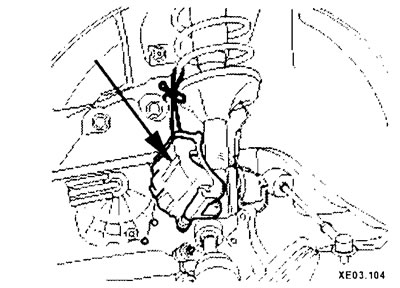
After disconnecting the wires from the battery, remove the battery.
After disconnecting the wires from the…


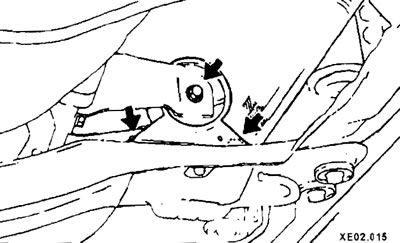
Cover the fenders of your car; there are special covers for this, but regular bedspreads or old blankets will do. Remove the hood.
Cover the fenders of your car; there…


Remove the air cleaner.

Label all vacuum hoses, electrical wiring, ground wires and fuel lines to ensure proper installation later, then disconnect them. Pieces of electrical tape with numbers on them are suitable for marking. If there is a possibility of hoses and/or wires getting mixed up, you may want to draw a diagram of the engine compartment and clearly label all lines, hoses and wires.


Lift the vehicle and secure it securely to the support posts (trestles). Drain all liquid from the cooling system.

Tag and disconnect all coolant hoses from the engine.
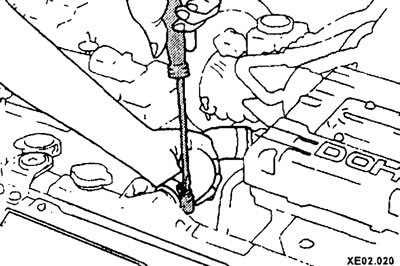
Tag and disconnect all coolant hoses…


Remove the lower protective cover (if present).

Disconnect the exhaust system from the engine by removing the clamp and bracket (2).
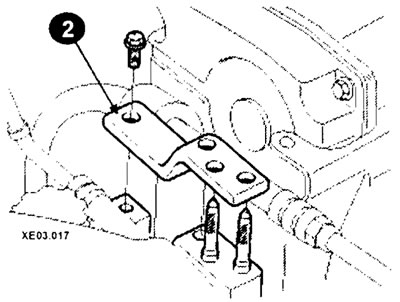
Disconnect the exhaust system from the…


Disconnect the gearshift rod.

Models with manual transmission
  • Remove the gearbox control mechanism.

Models with automatic transmission
  • Disconnect the automatic transmission control cable.
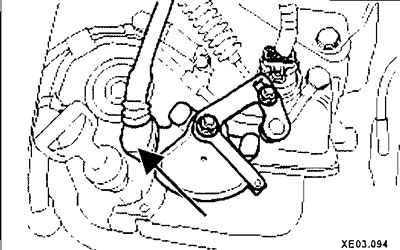
Disconnect the automatic transmission…


Disconnect the air conditioning compressor plug.


Disconnect the starter wires.

Disconnect the fuel lines from the engine to the chassis. Close or clamp open fittings/hoses.

Disconnect the ground wire from the clutch housing and disconnect the clutch drive.

Loosen the steering column bolt.
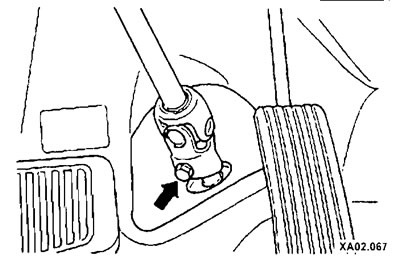
Loosen the steering column bolt.


Raise the front of the vehicle and remove the wheels.

Remove the side shield (A) by unscrewing the bolts (B).
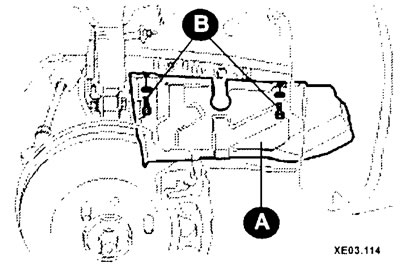
Remove the side shield (A) by…


Hang the wheel support on the wire.

Hang the wheel support on the wire.


Disconnect the steering knuckle from the shock absorber strut.
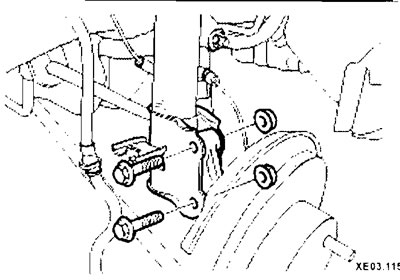


Disconnect the steering knuckle from…


Disconnect the wheel speed sensor (A) (models with ABS).
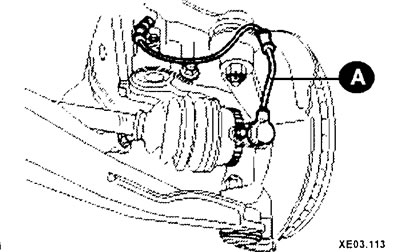
Disconnect the wheel speed sensor (A)…


Using a punch or special tool, remove the drive shafts (1) from the gearbox housing (2).
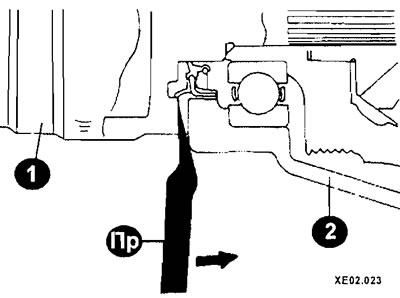
Using a punch or special tool, remove…


Hang the drive shafts from the body using wire.

Remove the ignition distributor (if equipped).

Drain the oil from the engine and remove the oil filter (if necessary).


You can remove the starter and generator by unscrewing the fasteners.
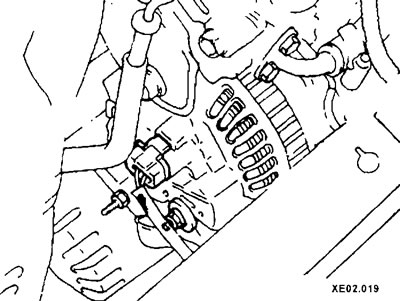
You can remove the starter and…


(The material was obtained from a web resource HyundaiBook)

Disconnect the front anti-roll bar from the front mount and rotate them to a position that does not interfere with removing the engine from the vehicle.

Support the weight of the transmission with a jack. Place a block of wood between the jack and the transmission to prevent damage.

Attach a special cable or chain to the engine and gearbox load elements.
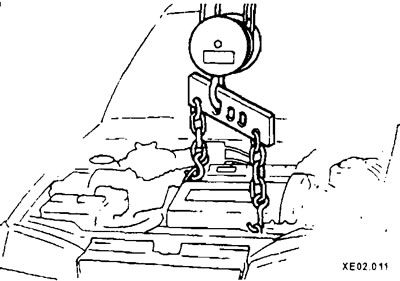
Attach a special cable or chain to the…


Place the winch in the working position and attach the rope/chain to it. Tighten the rope/chain.

Caution: Do not stand under the engine if its weight is supported only by a jack or winch.


Loosen the support bolts that secure the engine to the body.
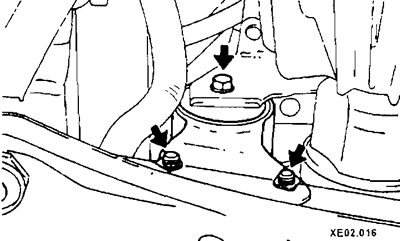


Front support for 1.6 and 1.8 liter…

Front support for 1.6 and 1.8 liter engines
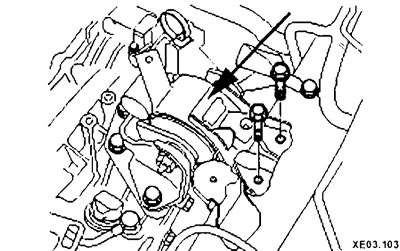

Front mount for 2.0 liter engine
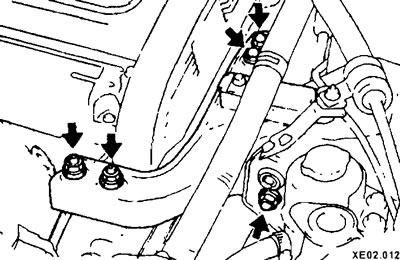
Front mount for 2.0 liter engine


Upper engine mount
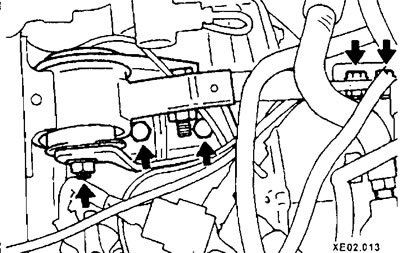
Upper engine mount


Transmission bracket
Transmission bracket


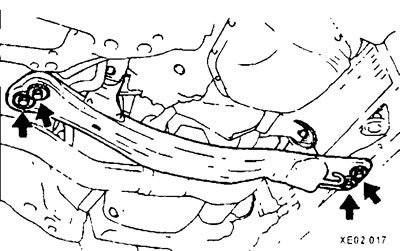
Central beam

Central beam


Rear engine mount

Rear engine mount


Disconnect the gearbox control rods.


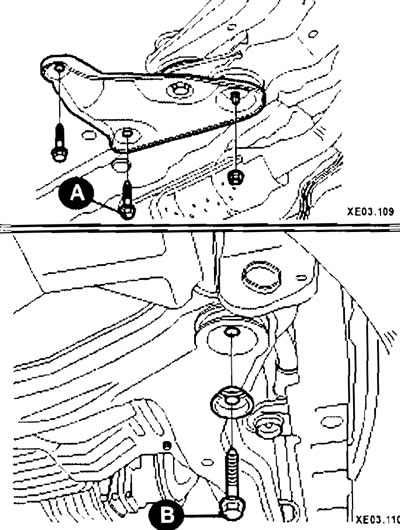
2.0 liter engine: Remove the bolts (A) and (B) securing the lower engine mount (see picture on the right).

Check again that nothing else secures the engine and gearbox to the body. If you find anything, disconnect it.

Lower the engine slightly to disengage the mount brackets.

Move the engine forward if necessary.
Move the engine forward if necessary.


Raise the engine slowly. Make sure there is nothing hanging from the engine as you lower the winch.

Lower the engine onto the workbench.

Check engine and gearbox mounts. If they are worn or damaged, replace them.

Install the front (A) and upper (B) engine mounts according to the marks (arrows). Do not mix them up.
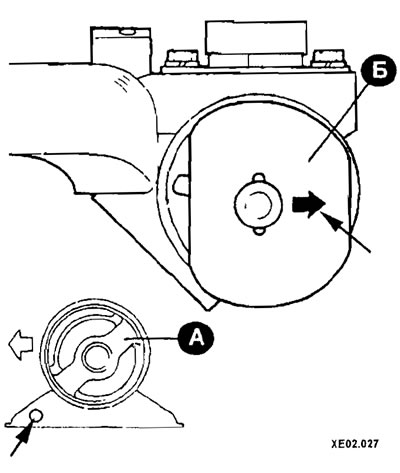
Install the front (A) and upper (B)…


Remember that the front (I) and rear (II) rubber bushings have different designs.
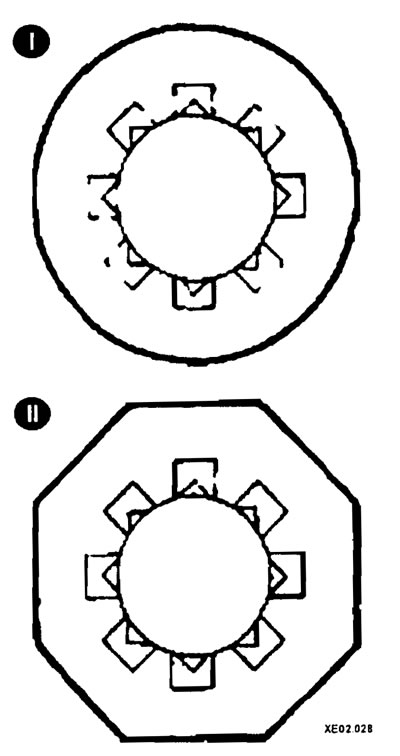


Remember that the front (I) and rear…


Carefully insert the engine into the engine compartment.

Align the holes in the engine brackets with the holes in the frame, insert the bolts, tightening them securely.

Reconnect all disconnected engine/gearbox components.

Fill the gearbox with coolant and oil. Check the brake fluid level and test the brakes.

Start the engine and check for leaks and that all components are functioning properly. Install the hood and test drive the vehicle.
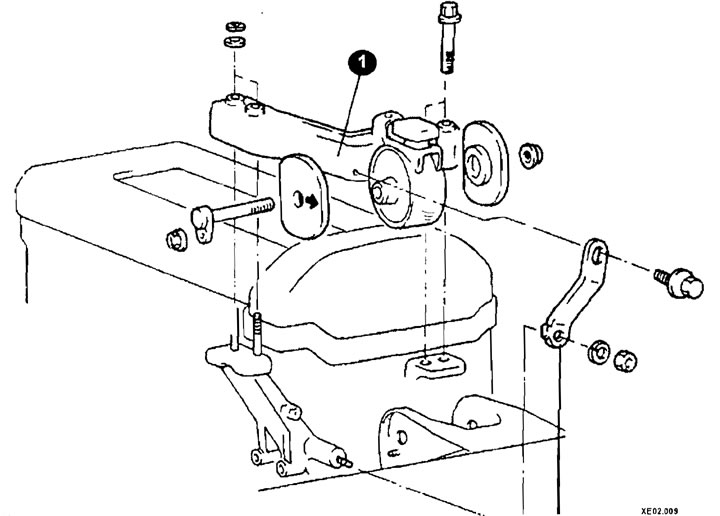
Mounting elements of the upper engine…

Mounting elements of the upper engine support (1)
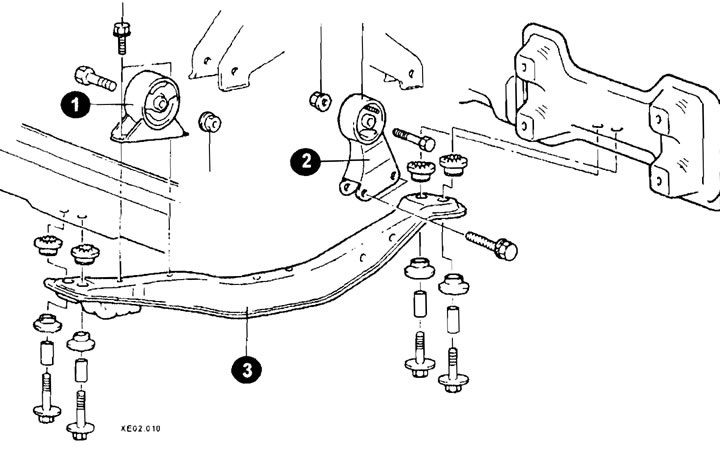

Engine Mounting Elements

Engine Mounting Elements
1 - front support;
2 - rear support;
3 - central beam.
This article is available at russian, bulgarian, belarusian, ukrainian, serbian, croatian, romanian, polish, slovak, hungarian
This article has been reviewed by: Konstantin Smirnov
Add to social network:

Previous
Elantra 1: Engine overhaul
Next

Engine Removal — General Information
Checks with a vacuum meter
Checking the compression in the cylinders
Engine Overhaul — General Information
General information about major repairs
Engine Overhaul Options
Engine overhaul — disassembly sequence
Cylinder head — repair
Cylinder Head — Removal (All Engines)
Cylinder head — disassembly (1.6 and 1.8 liter engines)
Cylinder Head — Disassembly (2.0L Engines)
We recommend other articles on the topic of Hyundai manuals:

Engine control — removal, inspection and installation Hyundai Accent 1 (1994-1999)
Engine Mounts — Removal and Installation Hyundai Getz (2002-2011)
Engine and gearbox assembly — removal and installation Hyundai Sonata 3 (1993-1998)
Removal and installation of the engine and gearbox assembly Hyundai Santa Fe 2 (2007-2012, petrol)
Removal and installation the engine with gearbox assembly Hyundai Tucson 1 (2005-2010)
Removal and installation of the engine and gearbox assembly Hyundai Matrix (2001-2010, petrol)
Link in different formats to this article

Visitor comments
No comments yet


How much will 14 + 28 ?


Elantra 3 (2000-2006) 
  • User manual
  • Control devices
  • Audio system
  • Starting the engine and driving
  • Faults en route
  • Maintenance and care
  • Technical information
  • Power unit
  • Gasoline engines
  • Diesel engines
  • Lubrication system
  • Cooling system
  • Fuel system (gasoline)
  • Fuel system (diesel)
  • Decreased toxicity
  • Ignition system
  • Transmission
  • Clutch
  • Mechanical gearbox
  • Automatic gearbox
  • Drive shafts and axles
  • Chassis
  • Car suspension
  • Steering
  • Brake system
  • Body
  • Exterior (external elements)
  • Interior (internal elements)
  • Air conditioning system
  • Electrical equipment
  • Equipment and devices
  • Headlights and lighting
  • Power devices
  • Electrical circuits
Elantra 2 (1995-2000, petrol) 
  • General information
  • Maintenance
  • Power unit
  • Engine repair
  • Cooling system
  • Intake and exhaust system
  • Fuel system
  • Transmission
  • Clutch
  • Manual gearbox
  • Automatic gearbox
  • Drive shafts and axles
  • Chassis
  • Front suspension
  • Rear suspension
  • Steering
  • Brake system
  • Body
  • Body elements
  • Electrical equipment
  • Equipment and devices
  • Electrical diagrams
Elantra 1 (1990-1995, petrol) 
  • General information
  • Introduction to the guide
  • Maintenance
  • Power unit
  • Minor engine repair
  • Engine overhaul
  • Lubrication system
  • Cooling system
  • Fuel injection system
  • Ignition system
  • Exhaust system
  • Transmission
  • Clutch
  • Manual gearbox
  • Automatic gearbox
  • Drive shafts
  • Chassis
  • Front suspension
  • Rear suspension
  • Steering
  • Wheels and tires
  • Troubleshooting
  • Brake system
  • Body
  • Body elements
  • Electrical equipment
  • Equipment and devices
  • Power devices
  • Heating and air conditioning
  • Electrical circuits
HyundaiBook.ru © 2018-2026 · Mobile version · Sitemap: EN BG BY UA RS HR RO PL SK HU · Administration · Site search · Hyundai owners Accent 1 · Accent 2 · Accent 3 · Elantra 1 · Elantra 2 · Elantra 3 · Getz · Sonata 3 · Sonata 4 · Santa Fe 2 · Tucson 1 · Tucson 2 · Matrix ·
This site uses cookies to optimize its functionality. By continuing, you agree to our terms.