


Identification data
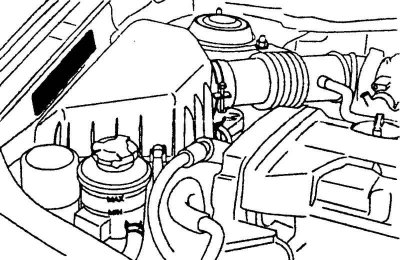
Fig. 1.1. Vehicle Identification Number (VIN)
The Vehicle Identification Number (VIN) is the number used to register a vehicle. It is located on the identification plate attached to the engine side of the partition wall between the passenger compartment and the engine compartment (Fig. 1.1).
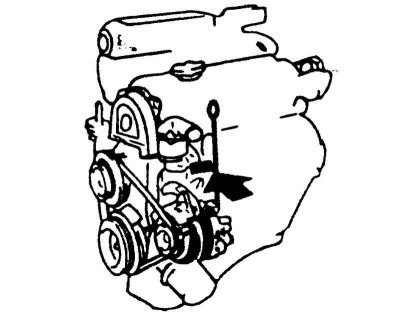
Fig. 1.2. Engine number
The engine number is stamped on the cylinder block, as shown in Figure 1.2.
Recommended tire pressure
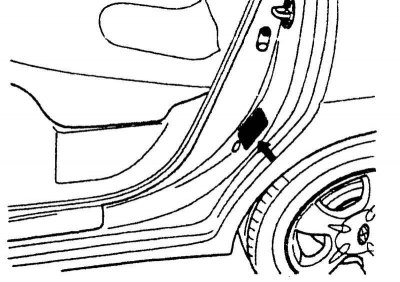
Fig. 1.3. Information on recommended tire pressure
Information on the recommended tire pressure is indicated on a plate attached to the door opening of the left rear door (Fig. 1.3).
Engine bay
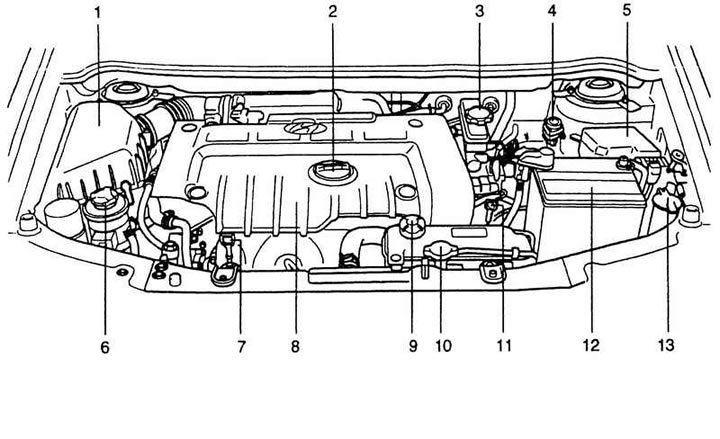
Fig. 1.4. Engine compartment of cars with an engine capacity of 1.6 l: 1 – air filter; 2 – engine oil filler cap; 3 – brake and clutch hydraulic fluid reservoir; 4 – Automatic cut-off switch; 5 – fuse box; 6 – Power steering fluid reservoir; 7 – engine oil dipstick; 8 – engine casing; 9 – expansion tank; 10 – radiator cap; 11 – Automatic transmission oil dipstick; 12 – battery; 13 – Windshield washer reservoir
Engine compartment of vehicles with a 1.6 liter engine displacement and two overhead camshafts (Fig. 1.4).
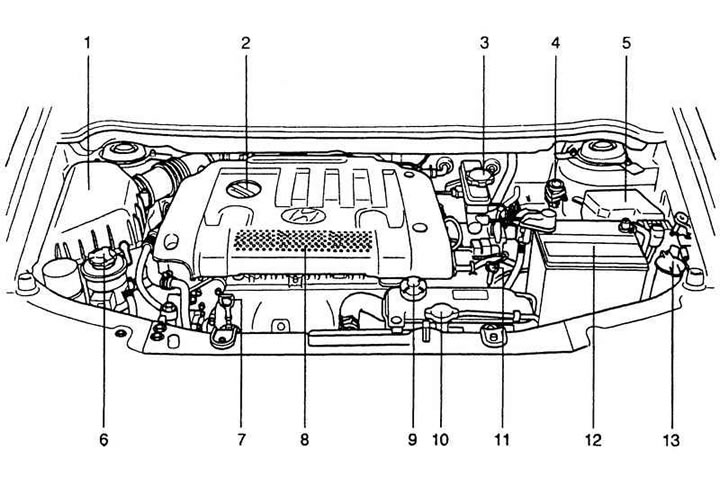
Fig. 1.5. Engine compartment of cars with an engine capacity of 1.8 l: 1 – air filter; 2 – engine oil filler cap; 3 – brake and clutch hydraulic fluid reservoir; 4 – Automatic cut-off switch; 5 – fuse box; 6 – Power steering fluid reservoir; 7 – engine oil dipstick; 8 – engine casing; 9 – expansion tank; 10 – radiator cap; 11 – Automatic transmission oil dipstick; 12 – battery; 13 – Windshield washer reservoir
Engine compartment of vehicles with a 1.8 liter engine displacement and two overhead camshafts (Fig. 1.5).
Caution: When checking and servicing the engine, be careful when handling tools to avoid damaging the plastic cylinder head cover.