


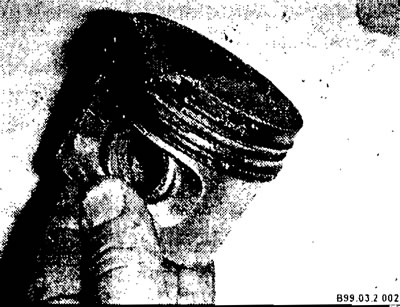
Caution: Install new piston rings whenever the engine is disassembled.
Using ring installation tools, carefully remove the old rings from the pistons. Be careful not to scratch or damage the pistons while doing this.
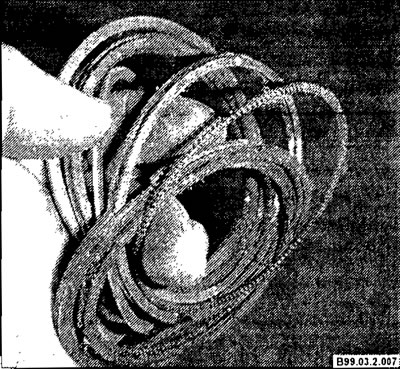
Clean all traces of carbon from the top of the piston using a hand wire brush or sandpaper. If there is a lot of carbon deposits, you can use a piece of an old piston ring.
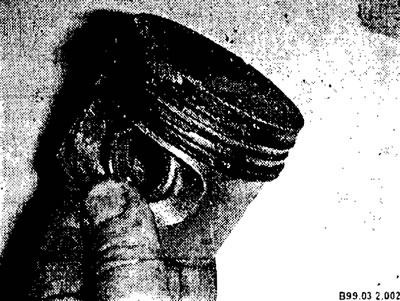
Never use a wire brush attached to a drill, as it may damage the piston, which is made of soft material.
Using a piece of an old piston ring, clean away any carbon deposits in the ring grooves. Clean off only the carbon deposits and do not remove metal or scratch the sides of the grooves.
After you have cleaned off the carbon deposits, clean the pistons and connecting rods with solvent and dry them. Make sure the oil return holes in the sides of the ring grooves are clean.
If the pistons and cylinder walls are not too worn or damaged, and if the cylinders have not been bored, old pistons can be used. Normal piston wear appears as vertical wear stripes on the piston bearing surfaces and a slight looseness of the top ring in its groove.
Check for nicks and scratches on the skirt bearing surfaces, in the piston pin bore, and for burnt areas on the edge of the head.
If the skirt is scratched or worn, the engine may suffer from overheating and/or abnormal combustion, resulting in excessively high operating temperatures. Such pistons should be replaced. Lubrication and cooling systems must be carefully checked. A hole in the piston head indicates abnormal combustion (premature (early) ignition). Burnt areas on the edge of the head usually indicate detonation. If any of the above problems occur, their causes must be eliminated, otherwise the damage will occur again. Causes may include intake air leaks, incorrect fuel-air mixture, incorrect ignition timing and incorrect operation of the exhaust gas recirculation system.
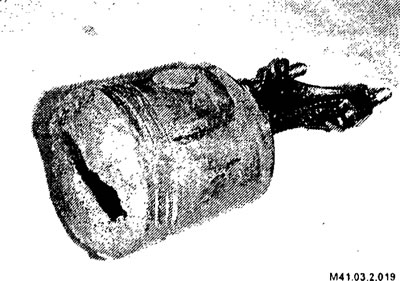
Typical burnt piston
Piston corrosion in the form of small pits indicates that coolant is leaking into the combustion chamber and/or crankcase. This problem must also be corrected.
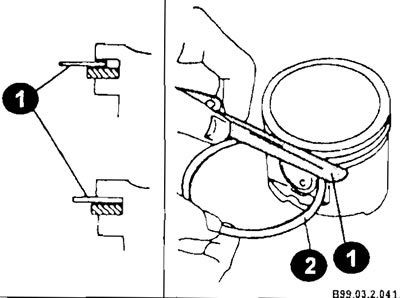
Measure the piston ring side clearance by placing a new ring (2) in each groove and inserting a feeler gauge (1) next to it. Measure the clearance at three or four points around the perimeter of each groove. Make sure you are using the correct ring - they are different. If the side clearance is greater than the permissible value, the piston must be replaced.
Check the clearance between the piston and the cylinder wall by measuring the cylinder bore diameter and the piston diameter. Measure the piston diameter across the skirt coaxially and at an angle of 90° to the piston pin. The clearance is defined as the difference between the diameters of the cylinder bore and the piston. If the clearance is greater than the permissible limit, the cylinder bores should be reamed and new pistons and rings should be used.
Check the clearance between the piston and connecting rod by moving them in opposite directions. Any noticeable play means there is excess wear that needs to be corrected. The pistons and connecting rods should be machined and new rings of the repair size should be installed.
Check the connecting rod for warpage. To do this, secure the connecting rod tightly to the fixture and measure the deviation of the connecting rod from the plane. If there is a deviation, the connecting rod must be replaced, selecting it according to weight.
Please note: The difference in weight between cranksets must not exceed 4g.
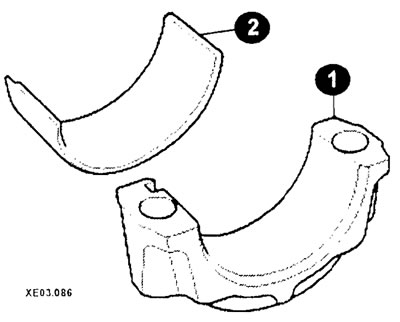
Check the connecting rods for cracks or other damage. Periodically remove the connecting rod caps (1), pull out the old bearing shells (2), wipe the surface of the bearings in the connecting rods and caps clean and check for scratches, burrs, etc.
After checking the connecting rods, replace the old bearing shells, reinstall the caps and tighten the nuts with your fingers.