


Note: If the engine does not operate at full power, there is increased oil consumption and a lean fuel-air mixture, it is necessary to check the compression in the engine cylinders.
1. Start and warm up the engine to operating temperature.
2. Stop the engine.
3. Disconnect the wires from the spark plugs.
4. Using a wrench (16 mm), remove the spark plugs.
5. Turn the engine over with the starter to remove foreign substances from the cylinders.
6. Screw the control pressure gauge into the spark plug socket.
7. Open the throttle valve fully by pressing the gas pedal all the way down.
8. While cranking the engine with the starter, read the pressure gauge readings. The standard compression value is 1420 kPa, the maximum permissible value is 1270 kPa.
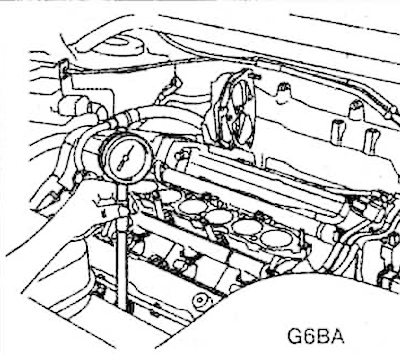 |
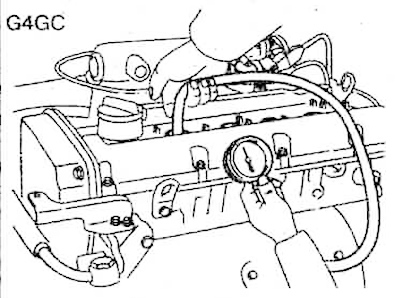 |
9. Repeat steps 6-8 for each cylinder. The difference in values should not exceed 100 kPa.
(The basis of the material is information from the website: www.hyundaibook.ru)
10. If the compression value in one of the cylinders or its difference relative to other cylinders does not correspond to the norm, pour a small amount of engine oil into the cylinder through the hole under the spark plug and repeat the operations according to points 6-9.
1) If the compression has increased after adding oil, this indicates an increase in the gap between the piston rings and the cylinder wall due to their wear.
2) If the compression remains the same, then the possible cause is valve sticking, loose valve seating, or poor sealing between the cylinder head and the cylinder block
11. Screw the spark plugs into the sockets and connect the wires to them.
Note: Spark plug tightening torque 20-30 Nm.