


Note: Check compression if power is reduced, oil or fuel consumption is increased.
1. Warm up the engine to operating temperature and turn it off.
2. Disconnect the high-voltage wires or remove the ignition coils.
4. Using a spark plug wrench (size 16 mm), remove the 4 spark plugs.
5. Install the compression gauge into the spark plug hole.
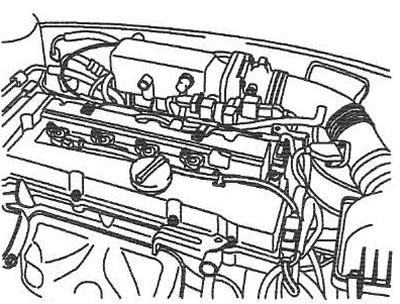 |
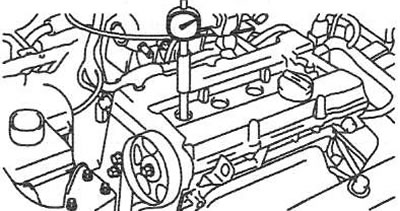 |
6. Open the throttle valve fully.
7. While turning the crankshaft with the starter, measure the compression.
Nominal value: 1618 kPa (1.4 l); 1422 kPa (1.6 l).
Minimum value: 1471 kPa (1.4 l); 1276 kPa (1.6 l).
Maximum difference between cylinders: 98 kPa.
Note: Use a fully charged battery to ensure the crankshaft rotates at 250 rpm or more.
8. Repeat the above steps for the remaining cylinders.
Note: This measurement should be taken as quickly as possible.
9. If the compression in one or more cylinders is below the minimum permissible value, pour a small amount of engine oil into the cylinder through the spark plug hole and check the compression in the cylinders again. If the compression pressure has increased, this means that the piston rings and/or cylinder wall are damaged. If the pressure has not increased, this means that the cylinder head gasket is damaged or the valves are not closing completely.
7. Install the spark plugs.
8. Connect the connectors or high-voltage wires.