


Power Electrical Equipment Hyundai Accent 2

General information about the charging system
The charging system includes a battery, a generator with a built-in regulator and a charge indicator lamp, and wires. The car has an alternator with a rectifier. The...
The charging system includes a battery, a generator with a built-in regulator and a charge indicator lamp, and wires. The car has an alternator with a rectifier. The...

Checking the charging circuit
Execution order 1. Turn on the ignition. 2. After turning on the ignition, with the engine running, the battery charging indicator lamp should light. 3. Disconnect the...
Execution order 1. Turn on the ignition. 2. After turning on the ignition, with the engine running, the battery charging indicator lamp should light. 3. Disconnect the...
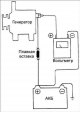
Checking the voltage drop on the wire connecting the battery to the generator
This test allows you to determine the reliability of the connection between the generator terminal "B" and the positive terminal of the battery. Preparing for the test...
This test allows you to determine the reliability of the connection between the generator terminal "B" and the positive terminal of the battery. Preparing for the test...
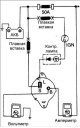
Checking the current generated by the generator
This test determines whether the generator produces a current that is equivalent to its rated power. Preparing for the test 1. Before testing, check the following items:...
This test determines whether the generator produces a current that is equivalent to its rated power. Preparing for the test 1. Before testing, check the following items:...
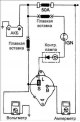
Checking the generated voltage
The purpose of this test is to verify that the electronic voltage regulator maintains the generated voltage at the required level. Preparing for the test 1. Before...
The purpose of this test is to verify that the electronic voltage regulator maintains the generated voltage at the required level. Preparing for the test 1. Before...
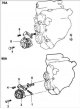
Generator — removal and installation
Generator mounting elements 1 – adjusting bolt; 2 – generator 90 A; 3 – bolt, 20–25 Nm; 4 – bolt, 20–28 Nm; 5 – bracket; 6 – bolt, 12–15 Nm; 7 – bolt; 8 – generator 75...
Generator mounting elements 1 – adjusting bolt; 2 – generator 90 A; 3 – bolt, 20–25 Nm; 4 – bolt, 20–28 Nm; 5 – bracket; 6 – bolt, 12–15 Nm; 7 – bolt; 8 – generator 75...

Battery
A battery is a device for storing energy in chemical form, which can then be used as electricity. A battery works because two different metals, when placed in an acidic...
A battery is a device for storing energy in chemical form, which can then be used as electricity. A battery works because two different metals, when placed in an acidic...

Checking the specific gravity of the electrolyte
Execution order 1. The specific gravity of battery electrolyte changes with temperature. An increase in temperature leads to a decrease in specific gravity and vice...
Execution order 1. The specific gravity of battery electrolyte changes with temperature. An increase in temperature leads to a decrease in specific gravity and vice...

Charging the battery
Specific gravity Charging method Slow charging (5A) Fast charging (20A) Less than 1,000 14 h 4 h 1,000–1,300 12 h 3 h 1,300–1,600 10 h 2.5 h 1,600–1,900 8 h 2.0 h...
Specific gravity Charging method Slow charging (5A) Fast charging (20A) Less than 1,000 14 h 4 h 1,000–1,300 12 h 3 h 1,300–1,600 10 h 2.5 h 1,600–1,900 8 h 2.0 h...

Battery inspection
Execution order 1. Turn off the ignition and all electrical consumers. 2. Disconnect the wires from the battery terminals. The negative wire should be disconnected first...
Execution order 1. Turn off the ignition and all electrical consumers. 2. Disconnect the wires from the battery terminals. The negative wire should be disconnected first...
Launch system — general information
The starting system includes the battery, starter, traction relay, ignition switch, interlock switch (only on vehicles with automatic transmission) and wires. When the...
The starting system includes the battery, starter, traction relay, ignition switch, interlock switch (only on vehicles with automatic transmission) and wires. When the...

Starter — removal and installation
1 – front cover; 2 – front hub; 3 – lid; 4 – bolt; 5 – traction relay solenoid; 6 – plunger; 7 – spring; 8 – gasket; 9 – lever; 10 – holders; 11 – spring; 12 – plug; 13...
1 – front cover; 2 – front hub; 3 – lid; 4 – bolt; 5 – traction relay solenoid; 6 – plunger; 7 – spring; 8 – gasket; 9 – lever; 10 – holders; 11 – spring; 12 – plug; 13...

Checking and replacing stator elements
Adjusting the gear clearance 1. Disconnect the wire from terminal M. 2. Using additional wires, connect the battery terminals to terminals S and M. 3. Turn on the...
Adjusting the gear clearance 1. Disconnect the wire from terminal M. 2. Using additional wires, connect the battery terminals to terminals S and M. 3. Turn on the...
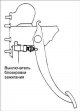
Ignition interlock switch
Check that the installation height, free play and clearance of the pin with the head and hole for the clutch pedal cotter pin are within normal limits.
Check that the installation height, free play and clearance of the pin with the head and hole for the clutch pedal cotter pin are within normal limits.

Checking the starter relay
Remove the starter relay and check the continuity between its terminals. If the continuity is not as required, replace the relay.
Remove the starter relay and check the continuity between its terminals. If the continuity is not as required, replace the relay.

Checking the ignition interlock switch
Check the continuity between the terminals of the ignition interlock switch.
Check the continuity between the terminals of the ignition interlock switch.
This section is available on russian, bulgarian, belarusian, ukrainian, serbian, croatian, romanian, polish, slovak, hungarian
We recommend other sections on the topic of Hyundai manuals:
Electrical equipment: Power devices Hyundai Elantra 3 (2000-2006)
Electrical equipment: Power devices Hyundai Getz (2002-2011)
Electrical equipment: Power devices Hyundai Santa Fe 2 (2007-2012, petrol)
Electrical equipment: Power devices Hyundai Matrix (2001-2010, petrol)
Link in different formats to this section
TextHTMLBB Code
- General information
- User manual
- Maintenance
- Power unit
- Engine repair
- Cooling and lubrication system
- Power and exhaust system
- Engine electrical equipment
- Engine management
- Transmission
- Clutch
- Mechanical gearbox
- Automatic gearbox
- Chassis
- Front suspension
- Rear suspension
- Wheels and tires
- Steering
- Brake system
- Body
- Exterior (external elements)
- Interior (internal elements)
- Heating and ventilation
- Electrical equipment
- Equipment and devices
- Electrical circuits
- User manual
- Control devices
- Starting engine and driving
- Troubleshooting
- Power unit
- SOHC engines
- DOHC engines
- Lubrication system
- Cooling system
- Decreased toxicity
- Fuel system
- Ignition system
- Transmission
- Clutch
- Mechanical gearbox
- Automatic gearbox
- Axles and drive shafts
- Chassis
- Car suspension
- Steering
- Brake system
- Body
- Exterior (external elements)
- Interior (internal elements)
- Air conditioning system
- Electrical equipment
- Equipment and devices
- Power devices
- General information
- Maintenance
- Power unit
- SOHC engines
- DOHC engines
- Cooling system
- Intake and exhaust systems
- Fuel supply (1.3 l, injection)
- Fuel supply (1.5 l, injection)
- Fuel supply (carburetor)
- Transmission
- Clutch
- Manual gearbox
- Automatic gearbox
- Drive shafts
- Chassis
- Car suspension
- Steering
- Brake system
- Body
- Body elements
- Electrical equipment
- Equipment and devices
- Electrical circuits