
HyundaiBook.ru
Repair Chevrolet Repair Honda Repair Toyota Repair Land Rover Repair VAZ Repair Renault Repair Nissan
English Русский
Български
Беларускі
Український
Српски
Hrvatski
Română
Polski
Slovenský
Magyar
ArticlesSitemapContacts  


  Accent   Elantra   Getz   Grandeur   Sonata   Santa Fe   Tucson   Others
Accent 1 (1994-1999) Accent 2 (1999-2005) Accent 3 (2005-2010)
  • Main
  • Accent
  • LC (1999-2005)
  • Electrical equipment
  • Power devices
  • Checking the generated voltage

Checking the generated voltage (Hyundai Accent LC)

0
Contents: Preparing for the test ⇓ Examination ⇓ Check result ⇓
The purpose of this test is to verify that the electronic voltage regulator maintains the generated voltage at the required level.

Preparing for the test


1. Before testing, check the following items:
  • the battery installed in the car must be fully charged;
  • check the tension of the generator drive belt.

2. Turn the ignition key to the "OFF" position.

3. Disconnect the cable from the negative battery terminal.

4. Connect a digital voltmeter between the generator "S (L)" terminals and ground. Connect the positive probe of the voltmeter to the generator "S (L)" terminal.

5. Disconnect the wire from the "B" terminal of the generator.

6. Connect a 0-100A DC ammeter in series between the "B" terminal and the wire disconnected from the generator. Make sure to connect the negative probe of the ammeter to the wire disconnected from the generator.
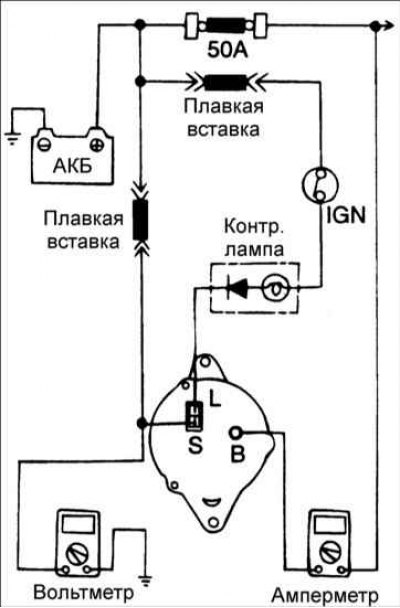
6. Connect a 0-100A DC ammeter in series between the «B» terminal and the wire…


7. Connect the tachometer and the wire to the negative terminal of the battery.

Examination


1. Make sure the voltmeter scale is clearly visible to determine the voltage value.

The voltmeter should show the battery voltage.


If the voltmeter shows a voltage of 0 V, this means that the electrical circuit connecting the "S (L)" terminal of the generator and the positive terminal of the battery is not closed, or the fuse link has burned out.

2. Start the engine and turn off all electrical consumers.

3. Increase the engine speed to 2,500 rpm and when the current decreases to less than 10 A, read the voltage value on the voltmeter.

Check result


1. If the voltage matches the required value, then the voltage regulator is working properly. If the voltage differs from the required value, then the voltage regulator or generator is faulty.

Voltage regulator temperature,°C
Voltage regulation, V
Generator 75 A
Generator 90 A
–20
14,2–15,4
14,3–15,2
20
13,9–14,9
14,1–14,7
60
13,4–14,6
13,5–14,4
80
13,1–14,5
13,3–14,3

2. After completing the generator current limit test, idle the engine and turn off the ignition.

3. Disconnect the cable from the negative battery terminal.

4. Remove the tachometer, voltmeter and ammeter.

5. Connect the wire to the "B" terminal of the generator.

6. Connect the cable to the negative terminal of the battery.
This article is available at russian, bulgarian, belarusian, ukrainian, serbian, croatian, romanian, polish, slovak, hungarian
This article has been reviewed by: Konstantin Smirnov
Add to social network:

Previous
Accent 2: Power devices
Next

Checking the current generated by the generator
Checking the voltage drop on the wire connecting the battery to the generator
Checking the charging circuit
General information about the charging system
Generator — removal and installation
Battery
Checking the specific gravity of the electrolyte
Charging the battery
Battery inspection
We recommend other articles on the topic of Hyundai manuals:

Checking the generated voltage Hyundai Elantra 3 (2000-2006)
Checking the pressure generated by the fuel pump Hyundai Getz (2002-2011)
Checking high voltage wires Hyundai Sonata 4 (2001-2012, petrol)
Checking the generator output voltage drop (2.4L) Hyundai Santa Fe 2 (2007-2012, petrol)
Checking spark plugs and high voltage wires Hyundai Tucson 1 (2005-2010)
Checking the generator output voltage drop Hyundai Matrix (2001-2010, petrol)

Link in different formats to this article

Visitor comments
No comments yet


How much will 35 + 15 ?


Accent 3 (2005-2010) 
  • General information
  • User manual
  • Maintenance
  • Power unit
  • Engine repair
  • Cooling and lubrication system
  • Power and exhaust system
  • Engine electrical equipment
  • Engine management
  • Transmission
  • Clutch
  • Mechanical gearbox
  • Automatic gearbox
  • Chassis
  • Front suspension
  • Rear suspension
  • Wheels and tires
  • Steering
  • Brake system
  • Body
  • Exterior (external elements)
  • Interior (internal elements)
  • Heating and ventilation
  • Electrical equipment
  • Equipment and devices
  • Electrical circuits
Accent 2 (1999-2005) 
  • User manual
  • Control devices
  • Starting engine and driving
  • Troubleshooting
  • Power unit
  • SOHC engines
  • DOHC engines
  • Lubrication system
  • Cooling system
  • Decreased toxicity
  • Fuel system
  • Ignition system
  • Transmission
  • Clutch
  • Mechanical gearbox
  • Automatic gearbox
  • Axles and drive shafts
  • Chassis
  • Car suspension
  • Steering
  • Brake system
  • Body
  • Exterior (external elements)
  • Interior (internal elements)
  • Air conditioning system
  • Electrical equipment
  • Equipment and devices
  • Power devices
Accent 1 (1994-1999) 
  • General information
  • Maintenance
  • Power unit
  • SOHC engines
  • DOHC engines
  • Cooling system
  • Intake and exhaust systems
  • Fuel supply (1.3 l, injection)
  • Fuel supply (1.5 l, injection)
  • Fuel supply (carburetor)
  • Transmission
  • Clutch
  • Manual gearbox
  • Automatic gearbox
  • Drive shafts
  • Chassis
  • Car suspension
  • Steering
  • Brake system
  • Body
  • Body elements
  • Electrical equipment
  • Equipment and devices
  • Electrical circuits
HyundaiBook.ru © 2018-2026 · Mobile version · Sitemap: EN BG BY UA RS HR RO PL SK HU · Administration · Site search · Hyundai owners Accent 1 · Accent 2 · Accent 3 · Elantra 1 · Elantra 2 · Elantra 3 · Getz · Sonata 3 · Sonata 4 · Santa Fe 2 · Tucson 1 · Tucson 2 · Matrix ·
This site uses cookies to optimize its functionality. By continuing, you agree to our terms.