


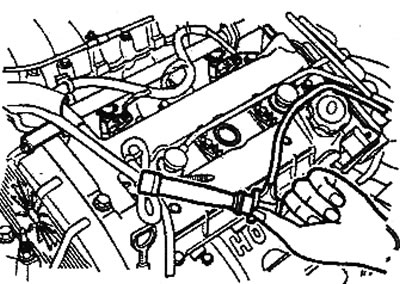
2. Disconnect the high tension wires from the spark plugs on one side and from the ignition coils on the other.
Caution: When removing and installing wires, be sure to hold only the rubber tip of the wire, not the wire itself. Improper handling of high-voltage wires can cause internal breaks in the wires.
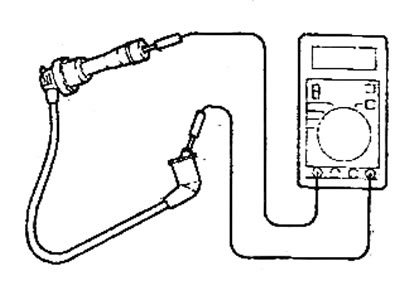
3. Using an ohmmeter, check the resistance of all high-tension spark plug wires. If the measured resistance exceeds the maximum permissible value, replace the spark plug wire.
Nominal resistance:
- 2.7L Engine:
- cylinder #1 — 4.39-6.59 kOhm
- cylinder #2 — 2.28-3.43 kOhm
- cylinder #3 — 3.49-5.24 kOhm
- cylinder #4 — 1.9-2.86 kOhm
- cylinder #5 — 3.25-4.87 kOhm
- cylinder #6 — 1.3-1.95 kOhm
- The maximum permissible value (per meter of wire length) is 10 kOhm
Caution: Measure from both ends of the wire. Do not pierce high voltage wires with a needle probe.
Note:
- If the resistance of the high voltage wire exceeds approximately 10 kOhm per 1 m of wire length, it is recommended to replace the wire.
- Installing wires with increased resistance will result in difficulties starting the engine in high humidity conditions.
4. Check the condition of the spark plug contacts and ignition coil (no damage, oxidation, contamination, etc.)
5. Install and connect the high voltage wires.
Caution: Incorrect installation of high-voltage spark plug wires leads to the induction of EMF in adjacent wires, which can cause misfires, jerking and twitching of the car at high speeds.
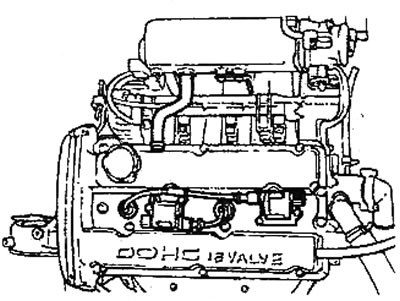
Engines 2.0 l/2.4 l.
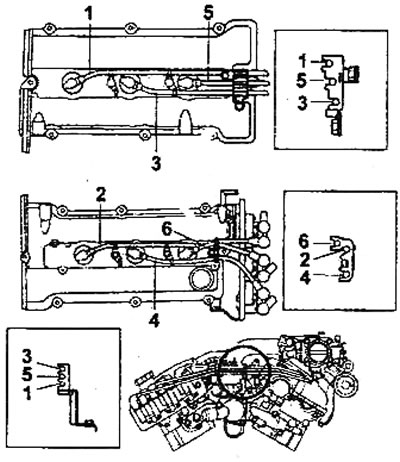
Engine 2.7 l.