2. Check the correct installation of the timing belt.
Attention:
- Do not bend, twist or stretch the timing belt.
- Do not allow the timing belt to come into contact with oil, coolant or water.
3. The belt should be carefully checked. If the following obvious defects are found, replace the belt with a new one.
- a) Hardened rubber on the back of the belt: shiny, inelastic and so hard that your fingernail will not leave a mark when you press on it.
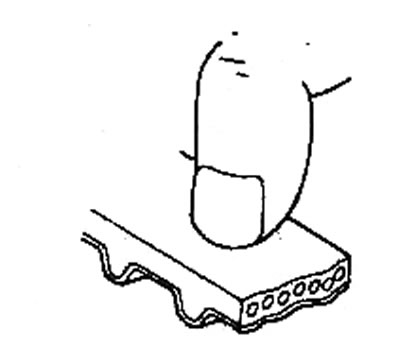
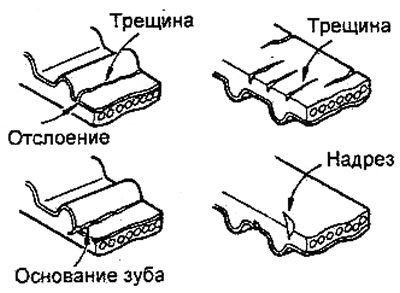
- b) Cracked rubber surface of the back side of the belt (due to overheating),
- c) Cracks or delamination of the belt cord (due to incorrect adjustment of the belt tension).
- d) Cracks at the base of the tooth.
Note: the defects described in subparagraphs "g" - "e" are caused by insufficient centering of pulleys or difficult rotation of auxiliary units.
- d) A cut on the side of the belt.
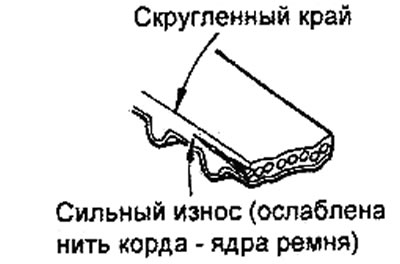
- e) Severe wear on the sidewall.
Note: A normal belt should have clearly pointed sides, like those cut with a knife.
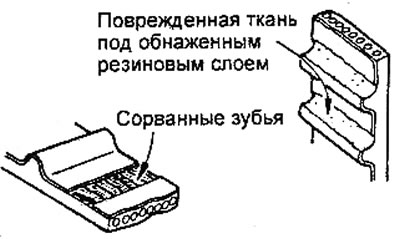
- g) Severe wear of teeth (due to incorrect belt tension).
Note:
- At the initial stage of belt wear, the fabric at the tooth leg on the working side is worn out (fleecy fabric fibers, the rubber layer has disappeared, the color has changed to white, the fabric structure is unclear).
- At the last stage of belt wear, the fabric at the tooth leg on the working side is completely worn out with the rubber layer exposed (the tooth width is reduced).
- c) Absence of a tooth.