


Note: If high oil consumption, loss of engine power or poor fuel economy is detected, a compression check should be performed.
1. Before measuring the compression, check the level and condition of the engine oil. Also, check that the condition of the starter and battery is normal.
Note: It is recommended to check for any engine management system fault codes.
2. Start the engine and warm it up to a coolant temperature of 80-95°C, then turn off the engine.
3. Disconnect the high tension spark plug wires.
Note: Disconnect the fuel pump connector and ignition coil connectors to prevent the ECM from commanding fuel injection and ignition.
4. Remove the spark plugs and cover the spark plug holes in the cylinder head with a clean rag.
5. Rotate the engine crankshaft with the starter to remove foreign particles from the cylinders.
Attention:
- Stay clear of the spark plug holes while cranking the engine with the starter.
- If coolant, oil, fuel, etc. gets into the cylinder during compression measurement (as a result of cracks), these substances will heat up and fly out of the spark plug hole under pressure, which is a dangerous phenomenon.
6. Install the compression gauge into the spark plug hole.
7. Press the accelerator pedal until the throttle valve is fully open.
8. Turn the engine crankshaft with the starter (approximately 4 revolutions) and read the compression gauge readings.
- Nominal value - 1200 kPa
- Minimum acceptable value:
- 2.0L/2.4L engines - 1180 kPa
- Engine 2.7 l - 1050 kPa
Note: values are given for a crankshaft speed of 250-400 rpm.
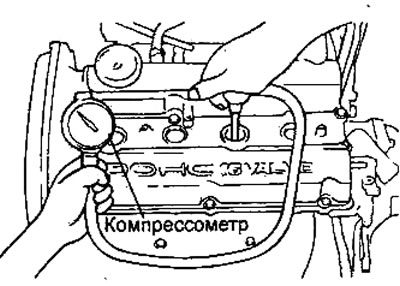
Engines 2.0 l / 2.4 l.
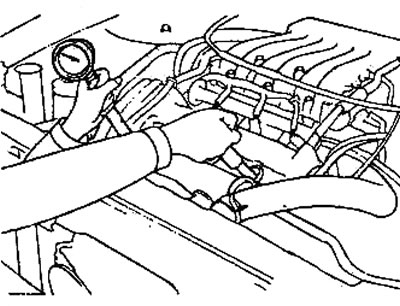
Engine 2.7 l.
9. Measure the compression for all remaining cylinders (repeat steps 6-8) and check that the difference in compression between the cylinders is less than the maximum permissible value.
- The maximum permissible value is no more than 100 kPa
10. If the compression in any cylinder does not correspond to the range of permissible values or the difference in compression between the cylinders exceeds the maximum permissible value, then pour a little motor oil into the spark plug hole of this cylinder and repeat the operations from points "6" to "9".
- a) If the compression has increased after adding oil, the cause of the malfunction is wear or damage to the piston ring and/or cylinder bore.
- b) If the compression does not increase after adding oil, the reasons are burnt or damaged valve seat, or gas (pressure) leakage through the cylinder head gasket.
11. Reinstall the spark plugs, ignition coils (2.0L/2.4L engines only), and connect the spark plug high-tension wires.
- Spark plug tightening torque: 20-30 Nm