


Removal
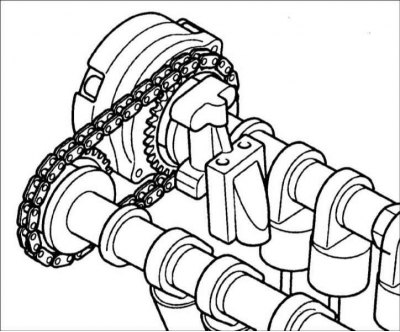
1. Remove the automatic chain tensioner mechanism.
2. Remove the camshaft bearing caps and chain.
3. Remove the camshafts.
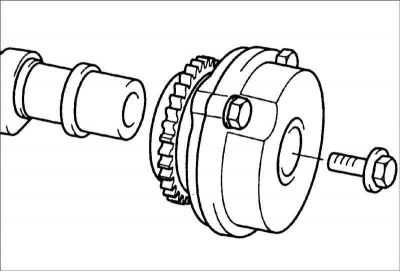
4. Remove the valve opening and closing torque adjustment (CVVT) mechanism. Secure the hexagonal part of the camshaft intended for the wrench in the vise.
Caution: Be careful not to damage the camshaft. Remove the CVVT mounting bolt.
5. Remove the oil control valve (OCV).
6. Remove the OCV filter.
7. Remove the oil temperature sensor (OTS).
[The article is borrowed from the website: hyundaibook.ru]
Examination
Do not re-use the fallen Valve Opening and Closing Torque Adjustment (CVVT) mechanism, as it may be deformed.
1. Do not disassemble the valve opening and closing torque adjustment (CVVT) mechanism.
2. When installing the valve Opening and closing Torque adjustment (CVVT) mechanism, a special tool must be used.
Variable Valve Timing (CVVT)
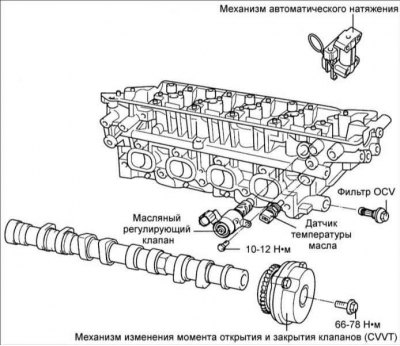
1. Clamp the hexagonal section of the camshaft intended for the wrench in a vice. Be careful not to damage the camshaft.
2. Make sure that the valve opening and closing torque variation mechanism (CVVT) does not rotate on the camshaft.
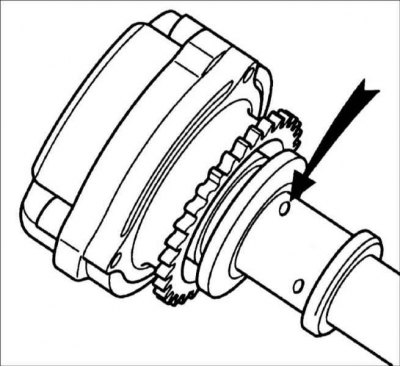
3. Use adhesive tape to seal all openings of the Valve Timing Change Mechanism (CVVT), except for the one indicated by the arrow in the figure.
4. Apply compressed air to the hole at a pressure of approximately 100 kPa.
- The valve opening and closing torque variation mechanism (CVVT) must rotate without applying an external force.
- Supplying air at higher pressure may cause the locking pin to become jammed (lack of pressure).
5. When performing the action described in step 4, use your hand to grasp the valve Opening and closing Torque adjustment (CVVT) and turn it in the forward direction.
- After disconnecting the closing pin, the valve opening and closing moment change mechanism (CVVT) must move freely in the forward direction.
- The movement of the variable valve timing (CVVT) mechanism from the maximum retarded position to the maximum advanced position is 20°.
6. If necessary, replace the variable valve timing (CVVT) mechanism, otherwise, turn it in the retard direction until the locking pin locks.
Oil Control Valve (OCV)
1. Use an ohmmeter to measure the internal resistance of the oil control valve (OCV). Resistance: 6.9 – 7.9 ohms at 20°C.
2. If the resistance is different from the required value, replace the oil control valve.
3. Check the operation of the oil control valve (OCV).
- Apply voltage from the battery terminals to the valve terminals: – make sure that the coil moves in the forward direction.
- Disconnect the wires from the battery terminals: – make sure that the coil returns to its original position.
OCV filter
Check the condition of the filter and that it is free of contamination. If there is contamination, clean or replace the filter.
Camshaft (CVVT)
Intake camshaft lobe height: 44.618 mm
Height of exhaust camshaft cams: 44.518 mm
Minimum permissible height of intake camshaft cams: 44.518 mm
Minimum permissible height of exhaust camshaft cams: 44.418 mm
Installation
1. Install the oil temperature sensor (OTS).
2. Install the OCV filter. Tightening torque: 41–51 N·m.
- Keep everything clean during assembly.
- When reassembling the oil control valve (OCV) filter, replace the washer.
3. Install the oil control valve (OCV). OCV tightening torque: 10–12 N·m.
- Do not reuse dropped parts.
- Prevent foreign matter from entering the OCV bushing.
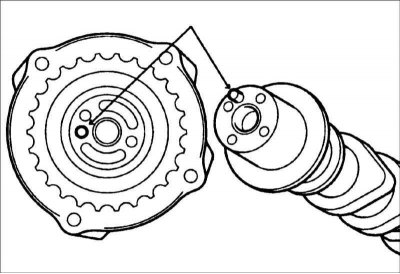
4. Carefully insert the camshaft stud into the hole of the variable valve timing (CVVT) mechanism.
5. After installing the CVVT on the camshaft, screw in the bolt, after lubricating the bolt threads with oil.
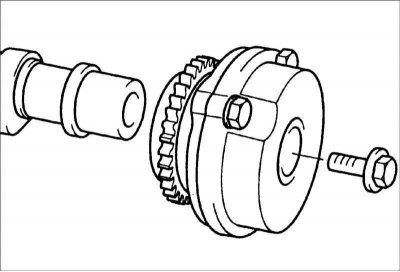
6. Tighten the CVVT mounting bolt to the camshaft.
- Place the hexagonal section of the camshaft intended for the wrench in a vice. Be careful not to damage the camshaft. CVVT bolt tightening torque: 66–78 Nm.
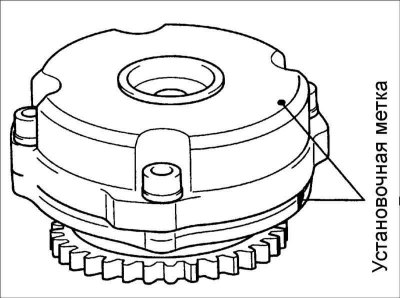
7. Install the chain on the camshaft sprockets as shown in the figure.
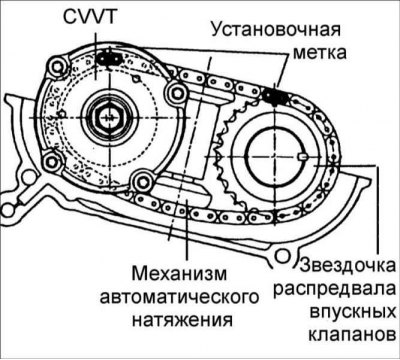
8. Install the camshafts and bearing caps.
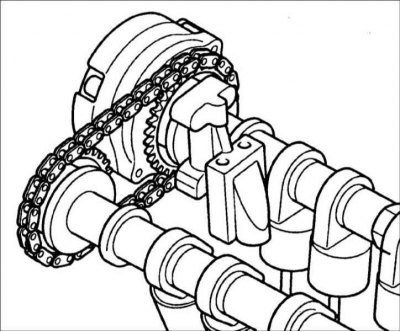
9. Install the automatic chain tensioner mechanism. Tightening torque: 8–10 Nm.
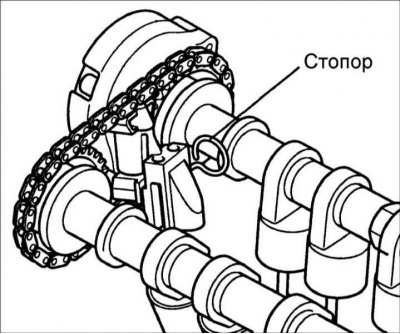
10. Remove the stopper blocking the automatic chain tensioning mechanism.