


Contents: Removal ⇓ Examination ⇓
Removal
1. Remove the cylinder head, timing belt, front cover, flywheel, pistons and crankshaft.
2. Using the special tool (09260–32000), unscrew the oil pressure sensor.
Examination
1. Remove any gasket, sealant, dirt, oil, grease or other foreign material from the engine block. Visually inspect the cylinder block for rust, corrosion, cracks and other defects.
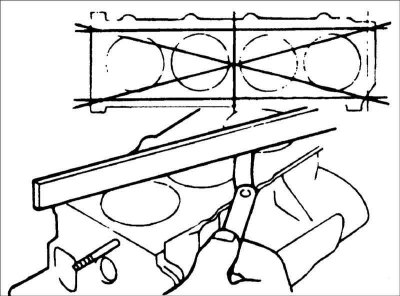
2. Clean the mating surfaces of the cylinder head and cylinder block from gasket residue. Using a metal ruler and feeler gauge, check the flatness of the mating surface of the cylinder block in six directions.
- Flatness deviation: 0.03 mm
- Maximum permissible deviation from flatness: 0.1 mm
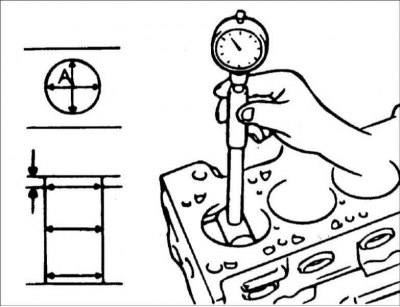
3. Measure the diameters of the cylinders in diametrically opposite directions, in three planes along the height of the cylinders. If the cylinder diameters exceed the permissible values, are out of round or tapered, or the cylinder surface is damaged or has wear, the cylinder block must be bored and new pistons and piston rings of the repair size must be installed.
The material is reprinted from another resource: HYUNDAIBOOK.RU
- Nominal cylinder diameter: 82 mm
- Cylinder taper: no more than 0.01 mm
4. If there is a step at the top of the cylinder, cut it off with a special tool.
5. Pistons of four larger sizes are supplied as spare parts: 0.25, 0.5, 0.75 and 1.00 mm.
6. When reboring cylinders to the nearest oversize, maintain the clearance between the piston and cylinder and ensure that the pistons are the same oversize.
7. Measure the outside diameter of each piston at 47 mm from the piston skirt.
Clearance between piston and cylinder:
- 1.8 and 2.0 l engines: 0.02–0.04 mm;
- 1.6L engines: 0.025–0.045 mm.
8. When using new parts, the maximum gap allowed is no more than 85 microns.