


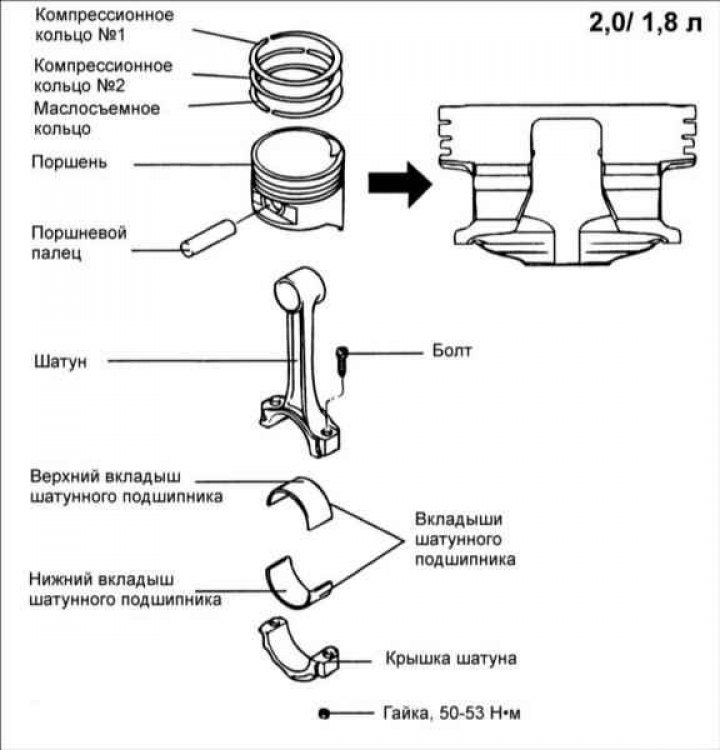
1.6L engines
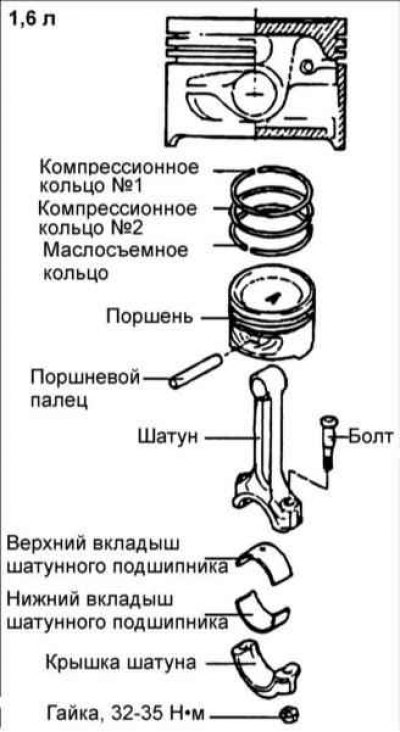
Removal
Connecting rod cap
Caution: Keep the connecting rod caps with the corresponding connecting rods for proper reinstallation into the engine cylinders.
1. Loosen the nuts and remove the connecting rod cap and the lower connecting rod bearing shell. To protect the crankshaft journals, place pieces of rubber or plastic tube on the connecting rod cap mounting bolts.
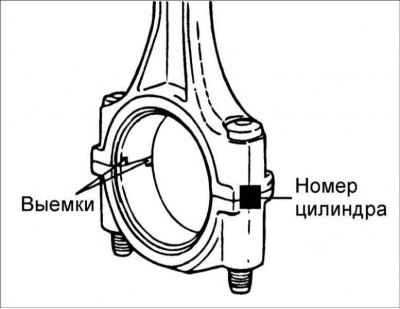
2. Using a wooden block or a hammer handle, push the piston and connecting rod out of the cylinder.
Removal and installation the piston pin
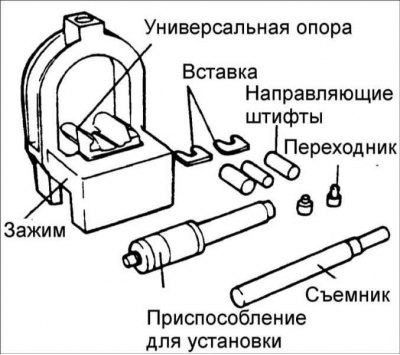
1. To disassemble and reassemble the piston and connecting rod, use special tools 09234–33001 and 09234–33002.
2. Install the universal supports into the clamp between the connecting rod and the piston.
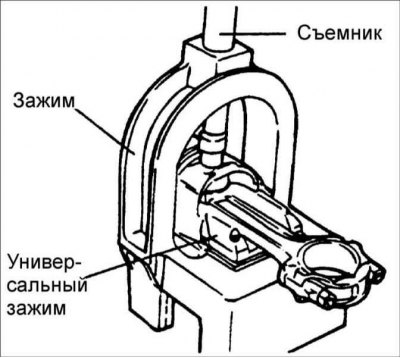
3. Insert the puller through the hole in the clamp arch.
Caution! Insert the clamp with the piston, connecting rod and puller under the press slide.
4. Use a puller to push the piston pin out of the piston.
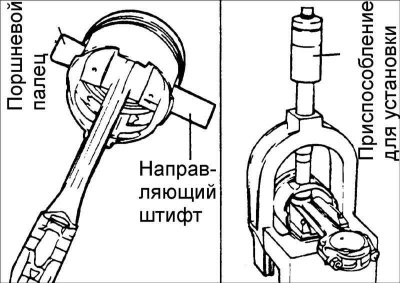
5. Install the guide pins through the piston into the connecting rod and install the piston pin on the other side of the piston.
Caution! The guide pins determine the position of the connecting rod in the piston. After the piston, connecting rod, piston pin and piston pin installation tool are installed into the inserts, the guide pins also determine their position in the clamp. If the guide pins are too small, the piston will not be centered in the fixture and damage to the clamp and/or fixture may occur.
6. Install the piston assembly onto the clamp, with the guide pin supporting the connecting rod in the piston pin. Make sure the piston moves onto the clamp until the guide pin contacts the fork insert.
7. Check the correct relative position of the piston and connecting rod and, by turning the knurled nut, secure the numbered sleeve on the shaft.
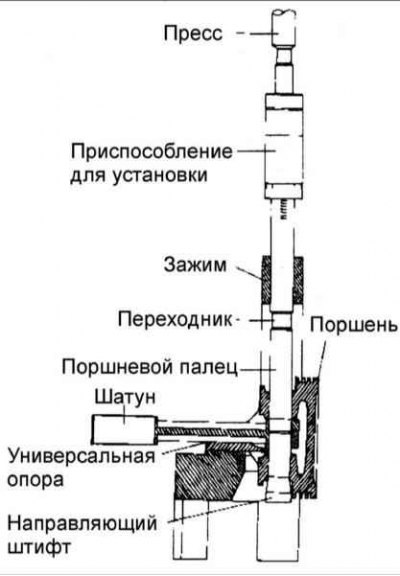
8. Insert the shaft through the hole in the clamp arch. Press the piston pin into the connecting rod until the bushing on the shaft contacts the top of the clamp arch, causing the guide pin to fall out of the piston.
Warning! The piston pin pressing force should not exceed 350–1350 kg on 1.8 and 2.0 l engines and 1250±500 kg on a 1.6 l engine.
Examination
Piston and piston pins
1. Inspect the outer surface of the piston for damage, wear or uneven wear. Replace the piston if necessary.
2. Check each piston ring for damage and uneven wear. Replace piston rings if necessary. When replacing the piston, it is also necessary to replace the piston rings.
3. Check the piston pin by inserting it into the piston hole. The piston pin should enter the piston smoothly when pressed by hand (at room temperature).
Piston rings
1. Insert a new piston ring into the piston groove and use a feeler gauge to measure the gap between the piston ring and the groove wall. If the clearance exceeds the maximum permissible value, replace the piston.
Clearance between piston ring and piston groove:
First compression ring:
- 1.8 and 2.0 l engines: 0.04–0.08 mm;
- 1.6L engines: 0.04–0.085 mm.
[The article is borrowed from the website: HyundaiBook]
Second compression ring:
- 1.8 and 2.0 l engines: 0.03–0.07 mm;
- 1.6L engines: 0.04–0.085 mm.
2. Measure the piston ring gap by manually inserting the piston ring into the engine cylinder. Use the bottom of the piston to push the piston ring into the bottom of the cylinder. Use a feeler gauge to measure the gap in the piston ring joint.
Piston ring gap:
- First compression ring:
- 1.8 and 2.0 l engines: 0.23–0.38 mm;
- 1.6L engines: 0.15–0.30 mm.
- Second compression ring:
- 1.8 and 2.0 l engines: 0.33–0.48 mm;
- 1.6L engines: 0.30–0.45 mm.
- Oil scraper ring:
- 1.8 and 2.0 l engines: 0.20–0.60 mm;
- 1.6L engines: 0.20–0.70 mm.
Maximum permissible clearance:
- First and second compression rings: 1.0 mm.
- Oil scraper ring: 1.0 mm.
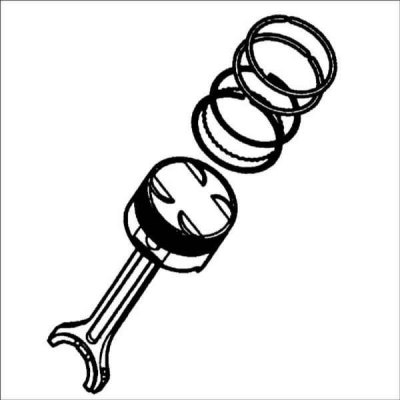
Attention! The marking is applied to the upper part of the piston ring, on the lock side.
Connecting rods
1. When installing, make sure that the connecting rod and connecting rod cap match the cylinder number they are being installed into. When installing a new connecting rod, make sure that the marks that determine its position are on the same side as the marks on the other connecting rods.
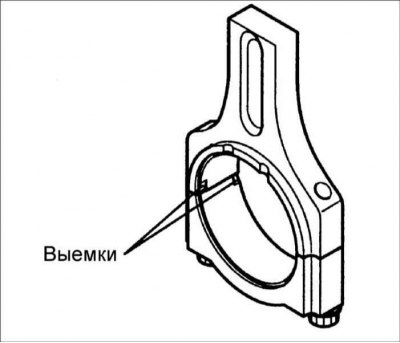
2. Replace the connecting rod if there is damage on both bearing surfaces. Also replace the connecting rod if there is wear or damage to the surface that mating with the piston pin.
Selection of pistons for 1.6L engine
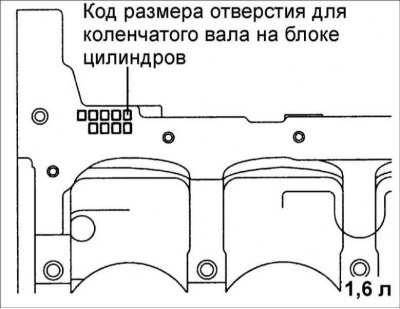
1. Check the cylinder bore size code located on the face of the cylinder block.
Class | Inner diameter of the cylinder | Size code |
A | 76.5–76.51 mm | A |
B | 76.51–76.52 mm | B |
C | 76.52–76.53 mm | C |
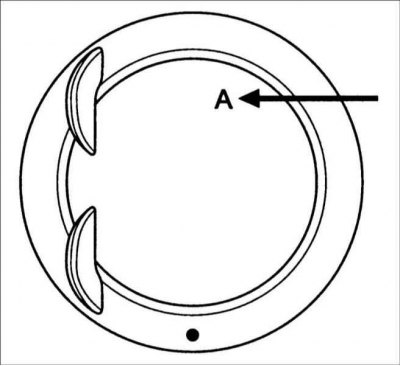
2. Check the piston diameter size code located on the piston crown.
Attention! The piston diameter size code is stamped on the piston bottom.
Class | Inner diameter of the cylinder | Size code |
A | 76.465–76.475 mm | A |
B | 76.475–76.485 mm | B |
C | 76.485–76.495 mm | C |
3. Select a piston whose diameter matches the cylinder class. Clearance between piston and cylinder: 0.025–0.045 mm.
Installation
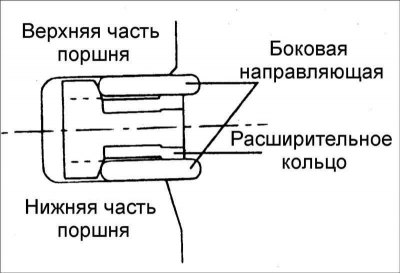
1. Install the expansion ring.
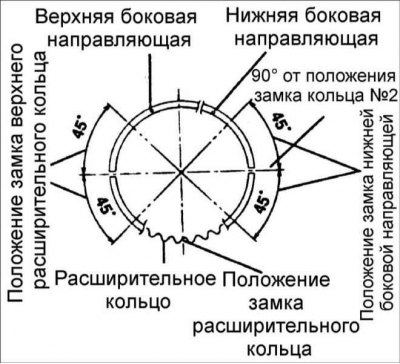
2. Install the top side guide. To install the side guide, first place one end of the side guide between the piston ring groove wall and the expansion ring, press it down, then press it around the perimeter to install it into the piston groove.
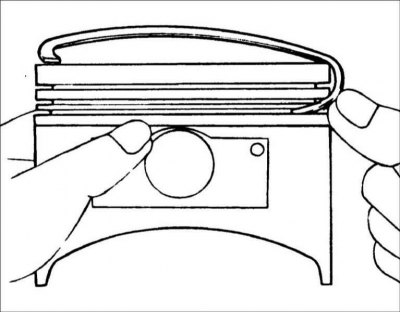
3. Install the lower side guide in the same way.
Caution: Do not use pliers to spread the piston rings when installing the side guide.
4. Apply a thin layer of engine oil to the piston and piston rings.
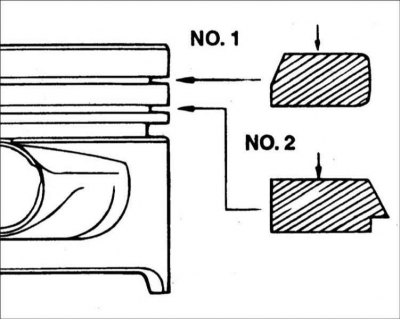
5. Using piston ring pliers, install compression ring No. 2.
6. Using piston ring pliers, install compression ring No. 1.
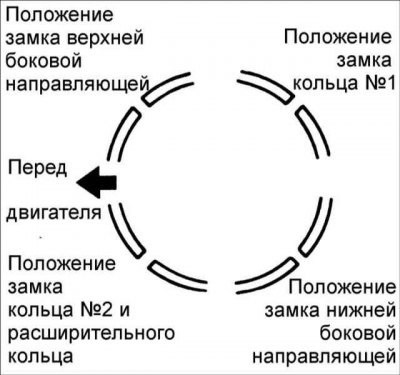
7. Position the piston ring locks as shown in the figure.
8. Using a special tool, compress the piston rings onto the piston. Place the piston with piston rings over the first cylinder, with the mark on the piston facing the front of the cylinder block. Using a hammer handle, press the piston into the cylinder until the lower head of the connecting rod is seated on the crankshaft journal.
9. Install the upper main bearing shells onto the engine cylinder block. When reinstalling the liners, place them in the same locations they were in before removal.
10. Install the main bearing shells into the crankshaft main bearing caps.
11. Make sure that the marks on the piston and connecting rod are facing the front of the cylinder block.
12. When installing a new connecting rod, make sure that the recesses for the bearing shell are on the same side.
13. Tighten the connecting rod cap bolts and nuts.
- lubricate the threads of nuts and bolts with engine oil;
- tighten the connecting rod cap bolts and nuts to the required torque.
Tightening torque:
- 1.8 and 2.0 l engines: 50–53 N·m;
- 1.6 l engines: 32–35 N·m.
Warning: Do not reuse connecting rod cap bolts more than three times.
14. Using a feeler gauge inserted between the connecting rod and the crankshaft, measure the connecting rod side clearance. Nominal side clearance of connecting rod: 0.10–0.25 mm. Maximum allowable clearance: 0.40 mm
15. Install the oil filter.
16. Install the oil pan.
17. Install the cylinder head.