


Brake system of the car Hyundai Accent 2

General information about the braking system
The vehicles use a hydraulically driven service brake system. The system works as follows: the brake pedal is connected to the master cylinder; when the pedal is...
The vehicles use a hydraulically driven service brake system. The system works as follows: the brake pedal is connected to the master cylinder; when the pedal is...
Technical data of the brake system
Elements of the braking system Master brake cylinder Type Tandem Cylinder diameter, mm 22,22 Vacuum brake booster Type Vacuum Effective diameter, mm 228,6 Ratio 4,0:1...
Elements of the braking system Master brake cylinder Type Tandem Cylinder diameter, mm 22,22 Vacuum brake booster Type Vacuum Effective diameter, mm 228,6 Ratio 4,0:1...

Anti-lock braking system (ABS)
The anti-lock braking system is designed to prevent the wheels from locking during intensive braking. Main functions of ABS: reducing the braking distance by eliminating...
The anti-lock braking system is designed to prevent the wheels from locking during intensive braking. Main functions of ABS: reducing the braking distance by eliminating...

Bleeding the hydraulic brake system using a scanner
Any hydraulic system will operate properly if the air is removed from it. Execution order 1. Remove the cap from the brake fluid reservoir. Recommended brake fluid: DOT3...
Any hydraulic system will operate properly if the air is removed from it. Execution order 1. Remove the cap from the brake fluid reservoir. Recommended brake fluid: DOT3...

Checking and adjusting the brake pedal position
Execution order 1. Turn the brake light switch until the required clearance is obtained between the switch and the brake pedal, then tighten the switch lock nut. Gap...
Execution order 1. Turn the brake light switch until the required clearance is obtained between the switch and the brake pedal, then tighten the switch lock nut. Gap...

Checking the brake booster
Execution order 1. Start the engine and stop it after 1-2 minutes. Press the brake pedal with normal force. If the first stroke of the pedal is long and the second...
Execution order 1. Start the engine and stop it after 1-2 minutes. Press the brake pedal with normal force. If the first stroke of the pedal is long and the second...

Bleeding the hydraulic brake drive system
Execution order 1. Remove the cap from the brake fluid reservoir. Warning! Brake fluid dissolves paint, plastic and wire insulation, so if the fluid accidentally comes...
Execution order 1. Remove the cap from the brake fluid reservoir. Warning! Brake fluid dissolves paint, plastic and wire insulation, so if the fluid accidentally comes...

Adjusting the parking brake stroke
Execution order 1. Check the number of clicks when tightening the parking brake lever with a force of 196 N. Lever travel: 6-7 clicks 2. If the number of clicks is...
Execution order 1. Check the number of clicks when tightening the parking brake lever with a force of 196 N. Lever travel: 6-7 clicks 2. If the number of clicks is...

Vacuum brake booster
1 – vacuum hose; 2 – clamp; 3 – pin with a head and a hole for a cotter pin; 4 – nut, 8–12 N·m; 5 – spacer gasket; 6 – gasket; 7 – brake booster. Removal 1. Disconnect...
1 – vacuum hose; 2 – clamp; 3 – pin with a head and a hole for a cotter pin; 4 – nut, 8–12 N·m; 5 – spacer gasket; 6 – gasket; 7 – brake booster. Removal 1. Disconnect...

Brake pipes and hoses
Examination 1. Check the brake hoses for cracks and local swelling. Replace the brake hose if necessary. 2. Check the brake lines for cracks, damage and corrosion. 3....
Examination 1. Check the brake hoses for cracks and local swelling. Replace the brake hose if necessary. 2. Check the brake lines for cracks, damage and corrosion. 3....

Pressure regulator
Do not remove the pressure regulator. The pressure regulator regulates the pressure in the rear brake drive depending on the load on the rear axle of the vehicle. As the...
Do not remove the pressure regulator. The pressure regulator regulates the pressure in the rear brake drive depending on the load on the rear axle of the vehicle. As the...

Brake pedal — removal and installation
1 – brake light switch; 2 – bushings; 3 – bracket; 4 – spring; 5 – pedal. Removal 1. Remove the brake light switch. 2. Remove the flange nuts (4EA) and bolt (1EA)...
1 – brake light switch; 2 – bushings; 3 – bracket; 4 – spring; 5 – pedal. Removal 1. Remove the brake light switch. 2. Remove the flange nuts (4EA) and bolt (1EA)...

Replacing the front brake pads
Front brake caliper 1 – brake shoe; 2 – dust cover; 3 – piston; 4 – sealing ring; 5 – support with cylinder; 6 – protective cover; 7 – bushing bolt, 22–32 Nm; 8 – bleed...
Front brake caliper 1 – brake shoe; 2 – dust cover; 3 – piston; 4 – sealing ring; 5 – support with cylinder; 6 – protective cover; 7 – bushing bolt, 22–32 Nm; 8 – bleed...

Front brake caliper
Removal 1. Remove the front wheel. 2. Remove the hollow bolt and disconnect the brake hose from the caliper. Warning: To prevent brake fluid from leaking, close the hole...
Removal 1. Remove the front wheel. 2. Remove the hollow bolt and disconnect the brake hose from the caliper. Warning: To prevent brake fluid from leaking, close the hole...

Master brake cylinder
1 – pressure regulator; 2 – main brake cylinder; 3 – cork; 4 – expansion tank; 5 – retaining ring; 6 – primary piston; 7 – secondary piston; 8 – nut, 8–12 Nm. Removal 1....
1 – pressure regulator; 2 – main brake cylinder; 3 – cork; 4 – expansion tank; 5 – retaining ring; 6 – primary piston; 7 – secondary piston; 8 – nut, 8–12 Nm. Removal 1....

Replacing brake pads on rear drum brakes
Brake shoes on rear drum brakes 1 – brake shoe support stand; 2 – brake shield; 3 – working brake cylinder; 4 – lever latch; 5 – expansion bar; 6 – parking brake lever;...
Brake shoes on rear drum brakes 1 – brake shoe support stand; 2 – brake shield; 3 – working brake cylinder; 4 – lever latch; 5 – expansion bar; 6 – parking brake lever;...

Replacing the working brake cylinder
Execution order 1. Remove the brake pads. 2. Disconnect the brake pipe. 3. Remove the bolts and the wheel cylinder. 4. Remove the dust boots from the wheel cylinder. 5....
Execution order 1. Remove the brake pads. 2. Disconnect the brake pipe. 3. Remove the bolts and the wheel cylinder. 4. Remove the dust boots from the wheel cylinder. 5....

Parking brake — removal and installation
1 – parking brake lever; 2 – adjusting nut; 3 – parking brake cables. Removal 1. Remove the rear console. 2. Loosen the adjusting nut and remove the parking brake cable....
1 – parking brake lever; 2 – adjusting nut; 3 – parking brake cables. Removal 1. Remove the rear console. 2. Loosen the adjusting nut and remove the parking brake cable....

HECU ABS Hydraulic Unit
Removal 1. Disconnect the brake lines from the HECU. 2. Remove the bracket mounting bolts and remove the HECU unit together with the bracket. Warning: Do not disassemble...
Removal 1. Disconnect the brake lines from the HECU. 2. Remove the bracket mounting bolts and remove the HECU unit together with the bracket. Warning: Do not disassemble...
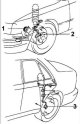
Wheel speed sensor
1 – rotor; 2 – front wheel speed sensor, 8–9.5 N·m; 3 – rear wheel speed sensor, 15.5–16.5 N·m. Removal Front wheel speed sensor Remove the bolt and front wheel speed...
1 – rotor; 2 – front wheel speed sensor, 8–9.5 N·m; 3 – rear wheel speed sensor, 15.5–16.5 N·m. Removal Front wheel speed sensor Remove the bolt and front wheel speed...
Troubleshooting
Sign Probable cause Method of elimination Noise or vibration when braking The caliper or brake shield is installed incorrectly Install the caliper or brake shield...
Sign Probable cause Method of elimination Noise or vibration when braking The caliper or brake shield is installed incorrectly Install the caliper or brake shield...
This section is available on russian, bulgarian, belarusian, ukrainian, serbian, croatian, romanian, polish, slovak, hungarian
We recommend other sections on the topic of Hyundai manuals:
Chassis: Brake system Hyundai Elantra 2 (1995-2000, petrol)
Chassis: Brake system Hyundai Getz (2002-2011)
Chassis: Brake system Hyundai Sonata 4 (2001-2012, petrol)
Chassis: Brake system Hyundai Santa Fe 2 (2007-2012, petrol)
Chassis: Brake system Hyundai Tucson 1 (2005-2010)
Chassis: Brake system Hyundai Matrix (2001-2010, petrol)
Link in different formats to this section
TextHTMLBB Code
- General information
- User manual
- Maintenance
- Power unit
- Engine repair
- Cooling and lubrication system
- Power and exhaust system
- Engine electrical equipment
- Engine management
- Transmission
- Clutch
- Mechanical gearbox
- Automatic gearbox
- Chassis
- Front suspension
- Rear suspension
- Wheels and tires
- Steering
- Brake system
- Body
- Exterior (external elements)
- Interior (internal elements)
- Heating and ventilation
- Electrical equipment
- Equipment and devices
- Electrical circuits
- User manual
- Control devices
- Starting engine and driving
- Troubleshooting
- Power unit
- SOHC engines
- DOHC engines
- Lubrication system
- Cooling system
- Decreased toxicity
- Fuel system
- Ignition system
- Transmission
- Clutch
- Mechanical gearbox
- Automatic gearbox
- Axles and drive shafts
- Chassis
- Car suspension
- Steering
- Brake system
- Body
- Exterior (external elements)
- Interior (internal elements)
- Air conditioning system
- Electrical equipment
- Equipment and devices
- Power devices
- General information
- Maintenance
- Power unit
- SOHC engines
- DOHC engines
- Cooling system
- Intake and exhaust systems
- Fuel supply (1.3 l, injection)
- Fuel supply (1.5 l, injection)
- Fuel supply (carburetor)
- Transmission
- Clutch
- Manual gearbox
- Automatic gearbox
- Drive shafts
- Chassis
- Car suspension
- Steering
- Brake system
- Body
- Body elements
- Electrical equipment
- Equipment and devices
- Electrical circuits