


Brake system of the car Hyundai Tucson 1

Maintenance and adjustments
Bleeding the brake system 1. Make sure that the brake fluid level in the expansion tank is at the MAX mark (A). 2. Attach a vinyl hose to the bleed nipple on the wheel...
Bleeding the brake system 1. Make sure that the brake fluid level in the expansion tank is at the MAX mark (A). 2. Attach a vinyl hose to the bleed nipple on the wheel...

Adjusting the height of the brake pedal above the floor
1. Remove the mat and measure the height of the pedal above the floor (C). Measure between the center of the pedal (D) and the floor surface. If the pedal height is not...
1. Remove the mat and measure the height of the pedal above the floor (C). Measure between the center of the pedal (D) and the floor surface. If the pedal height is not...


Brake pedal — check
1. Check the bushings for wear. 2. Check the brake pedal for deformation. 3. Check the pedal return spring for damage. 4. Check the brake light switch. To do this,...
1. Check the bushings for wear. 2. Check the brake pedal for deformation. 3. Check the pedal return spring for damage. 4. Check the brake light switch. To do this,...

Removal the brake pedal
1. Remove the lower instrument panel trim, 2. Loosen the four bolts and remove the steering column trim. 3. Remove the brake light switch (A). 4. Disconnect the shift...
1. Remove the lower instrument panel trim, 2. Loosen the four bolts and remove the steering column trim. 3. Remove the brake light switch (A). 4. Disconnect the shift...

Installing the brake pedal
1. Installation is carried out in the reverse order of removal. Note: Coat the bushings and pin with grease before installing the brake pedal. 2. Tighten the mounting...
1. Installation is carried out in the reverse order of removal. Note: Coat the bushings and pin with grease before installing the brake pedal. 2. Tighten the mounting...


Checking the operation of the brake booster
To simply check the operation of the vacuum booster, do the following. 1. Start the engine, let it run for 1-2 minutes and stop it. Press the brake pedal several times...
To simply check the operation of the vacuum booster, do the following. 1. Start the engine, let it run for 1-2 minutes and stop it. Press the brake pedal several times...

Vacuum Hose (Check Valve) — Checking
1. Disconnect the vacuum hose with built-in check valve (A) from the vacuum booster. 2. Start the engine at idle speed. A vacuum should be created in the hose. If this...
1. Disconnect the vacuum hose with built-in check valve (A) from the vacuum booster. 2. Start the engine at idle speed. A vacuum should be created in the hose. If this...

Vacuum Switch (Diesel Engine Models Only)
To simply check the operation of the vacuum circuit breaker, you need to do the following: 1. Block the wheels using suitable stops. 2. Release the parking brake and...
To simply check the operation of the vacuum circuit breaker, you need to do the following: 1. Block the wheels using suitable stops. 2. Release the parking brake and...

Removal the vacuum booster
1. Remove the master cylinder (see below). 2. Disconnect the vacuum hose from the vacuum booster. 3. Remove the stud (A) and pin (B). 4. Unscrew the four nuts securing...
1. Remove the master cylinder (see below). 2. Disconnect the vacuum hose from the vacuum booster. 3. Remove the stud (A) and pin (B). 4. Unscrew the four nuts securing...

Installing a vacuum booster
1. Adjust the length of the amplifier rod and install the gasket. Nominal length A: 106±0.5 mm. 2. Insert the amplifier and tighten the nuts (C). 3. Connect the booster...
1. Adjust the length of the amplifier rod and install the gasket. Nominal length A: 106±0.5 mm. 2. Insert the amplifier and tighten the nuts (C). 3. Connect the booster...


Brake lines — check
Check brake lines for corrosion, damage and cracks. Check brake hoses for leaks, cracks and damage. Check brake line connections for leaks.
Check brake lines for corrosion, damage and cracks. Check brake hoses for leaks, cracks and damage. Check brake line connections for leaks.

Brake pipes — removal and installation
Removal 1. Using a spanner (10 mm) (B), disconnect the brake hoses (C) from the brake pipes (A). Installation 1. Secure the brake hose (A) to the steering knuckle with...
Removal 1. Using a spanner (10 mm) (B), disconnect the brake hoses (C) from the brake pipes (A). Installation 1. Secure the brake hose (A) to the steering knuckle with...


Master Cylinder — Removal
1. Loosen the air filter mounting bolts (B) and remove the air filter housing (A) from the bracket. 2. Disconnect the brake fluid level sensor connector (A) and remove...
1. Loosen the air filter mounting bolts (B) and remove the air filter housing (A) from the bracket. 2. Disconnect the brake fluid level sensor connector (A) and remove...

Master Cylinder — Installation
1. Install the brake master cylinder (C) onto the brake booster and tighten the two mounting nuts (B). 2. Connect the brake hoses (A) and the brake fluid level sensor...
1. Install the brake master cylinder (C) onto the brake booster and tighten the two mounting nuts (B). 2. Connect the brake hoses (A) and the brake fluid level sensor...

Brake force distributor
Checking the technical condition 1. Disconnect the front (C) and rear (B) brake hoses from the brake master cylinder (A). 2. Connect two pressure gauges (D) to the...
Checking the technical condition 1. Disconnect the front (C) and rear (B) brake hoses from the brake master cylinder (A). 2. Connect two pressure gauges (D) to the...


Checking the condition of the front disc brake pads
1. Check the thickness of the brake pads through the hole in the caliper. The nominal thickness of the brake pads is 11 mm, the maximum permissible thickness is 2 mm.
1. Check the thickness of the brake pads through the hole in the caliper. The nominal thickness of the brake pads is 11 mm, the maximum permissible thickness is 2 mm.

Replacing the front disc brake pads
1. Raise the front of the vehicle and make sure it is securely supported. Remove the front wheels. 2. Loosen the two guide rod bolts and secure the caliper in such a way...
1. Raise the front of the vehicle and make sure it is securely supported. Remove the front wheels. 2. Loosen the two guide rod bolts and secure the caliper in such a way...

Installing front disc brake pads
1. Install the holders (A) on the support (B). 2. Clean the working surface of the brake linings from foreign objects and install the brake linings with the wear...
1. Install the holders (A) on the support (B). 2. Clean the working surface of the brake linings from foreign objects and install the brake linings with the wear...

Checking the technical condition of the front disc brake mechanism
Checking the thickness of the brake disc 1. Remove all rust and dirt from the surface of the brake disc, and then measure the thickness of the disc in at least four...
Checking the thickness of the brake disc 1. Remove all rust and dirt from the surface of the brake disc, and then measure the thickness of the disc in at least four...

Checking the runout of the brake disc of the front disc brakes
1. Loosen the guide bolt, turn the caliper upward and hang it with wire or other means. 2. Place a dial gauge 5mm from the outer edge of the brake disc and measure the...
1. Loosen the guide bolt, turn the caliper upward and hang it with wire or other means. 2. Place a dial gauge 5mm from the outer edge of the brake disc and measure the...


Checking the condition of the rear disc brake pads
1. Check the thickness of the brake pads through the hole in the caliper. The nominal thickness of the brake pads is 10 mm, the maximum permissible thickness is 2 mm.
1. Check the thickness of the brake pads through the hole in the caliper. The nominal thickness of the brake pads is 10 mm, the maximum permissible thickness is 2 mm.

Replacing rear disc brake pads
1. Raise the rear of the vehicle and make sure it is securely supported. Remove the rear wheels. 2. Loosen the two guide rod bolts (B) and secure the caliper (A) in such...
1. Raise the rear of the vehicle and make sure it is securely supported. Remove the rear wheels. 2. Loosen the two guide rod bolts (B) and secure the caliper (A) in such...

Installing rear disc brake pads
1. Install the springs (A) into the fastener (B). 2. Clean the sidewalls (A) and brake linings (B) from dirt and foreign objects. 3. With a special tool (09581-11000)...
1. Install the springs (A) into the fastener (B). 2. Clean the sidewalls (A) and brake linings (B) from dirt and foreign objects. 3. With a special tool (09581-11000)...
Checking the technical condition of the rear disc brakes
The technical condition of the rear disc brake elements is checked in the same way as for the front disc brake mechanisms (see above). Rear brake disc thickness: Nominal...
The technical condition of the rear disc brake elements is checked in the same way as for the front disc brake mechanisms (see above). Rear brake disc thickness: Nominal...


Checking the technical condition of the drum brake mechanism
1. Measure the inner diameter of the brake drum, it should be 228.6-230.6 mm. Check the runout of the brake drum. 2. Check the slave cylinder (A) for leaks. Check the...
1. Measure the inner diameter of the brake drum, it should be 228.6-230.6 mm. Check the runout of the brake drum. 2. Check the slave cylinder (A) for leaks. Check the...

Removal the drum brake mechanism
1. Remove the stop pins (B) by pressing on the stops (C). Disconnect the upper return spring (A). 3. Disconnect the lower return spring (B) from the brake shoes (A)....
1. Remove the stop pins (B) by pressing on the stops (C). Disconnect the upper return spring (A). 3. Disconnect the lower return spring (B) from the brake shoes (A)....

Installation of drum brake mechanism
1. Apply grease (C) between the slave cylinder (A) and the return plate (B) and install the slave cylinder. 2. Connect the brake line (D) to the slave cylinder. 3....
1. Apply grease (C) between the slave cylinder (A) and the return plate (B) and install the slave cylinder. 2. Connect the brake line (D) to the slave cylinder. 3....


Checking and adjusting the parking brake system
1. Pull the parking brake lever (A) with a force of 196 N until it stops. The stroke of the parking brake lever (B) should be 7-8 sector clicks. 2. Adjust the lever if...
1. Pull the parking brake lever (A) with a force of 196 N until it stops. The stroke of the parking brake lever (B) should be 7-8 sector clicks. 2. Adjust the lever if...

Removal the parking brake
Note: The parking brake cable must have the same cross-section along its entire length. 1. Remove the trim panel. 2. Loosen the adjusting nut (A) of the lever. 3....
Note: The parking brake cable must have the same cross-section along its entire length. 1. Remove the trim panel. 2. Loosen the adjusting nut (A) of the lever. 3....
Installing the parking brake
1. Installation is carried out in the reverse order of removal. 2. Apply multi-purpose grease SAE J310, NLGI No.2 to the friction surfaces of the sector and pawl. 3....
1. Installation is carried out in the reverse order of removal. 2. Apply multi-purpose grease SAE J310, NLGI No.2 to the friction surfaces of the sector and pawl. 3....

Parking Brake Switch — Check
1. Remove the trim panel and disconnect the connector (A) from the switch (B). 2. Check the continuity of the circuit between the switch terminals. When the lever is...
1. Remove the trim panel and disconnect the connector (A) from the switch (B). 2. Check the continuity of the circuit between the switch terminals. When the lever is...


Anti-lock braking system (ABS) — general information
The anti-lock braking system (ABS) is used to regulate the pressure in the brake mechanisms of all wheels when braking in difficult road conditions, preventing wheel...
The anti-lock braking system (ABS) is used to regulate the pressure in the brake mechanisms of all wheels when braking in difficult road conditions, preventing wheel...
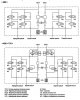

Hydroelectronic control unit of the anti-lock braking system (HEB)
GECU pinout diagram GEBU electrical circuits
GECU pinout diagram GEBU electrical circuits

Removal and installation of the GEBU
Removal 1. Disconnect the double clamp (A) from the ECU. 2. Using a wrench, disconnect the brake lines from the ECU. Note. Do not allow brake fluid to come into contact...
Removal 1. Disconnect the double clamp (A) from the ECU. 2. Using a wrench, disconnect the brake lines from the ECU. Note. Do not allow brake fluid to come into contact...


Removal the front wheel speed sensors
1. Loosen the front speed sensor mounting bolt (A). 2. Remove the mudguard (A) and fender liner (B). 3. Remove the speed sensor after disconnecting the sensor connector...
1. Loosen the front speed sensor mounting bolt (A). 2. Remove the mudguard (A) and fender liner (B). 3. Remove the speed sensor after disconnecting the sensor connector...

Removal the rear wheel speed sensors
1. Loosen the speed sensor mounting bolt (A). 2. Disconnect the wheel speed sensor connectors under the rear seats of the vehicle and remove the sensors.
1. Loosen the speed sensor mounting bolt (A). 2. Disconnect the wheel speed sensor connectors under the rear seats of the vehicle and remove the sensors.

Checking the technical condition of speed sensors
1. Connect the oscilloscope to the speed sensor connectors as shown in the diagram below and check the voltage between the sensor terminals by rotating the wheel by...
1. Connect the oscilloscope to the speed sensor connectors as shown in the diagram below and check the voltage between the sensor terminals by rotating the wheel by...


G-sensor — check
1. Connect the tester to terminals 2 and 3 of the G-sensor connector. 2. Measure the voltage with the ignition switch on. It should be 2.5 V. 3. Move the G-sensor up and...
1. Connect the tester to terminals 2 and 3 of the G-sensor connector. 2. Measure the voltage with the ignition switch on. It should be 2.5 V. 3. Move the G-sensor up and...

Vehicle Dynamics Control (ESP)
Electronic stability program ESP (vehicle dynamics control) is a feedback system that helps maintain directional stability while the vehicle is moving. It is integrated...
Electronic stability program ESP (vehicle dynamics control) is a feedback system that helps maintain directional stability while the vehicle is moving. It is integrated...


This section is available on russian, bulgarian, belarusian, ukrainian, serbian, croatian, romanian, polish, slovak, hungarian
We recommend other sections on the topic of Hyundai manuals:
Chassis: Brake system Hyundai Accent 2 (1999-2005)
Chassis: Brake system Hyundai Elantra 3 (2000-2006)
Chassis: Brake system Hyundai Getz (2002-2011)
Chassis: Brake system Hyundai Sonata 4 (2001-2012, petrol)
Chassis: Brake system Hyundai Santa Fe 2 (2007-2012, petrol)
Chassis: Brake system Hyundai Matrix (2001-2010, petrol)
Link in different formats to this section
TextHTMLBB Code
- General information
- Faults en route
- User manual
- Maintenance
- Power unit
- Gasoline engines
- Diesel engines
- Engine cooling system
- Engine lubrication system
- Engine power system
- Control system
- Intake and exhaust systems
- Engine electrical equipment
- Transmission
- Clutch
- Mechanical gearbox
- Automatic gearbox
- Drive shafts
- Chassis
- Suspension and wheels
- Brake system
- Steering
- Body
- Exterior (external elements)
- Interior (internal elements)
- Security systems
- Air conditioning and heater
- Electrical equipment
- Electrical circuits
- General information
- User manual
- Maintenance
- Power unit
- Gasoline engine G6BA
- Gasoline engine G4GC
- Diesel engine D4EA
- Fuel system (gasoline)
- Fuel system (diesel)
- Engine lubrication system
- Engine cooling system
- Engine electrical equipment
- Transmission
- Clutch
- Car gearbox
- Drive shafts and cardan
- Chassis
- Car suspension
- Steering
- Brake system
- Body
- Exterior (external elements)
- Interior (internal elements)
- Air conditioning and heater
- Airbags
- Electrical equipment
- Equipment and devices
- Electrical circuits