


Gasoline engine G6BA car Hyundai Tucson 1


Compression check
Note: If the engine does not operate at full power, there is increased oil consumption and a lean fuel-air mixture, it is necessary to check the compression in the...
Note: If the engine does not operate at full power, there is increased oil consumption and a lean fuel-air mixture, it is necessary to check the compression in the...

Adjusting the drive belt tension
The G6BA engine is equipped with an automatic drive belt tensioner, so it does not require additional adjustment. To adjust the tension of the G4GC engine drive belt,...
The G6BA engine is equipped with an automatic drive belt tensioner, so it does not require additional adjustment. To adjust the tension of the G4GC engine drive belt,...

Checking and adjusting valve clearances
The G6BA engine is equipped with an automatic valve clearance adjuster, so there is no need for operations related to checking and adjusting clearances. To check and...
The G6BA engine is equipped with an automatic valve clearance adjuster, so there is no need for operations related to checking and adjusting clearances. To check and...


Timing drive mechanism — removal
Note: This operation does not require removing the engine from the vehicle. 1. Remove the engine cover. 2. Remove the front right wheel. 3. Loosen the two mounting bolts...
Note: This operation does not require removing the engine from the vehicle. 1. Remove the engine cover. 2. Remove the front right wheel. 3. Loosen the two mounting bolts...

Checking the technical condition of gears, tensioners, pulleys and drive belts
1. Check the camshaft and crankshaft gears, tensioner pulleys and intermediate pulleys for damage, cracks and signs of excessive wear. If defects are found, replace the...
1. Check the camshaft and crankshaft gears, tensioner pulleys and intermediate pulleys for damage, cracks and signs of excessive wear. If defects are found, replace the...

Timing drive mechanism — installation
1. Align the gear groove with the key on the shaft and place the gear on the crankshaft. 2. Manually tighten the camshaft gear bolts, then tighten them with a wrench to...
1. Align the gear groove with the key on the shaft and place the gear on the crankshaft. 2. Manually tighten the camshaft gear bolts, then tighten them with a wrench to...


Cylinder head — removal
Note: 1. To avoid incorrect connections during installation, mark all connectors and hoses when disconnecting them. 2. Check drive belts before removing the cylinder...
Note: 1. To avoid incorrect connections during installation, mark all connectors and hoses when disconnecting them. 2. Check drive belts before removing the cylinder...

Cylinder head — disassembly
Note: Mark the hydraulic lifter, valves and valve springs during disassembly for proper reassembly later. 1. Remove the hydraulic compensator (A). 2. Using special...
Note: Mark the hydraulic lifter, valves and valve springs during disassembly for proper reassembly later. 1. Remove the hydraulic compensator (A). 2. Using special...

Cylinder head — technical condition check
1. Turn the crankshaft one by one to set each cylinder to the top dead center position. In this position, clean the piston surface from soot with a scraper. 2. Using a...
1. Turn the crankshaft one by one to set each cylinder to the top dead center position. In this position, clean the piston surface from soot with a scraper. 2. Using a...

Cylinder head — replacing guide bushings
1. Using a special device (09221-3F100A) remove the valve guides from the cylinder head. 2. Ream the hole in the cylinder block to a new repair size to press on a new...
1. Using a special device (09221-3F100A) remove the valve guides from the cylinder head. 2. Ream the hole in the cylinder block to a new repair size to press on a new...

Cylinder head — assembly
Note: Clean all parts thoroughly. Apply engine oil to all friction surfaces immediately before assembly. Replace all seals and valve stem seals with new ones during...
Note: Clean all parts thoroughly. Apply engine oil to all friction surfaces immediately before assembly. Replace all seals and valve stem seals with new ones during...

Cylinder head — installation
Note: 1. Clean all surfaces thoroughly before installation. 2. Always use new gaskets. 3. The cylinder head gasket is metal. Be careful not to bend it. 4. Turn the...
Note: 1. Clean all surfaces thoroughly before installation. 2. Always use new gaskets. 3. The cylinder head gasket is metal. Be careful not to bend it. 4. Turn the...

Removal and installation the engine with gearbox assembly
Note: 1. To avoid incorrect connections during installation, mark all connectors and hoses when disconnecting them. 2. Check drive belts before removing the cylinder...
Note: 1. To avoid incorrect connections during installation, mark all connectors and hoses when disconnecting them. 2. Check drive belts before removing the cylinder...
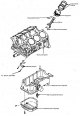

Cylinder Block — Disassembly
1. Automatic transmission - remove the flange. 2. Install the engine on a special stand for disassembly. 3. Remove the drive belt. 4. Remove the cylinder head. 5. Remove...
1. Automatic transmission - remove the flange. 2. Install the engine on a special stand for disassembly. 3. Remove the drive belt. 4. Remove the cylinder head. 5. Remove...

Cylinder block — checking technical condition
1. Measure the connecting rod axial clearance. To do this, move the connecting rod along the crankshaft until it stops in one direction or another and measure the...
1. Measure the connecting rod axial clearance. To do this, move the connecting rod along the crankshaft until it stops in one direction or another and measure the...

Cylinder Block — Assembly
Note: 1. Clean all parts thoroughly before assembly. 2. Immediately before assembly, apply a thin layer of fresh engine oil to all friction surfaces. 3. When assembling,...
Note: 1. Clean all parts thoroughly before assembly. 2. Immediately before assembly, apply a thin layer of fresh engine oil to all friction surfaces. 3. When assembling,...


Intake and exhaust systems — removal
1. Remove the engine cover. 2. Remove the air filter hose. 3. Disconnect the throttle cable. 4. Disconnect all connectors and hoses (for more details, see section "...
1. Remove the engine cover. 2. Remove the air filter hose. 3. Disconnect the throttle cable. 4. Disconnect all connectors and hoses (for more details, see section "...

Intake and exhaust systems — installation
1. Install the intake manifold with the gasket and tighten the mounting bolts in the order shown in the figure to a torque of 19 - 21 Nm. 2. Install the fuel rail...
1. Install the intake manifold with the gasket and tighten the mounting bolts in the order shown in the figure to a torque of 19 - 21 Nm. 2. Install the fuel rail...


This section is available on russian, bulgarian, belarusian, ukrainian, serbian, croatian, romanian, polish, slovak, hungarian
Link in different formats to this section
TextHTMLBB Code
- General information
- Faults en route
- User manual
- Maintenance
- Power unit
- Gasoline engines
- Diesel engines
- Engine cooling system
- Engine lubrication system
- Engine power system
- Control system
- Intake and exhaust systems
- Engine electrical equipment
- Transmission
- Clutch
- Mechanical gearbox
- Automatic gearbox
- Drive shafts
- Chassis
- Suspension and wheels
- Brake system
- Steering
- Body
- Exterior (external elements)
- Interior (internal elements)
- Security systems
- Air conditioning and heater
- Electrical equipment
- Electrical circuits
- General information
- User manual
- Maintenance
- Power unit
- Gasoline engine G6BA
- Gasoline engine G4GC
- Diesel engine D4EA
- Fuel system (gasoline)
- Fuel system (diesel)
- Engine lubrication system
- Engine cooling system
- Engine electrical equipment
- Transmission
- Clutch
- Car gearbox
- Drive shafts and cardan
- Chassis
- Car suspension
- Steering
- Brake system
- Body
- Exterior (external elements)
- Interior (internal elements)
- Air conditioning and heater
- Airbags
- Electrical equipment
- Equipment and devices
- Electrical circuits