


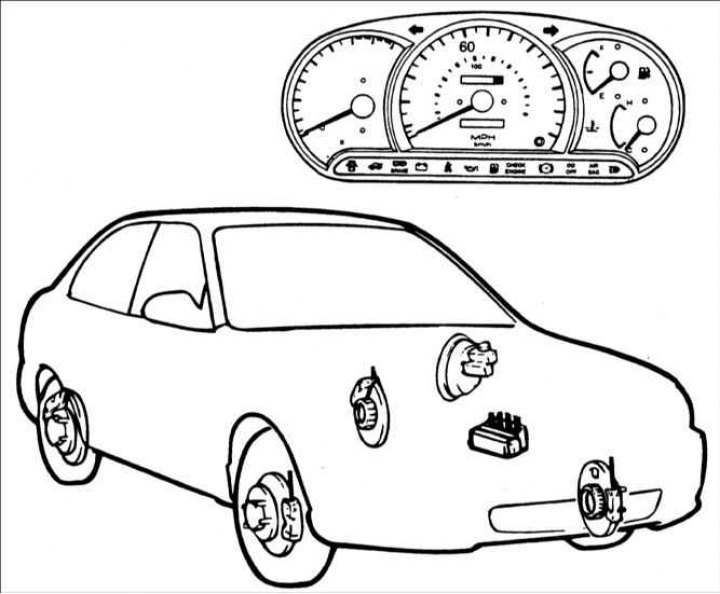
The anti-lock braking system is designed to prevent the wheels from locking during intensive braking.
Main functions of ABS:
- reducing the braking distance by eliminating wheel locking during heavy braking;
- improving the stability of vehicle control during braking.
The anti-lock braking system operates based on information from four sensors transmitted to the ABS unit. The system controls each wheel separately and reduces the fluid pressure in the wheel brake mechanism whose wheel begins to lock.
The original source of the article is the website: HyundaiBook.ru
Under normal conditions, the standard brake system applies the brakes until the wheel locks up, which is detected by the ABS control unit. During normal braking, the intake valves are normally open and the exhaust valves are normally closed.
When the ABS control unit detects a wheel lock, it controls each valve to increase or decrease pressure.
The ABS control unit determines the rotation speed and deceleration rate of each wheel based on information from the wheel speed sensors. When braking, the wheel speed decreases and the ABS unit determines the difference between the vehicle speed and the wheel speed. If the deceleration of some wheels exceeds the expected value, the ABS unit determines the onset of locking and opens the corresponding electromagnetic valves to reduce the brake fluid pressure. At the same time, the wheel speed increases and the electromagnetic pressure relief valve closes, increasing the brake fluid pressure in the working brake cylinder of the corresponding wheel.