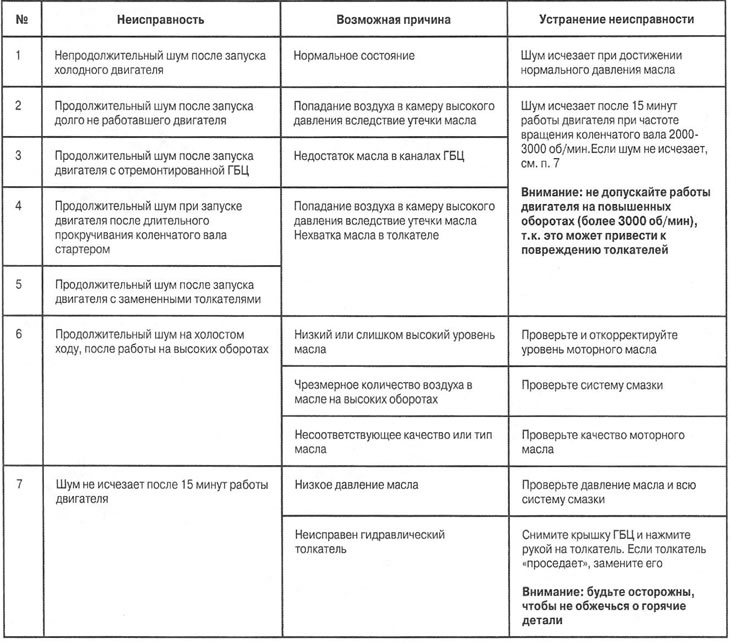
Contents: Cylinder head ⇓ Valve guide bushings ⇓ Replacing the guide bushing ⇓ Valves ⇓ Valve seats ⇓ Replacing the valve seat ⇓ Valve springs ⇓ Camshaft ⇓ Checking the bearing clearance ⇓ Checking the axial clearance ⇓ Timing phase regulator ⇓ Hydraulic tappets ⇓
Cylinder head
1. Using a metal ruler and a set of flat feeler gauges, check the deviation from the plane of the cylinder head surface. Limit value: 0.05 mm (from the gasket side); 0.03 mm (from the collector side).
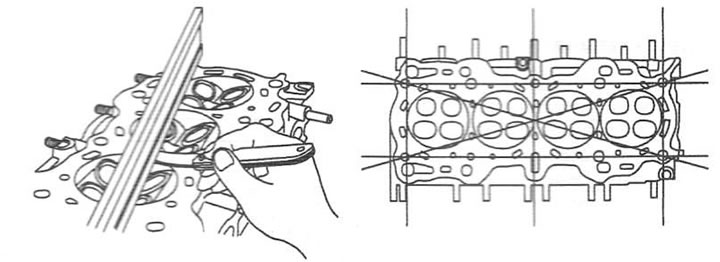
2. Check the combustion chambers, intake and exhaust ports and cylinder mirror for cracks. If damage is found, replace the cylinder head.
Valve guide bushings
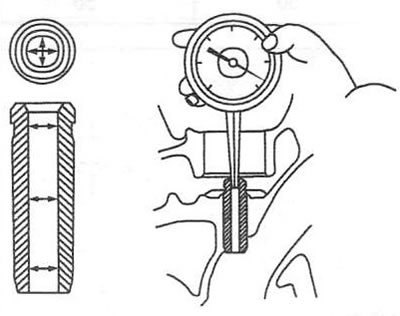
3. Using a bore gauge, measure the inner diameter of the valve guide bushing in several places along mutually perpendicular diameters. Nominal value: 6.500-6.015 mm.
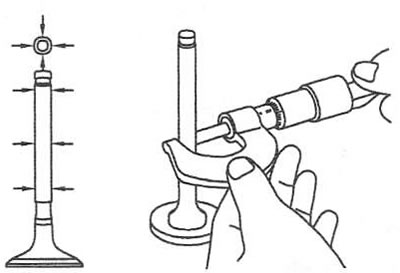
4. Using a micrometer, measure the valve stem diameter in several places along mutually perpendicular diameters. Nominal value: 5.955-5.970 mm (inlet valve); 5.935-5.950 mm (exhaust valve).
5. Calculate the clearance between the valve stem and the guide bushing. Nominal value: 0.03-0.06 mm (inlet valve); 0.05-0.08 mm (exhaust valve). If the obtained value is greater than the nominal value, replace the valve and bushing.
Replacing the guide bushing
6. Using a suitable drift, press the guide bushing out of the cylinder head.
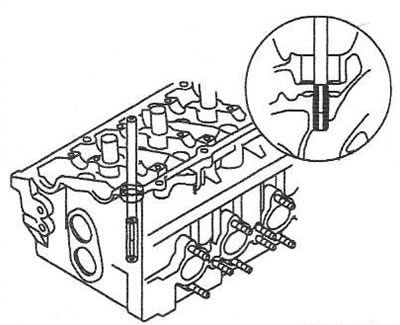
7. Ream the cylinder head mounting holes in accordance with the repair dimensions of the bushings (see table).
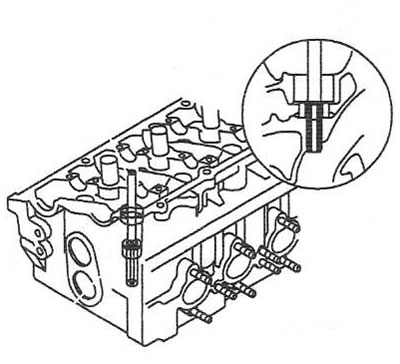
8. Using a suitable mandrel, press in the guide bushing. The bushing should be pressed in from the top side of the cylinder head.
Please note: the inlet and outlet valve bushings have different lengths:
- 36.3-36.7 mm (inlet valve);
- 40.8-41.2 mm (exhaust valve).
Repair dimensions of valve guide bushings
| Size, mm | Size designation | Bushing bore diameter, mm | Outer diameter of the bushing, mm |
| Nominal | - | 11,000-11,018 | 11,050-11,060 |
| +0,05 | 5 | 11,050-11,068 | 11,100-11,110 |
| +0,25 | 25 | 11,250-11,268 | 11,300-11,310 |
| +0,50 | 50 | 11,500-11,518 | 11,550-11,560 |
| +0,50 | 50 | 11,500-11,518 | 11,550-11,560 |
 |
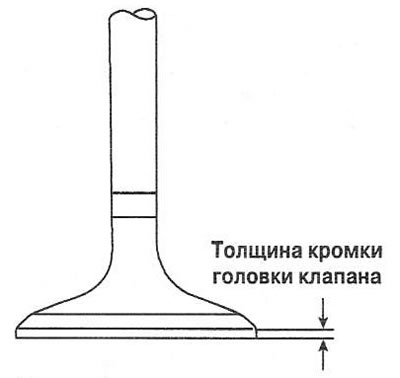 Nominal value: Nominal value:
1.1-0.8 mm (inlet valve) 1.3-1.0 mm (exhaust valve) |
9. After installing the bushings, insert the new valves and check the clearance between the bushing and the valve stem using a travel indicator while rocking the valve stem.
10. Check the correct seating of the valve. If necessary, treat the valve seat locking surfaces.
Valves
11. Check the valve head chamfer angle and for excessive wear. If damage is found, replace the valves.
12. Check the thickness of the valve head edge. Standard value: 1.1-0.8 mm (inlet valve); 1.3-1.0 mm (exhaust valve). If the measured value is less than the nominal value, replace the valve.
13. Check the valve stem for damage. If any defects are found, replace the valve.
Valve seats
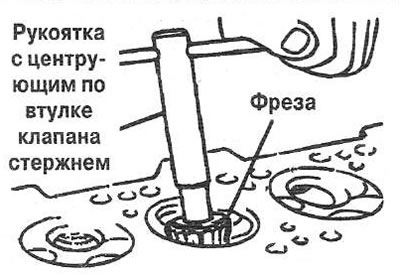
14. Check the valve seats for wear and burnout. If necessary, resurface or replace the valve seats. Before resurfacing the seats, check the guide bushing for wear. If the bushing is excessively worn, replace it and grind the valve seats to the repair dimensions.
 |
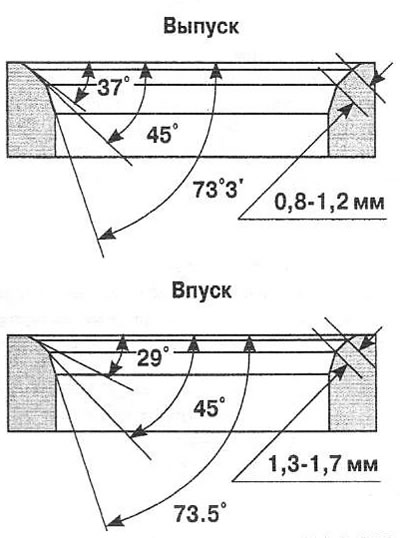 |
15. After repairing the seat, grind the valve using lapping paste. Make sure that the contact strip of the valve with the seat is located in the middle of the chamfer of the valve plate.
Replacing the valve seat
16. Remove as much metal from the seats as possible, being careful not to damage the cylinder head.
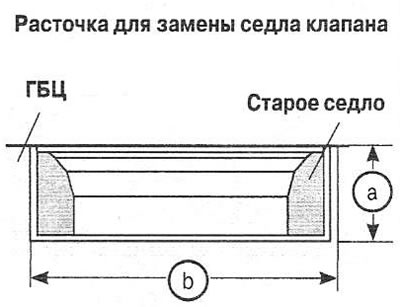 a. Boring depth for new seat = +0.30-0.60 mm a. Boring depth for new seat = +0.30-0.60 mm
c. Bore diameter for new seat = + 0.30-0.60 mm |
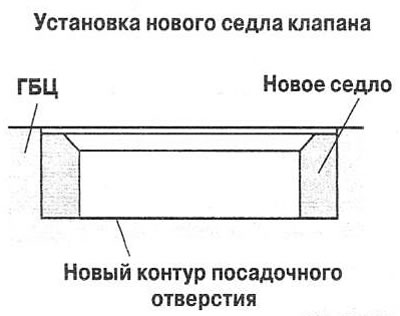 |
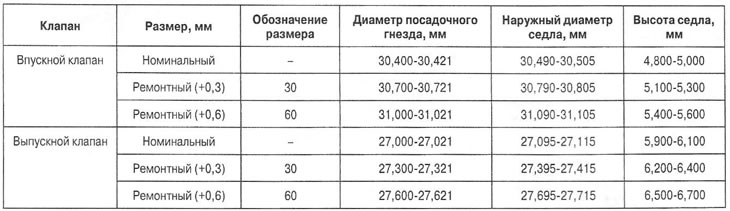
17. Increase the diameter of the valve seat seats in accordance with the repair size of the valve seat.
18. Heat the cylinder head to 250°C and press in the valve seats.
19. Grind the valves to the seat using lapping paste.
Repair dimensions of valve seats
Valve springs
20. Using a square, check the deviation of the valve spring from the vertical. Nominal value: less than 1.5°.
21. Use a caliper to measure the height of the spring in its free state. Nominal value: 44.0 mm.
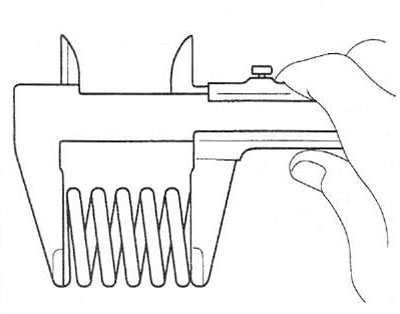
22. Check the valve spring height under a load of 216±11 and 451±22 N. The nominal value is 35.0 and 27.2 mm, respectively. If the nominal value is not achieved, replace the spring.
Camshaft
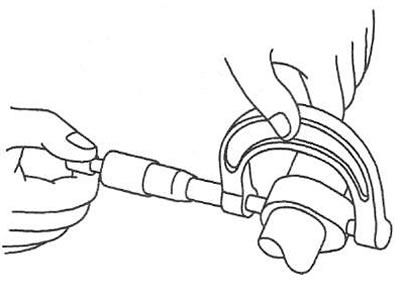
23. Measure the camshaft lobe height with a micrometer. Standard value: intake camshaft - 43.3484-43.5484 mm; exhaust camshaft - 43.7489-43.9489 mm (1.4 L), 43.5486-43.7486 mm (1.6 L). If the measured value is less than the standard, replace the camshaft.
Checking the bearing clearance
24. Clean the bearing caps and camshaft journals.
25. Install the camshafts onto the cylinder head.
[The full version is located on the website: HyundaiBook.ru]
26. Place a piece of plastic gauge on each camshaft journal.
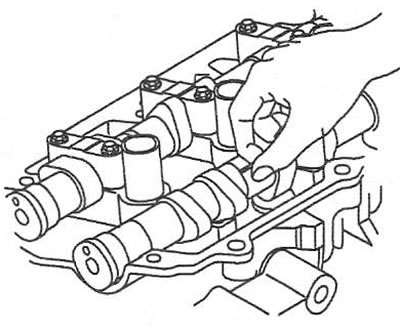
27. Install the bearing caps and tighten the mounting bolts to the specified torque.
Caution: Do not turn the camshaft.
28. Remove the camshaft bearing caps.
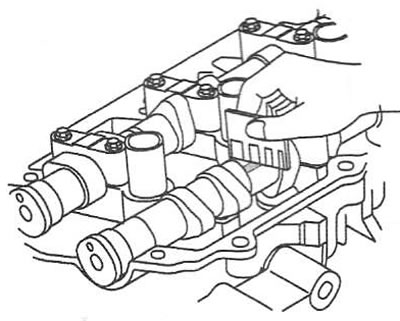
29. Using a control scale, measure the width of the flattened section of the gauge at its widest point. Nominal clearance: 0.020-0.061 mm. Limit clearance: 0.1 mm. If the clearance exceeds the maximum value, replace the camshaft or cylinder head.
30. Remove the plastic gauge completely.
Checking the axial clearance
31. Install the camshaft and bearing caps.
32. Use a dial indicator to measure the axial clearance of the camshaft by moving it back and forth with a screwdriver. Nominal value: 0.056-0.064 mm. If the clearance exceeds the nominal value, replace the camshaft or cylinder head.
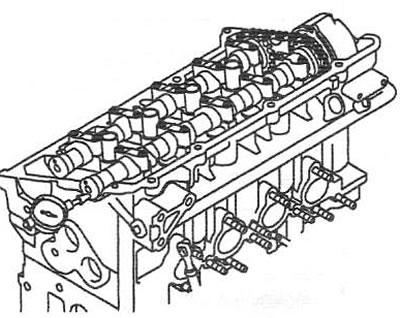
33. Remove the camshafts.
Timing phase regulator
34. Make sure that the timing phase adjuster does not turn.
35. Seal all channels with tape except for the hole indicated by the arrow.
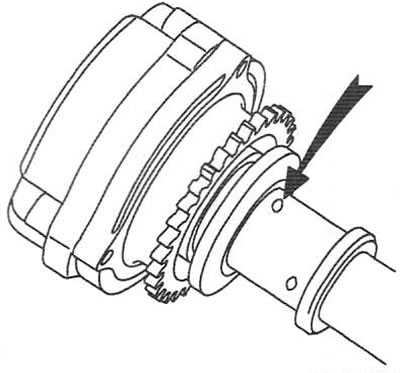
36. Apply air pressure of approximately 98 kPa to the free hole of the camshaft to unlock the locking pin in the maximum retard position.
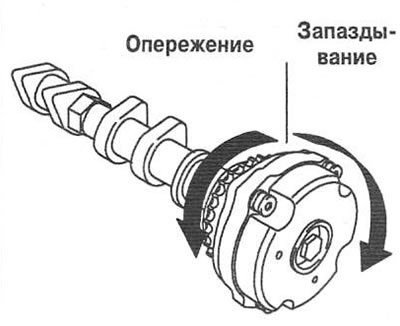
Note: Place a clean cloth around the hole to prevent oil from splashing. If the air pressure is insufficient, the lock pin will not be released.
37. Keeping the pressure constant, turn the regulator towards the advance side.
38. Stop the supply of compressed air to the channel.
39. Turn the regulator from side to side several times without bringing it to the maximum lag position and check the smoothness of rotation. Adjustment range: approximately 20°.
40. Manually turn the regulator to the maximum delay position and lock it.
Hydraulic tappets
41. Hold the upper side (A) and press the diaphragm (B) of the hydraulic tappet completely filled with oil with your finger. If the diaphragm moves, replace the tappet.
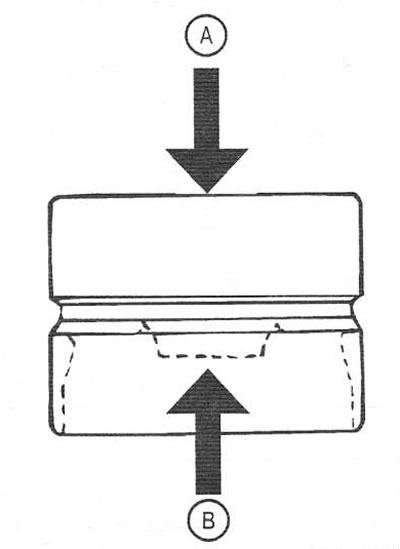
Possible malfunctions of the hydraulic tappet