


Lay out the new pistons and rings with the connecting rods so that the clearance check between the ends of the rings will be carried out on those pistons and in those cylinders where these rings will be installed.
Insert the upper (first) ring (2) into the first cylinder and position it perpendicular to the walls, pushing it with the piston (1). The ring should be positioned near the extreme point of the ring stroke.
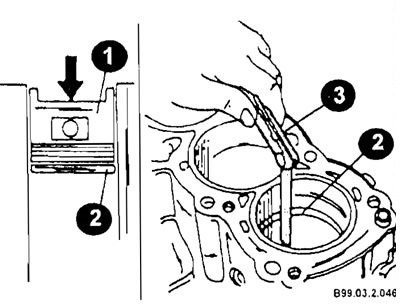
To measure the gap between the ends of the rings, insert feeler gauges (3) of different thicknesses into the gap until you find a feeler gauge equal to the width of the gap. The feeler gauge should slide between the ends of the ring with little effort. Compare the obtained gap value with the technical data.
The required gap size for all rings is 0.3+0.15 mm. If the gap is larger or smaller than the norm, check again whether you have taken the correct ring size.
If the gap is too small, it must be increased, otherwise the ends of the rings may touch each other while the engine is running, which can cause serious damage. The gap can be increased by carefully filing the ends of the rings with a fine file. Clamp the file in a vice and slowly move the ends of the rings over the file so that the metal is removed from the outside in. Filing is done at right angles and all burrs must be removed before assembly.
Repeat the above procedure for all remaining rings.
After checking the clearance between the ring ends, the rings can be installed on the pistons using a fixture.
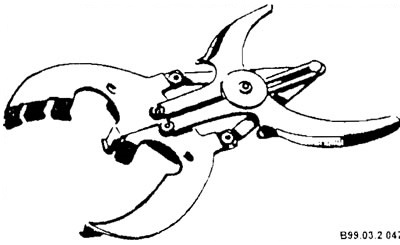
Device for installing/removing piston rings
Usually the oil scraper ring is installed first (the very bottom).
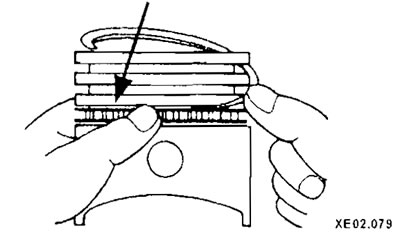
Caution: If an old oil scraper ring is installed, it must be thoroughly cleaned.
After the oil control ring is installed, make sure the ring rotates easily in the groove.
The second compression ring (middle) is installed next.
Note: Do not confuse the top and middle rings - they have different cross-sections.
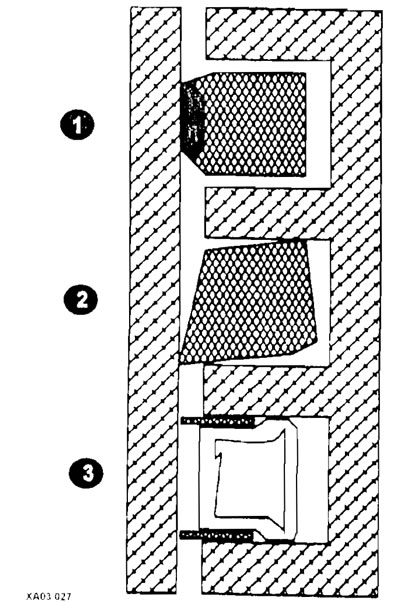
Correct placement of rings in piston grooves
1 - upper compression ring;
2 - lower compression ring;
3 - oil scraper ring.
Using a ring installation tool, insert the ring into the middle groove of the piston. Do not stretch the ring more than necessary to allow the piston to pass through it.
The top (first) ring is installed in the same way.
Installing piston tracks - a simplified installation method
Check that piston ring grooves and oil passages are thoroughly cleaned. Always install rings by sliding them from the top of the piston.
The easiest method for installing rings is to use a flat feeler gauge (thickness 0.3-0.5 mm). The feeler gauge is pressed against the piston and the ring slides along it. This operation is the reverse of the ring removal operation.
After installing the rings, rotate them so that their locks are located at 120° intervals.