HyundaiBook.ru
Repair Chevrolet Repair Honda Repair Toyota Repair Land Rover Repair VAZ Repair Renault Repair Nissan
English Русский
Български
Беларускі
Український
Српски
Hrvatski
Română
Polski
Slovenský
Magyar
ArticlesSitemapContacts  


  Accent   Elantra   Getz   Grandeur   Sonata   Santa Fe   Tucson   Others
Elantra 1 (1990-1995, petrol) Elantra 2 (1995-2000, petrol) Elantra 3 (2000-2006)
  • Main
  • Elantra
  • J1 (1990-1995)
  • Power unit
  • Engine overhaul
  • Cylinder Head — Disassembly (2.0L Engines)

Cylinder Head — Disassembly (2.0L Engines) (Hyundai Elantra J1)

0
Label all parts and store them separately so that they can be returned to their original positions when installed.

Place the cylinder head on a table or in a vice.

If they have not been removed, then unscrew the coolant temperature gauge sensor and the oil pressure sensor.

Remove the chain tensioner by unscrewing the two bolts.
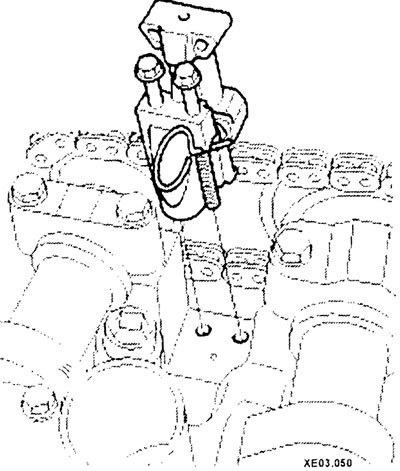
Remove the chain tensioner by…


After unscrewing the bolts, remove the camshaft bearing housings.

Remove the camshafts from the cylinder head beds. Remove the chain connecting the camshafts.
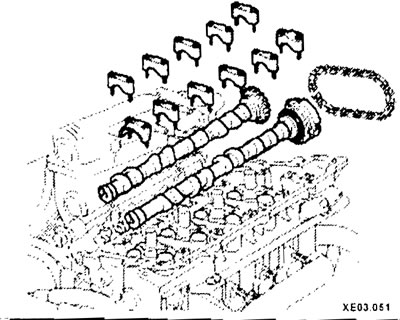
Remove the camshafts from the cylinder…


Remove the camshaft oil seals.

Depending on the model, remove the hydraulic valve lifters or adjusting washers with lifters from the cylinder head holes.
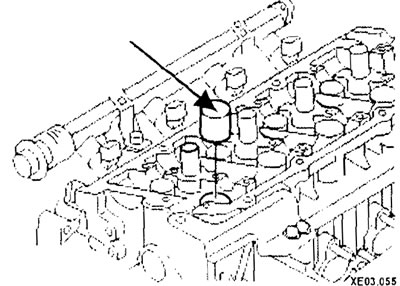
Depending on the model, remove the…


Before removing the valves, mark them and store them with the associated parts so that they can be returned to their original positions when reinstalling.


Compress the springs on the first valve with a tool and remove the crackers.
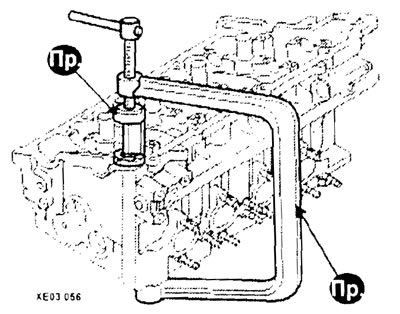
Compress the springs on the first valve…


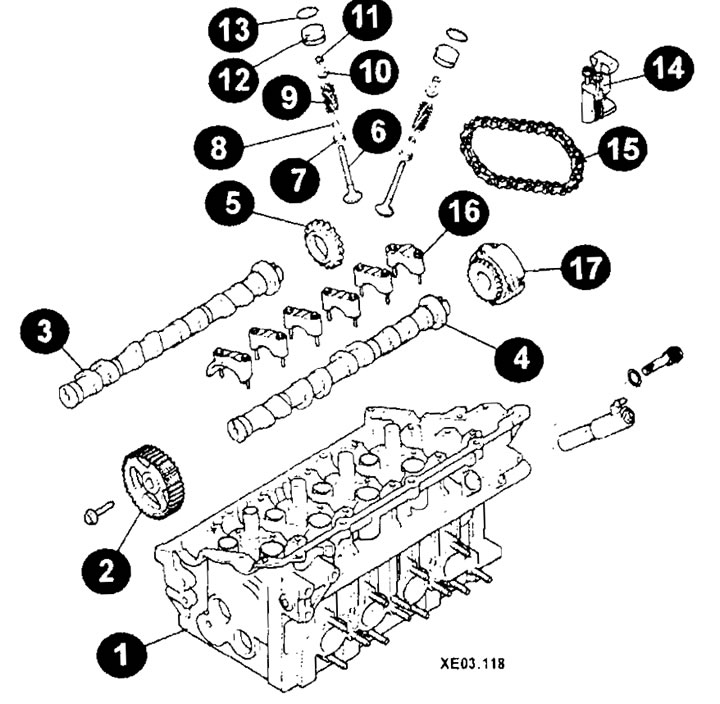
2.0 liter engine cylinder head…

2.0 liter engine cylinder head components
1 - cylinder head;
2 - gear wheel;
3 - intake camshaft;
4 - exhaust camshaft;
5 - star;
6 - inlet valve;
7 - valve seat;
8 - oil deflector cap;
9 - spring;
10 - upper valve plate;
11 - crackers;
12 - pusher;
13 - adjusting washer;
14 - Automatic chain tensioner;
15 - chain;
16 - camshaft cover;
17 - crankshaft position sensor.


Carefully release the spring, remove the plate and springs.

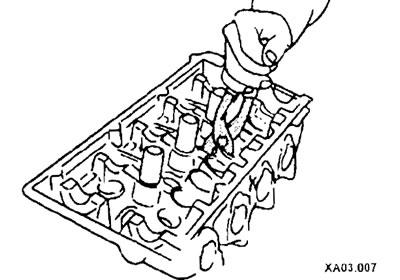
Remove the seals from the valve using the tool (see previous section) or with pliers.
(The basis of the material is information from the website: hyundaibook.ru)

Remove the seals from the valve using…


Remove the valve from the head. If the valve gets stuck in the guide (does not pass through it), push it back into the head and file down the cracker groove and the end of the valve using a file.


Remove the spring seat.

Repeat the procedure for the remaining valves. Remember to keep all valve parts together so that you can install them in their original position during assembly.

Note: For quick valve disassembly procedure, see. in the previous chapter.
This article is available at russian, bulgarian, belarusian, ukrainian, serbian, croatian, romanian, polish, slovak, hungarian
This article has been reviewed by: Konstantin Smirnov
Add to social network:

Previous
Elantra 1: Engine overhaul
Next

Cylinder head — disassembly (1.6 and 1.8 liter engines)
Cylinder Head — Removal (All Engines)
Cylinder head — repair
Engine overhaul — disassembly sequence
Engine Overhaul Options
Cylinder Head Components — Cleaning and Checking
Cylinder head — assembly
Camshaft — Checking and Replacing
Valves, valve seats and guides — inspection and repair
Lapping valves
We recommend other articles on the topic of Hyundai manuals:

Cylinder head — removal, inspection and installation Hyundai Accent 1 (1994-1999)
Cylinder head — removal and installation Hyundai Getz (2002-2011)
Cylinder head and valves — components Hyundai Sonata 3 (1993-1998)
Disassembly, inspection and assembly of the cylinder head Hyundai Santa Fe 2 (2007-2012, petrol)
Cylinder head — device Hyundai Tucson 1 (2005-2010)
Disassembly, inspection and assembly of the cylinder head Hyundai Matrix (2001-2010, petrol)

Link in different formats to this article

Visitor comments
No comments yet


How much will 34 + 33 ?


Elantra 3 (2000-2006) 
  • User manual
  • Control devices
  • Audio system
  • Starting the engine and driving
  • Faults en route
  • Maintenance and care
  • Technical information
  • Power unit
  • Gasoline engines
  • Diesel engines
  • Lubrication system
  • Cooling system
  • Fuel system (gasoline)
  • Fuel system (diesel)
  • Decreased toxicity
  • Ignition system
  • Transmission
  • Clutch
  • Mechanical gearbox
  • Automatic gearbox
  • Drive shafts and axles
  • Chassis
  • Car suspension
  • Steering
  • Brake system
  • Body
  • Exterior (external elements)
  • Interior (internal elements)
  • Air conditioning system
  • Electrical equipment
  • Equipment and devices
  • Headlights and lighting
  • Power devices
  • Electrical circuits
Elantra 2 (1995-2000, petrol) 
  • General information
  • Maintenance
  • Power unit
  • Engine repair
  • Cooling system
  • Intake and exhaust system
  • Fuel system
  • Transmission
  • Clutch
  • Manual gearbox
  • Automatic gearbox
  • Drive shafts and axles
  • Chassis
  • Front suspension
  • Rear suspension
  • Steering
  • Brake system
  • Body
  • Body elements
  • Electrical equipment
  • Equipment and devices
  • Electrical diagrams
Elantra 1 (1990-1995, petrol) 
  • General information
  • Introduction to the guide
  • Maintenance
  • Power unit
  • Minor engine repair
  • Engine overhaul
  • Lubrication system
  • Cooling system
  • Fuel injection system
  • Ignition system
  • Exhaust system
  • Transmission
  • Clutch
  • Manual gearbox
  • Automatic gearbox
  • Drive shafts
  • Chassis
  • Front suspension
  • Rear suspension
  • Steering
  • Wheels and tires
  • Troubleshooting
  • Brake system
  • Body
  • Body elements
  • Electrical equipment
  • Equipment and devices
  • Power devices
  • Heating and air conditioning
  • Electrical circuits
HyundaiBook.ru © 2018-2026 · Mobile version · Sitemap: EN BG BY UA RS HR RO PL SK HU · Administration · Site search · Hyundai owners Accent 1 · Accent 2 · Accent 3 · Elantra 1 · Elantra 2 · Elantra 3 · Getz · Sonata 3 · Sonata 4 · Santa Fe 2 · Tucson 1 · Tucson 2 · Matrix ·
This site uses cookies to optimize its functionality. By continuing, you agree to our terms.