Procedure
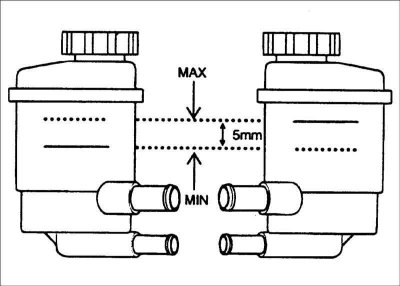
1. Fill the power steering reservoir with the recommended fluid up to the "MAX" mark.
2. Raise the front wheels.
3. Disconnect the high-voltage wire from the ignition coil. Periodically turn on the starter for 15–20 seconds and at the same time turn the steering wheel from lock to lock 5–6 times.
- 1. During the bleeding process, constantly add fluid so that its level in the tank does not fall below the filter installation location.
- 2. If bleeding is performed when the engine crankshaft is not rotating, the air will be dissolved in the fluid again.
4. Connect the high-tension wire to the ignition coil, start the engine and let it run at idle speed.
5. Turn the steering wheel from lock to lock several times. Check that the liquid is not foaming and that its level has not dropped.
The original article is posted on the portal HYUNDAIBOOK.ru
Warning: To avoid damage, do not hold the steering wheel at full lock for more than 10 seconds.
6. Check that the fluid is not milky and that its level is between the "MIN" and "MAX" marks on the tank.
7. Check that there is a slight change in the fluid level when turning the steering wheel left and right.
- 1. If the fluid level changes more than 5 mm, repeat bleeding the power steering hydraulic system.
- 2. If the fluid level rises suddenly after the engine has stopped, there is still air in the system.
- 3. If there is air in the hydraulic power steering drive, extraneous noise will be heard when the pump is operating. Air in the system will reduce the life of the pump and other parts.