
HyundaiBook.ru
Repair Chevrolet Repair Honda Repair Toyota Repair Land Rover Repair VAZ Repair Renault Repair Nissan
English Русский
Български
Беларускі
Український
Српски
Hrvatski
Română
Polski
Slovenský
Magyar
ArticlesSitemapContacts  


  Accent   Elantra   Getz   Grandeur   Sonata   Santa Fe   Tucson   Others
Accent 1 (1994-1999) Accent 2 (1999-2005) Accent 3 (2005-2010)
  • Main
  • Accent
  • LC (1999-2005)
  • Power unit
  • DOHC engines
  • Connecting rods — removal and installation

Connecting rods — removal and installation (Hyundai Accent LC)

0
Contents: Piston and connecting rod ⇓ Removal ⇓ Examination ⇓ Installation ⇓
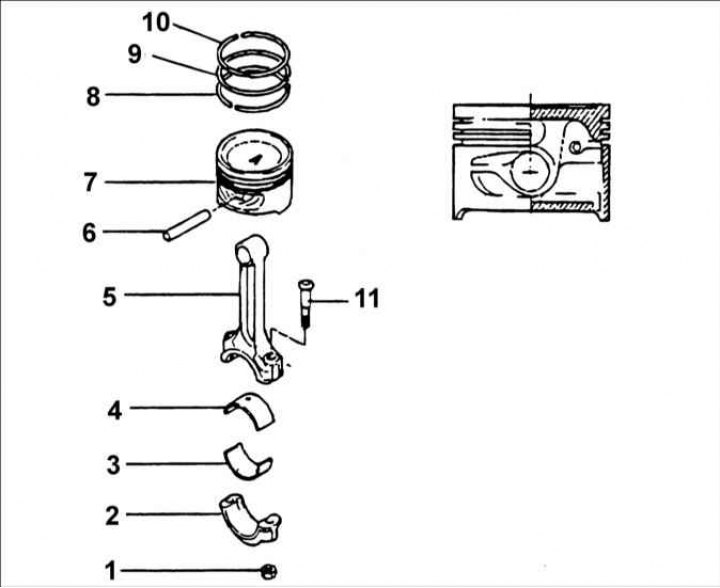
Piston and connecting rod


1 – bolt, 32–35 Nm; 2 – connecting rod cover; 3 – lower connecting rod bearing…

1 – bolt, 32–35 Nm; 2 – connecting rod cover; 3 – lower connecting rod bearing shell; 4 – upper connecting rod bearing shell; 5 – connecting rod; 6 – piston pin; 7 – piston; 8 – oil scraper ring; 9 – compression ring No.2; 10 – compression ring No.1; 11 – bolt.


Removal


Warning: Keep the connecting rod caps with the corresponding connecting rods for proper reinstallation into the engine cylinders.


1. Loosen the nuts and remove the connecting rod cap and the lower connecting rod bearing shell. To protect the crankshaft journals, place sections of rubber or plastic tube on the connecting rod cap mounting bolts.

2. Use a wooden block or a hammer handle to push the piston and connecting rod out of the cylinder.
2. Use a wooden block or a hammer handle to push the piston and connecting rod…


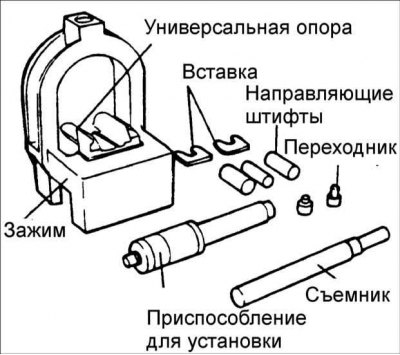
3. To disassemble and reassemble the piston and connecting rod, use special tools 09234–33001.


4. Install the universal supports into the clamp between the connecting rod and the piston.

5. Insert the puller through the hole in the clamp arch.

Warning! Insert the clamp with the piston, connecting rod and puller under the press slide.
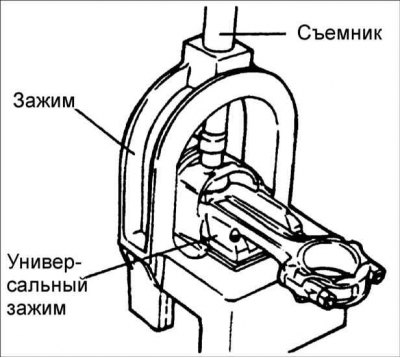

Warning! Insert the clamp with the piston, connecting rod and puller under the…


6. Use a puller to push the piston pin out of the piston.

Examination


Examination


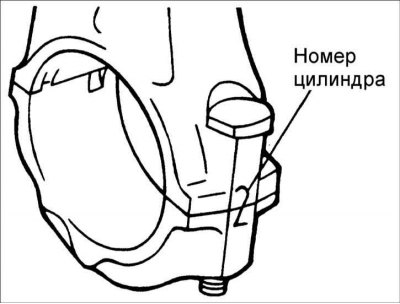
1. When installing, make sure that the connecting rod and connecting rod cap match the cylinder number they are being installed in. When installing a new connecting rod, make sure that the marks that determine its position are on the same side as the marks on the other connecting rods.

2. Replace the connecting rod if there is damage on both bearing surfaces. Also replace the connecting rod if there is wear or damage on the surface mating with the piston pin.
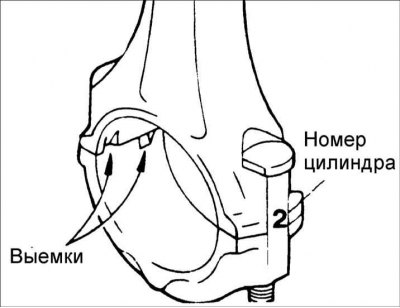


2. Replace the connecting rod if there is damage on both bearing surfaces. Also…


3. Check the bend of each connecting rod. If necessary, replace the connecting rods. Replace the connecting rod together with the connecting rod cap.
  • Allowable bending of connecting rod: 0.05 mm/ 100 mm length
  • Permissible twisting of the connecting rod: 0.1 mm / 100 mm length

Installation


1. Install the guide pins through the piston into the connecting rod and install the piston pin on the other side of the piston.

Warning! The guide pins determine the position of the connecting rod in the piston. After installing the piston, connecting rod, piston pin and piston pin installation tool into the inserts, the guide pins also determine their position in the clamp.
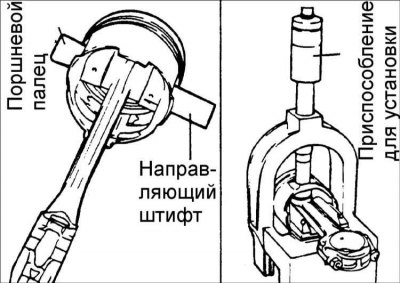

Warning! The guide pins determine the position of the connecting rod in the…


2. The guide pins determine the position of the connecting rod in the piston. After installing the piston, connecting rod, piston pin and piston pin installation tool into the inserts, the guide pins also determine their position in the clamp.


3. Check the correct relative position of the piston and connecting rod and, by turning the knurled nut, secure the numbered sleeve on the shaft.

4. Insert the shaft through the hole in the clamp arch. Press the piston pin into the connecting rod until the bushing on the shaft contacts the top of the clamp arch, and the guide pin should fall out of the piston.

Warning! The piston pin pressing force must not exceed 22,500 N.
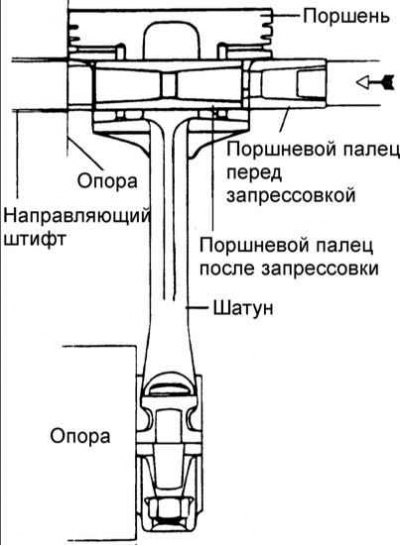

Warning! The piston pin pressing force must not exceed 22,500 N.


Pressing depth: 0.3–0.5 mm

5. Make sure the piston and connecting rod marks are facing the front of the engine.

6. After installing the connecting rod caps, check that the cylinder number on the connecting rod and cap matches the cylinder number.

7. When installing a new connecting rod, make sure the bearing support recesses are on the same side as the other connecting rods.
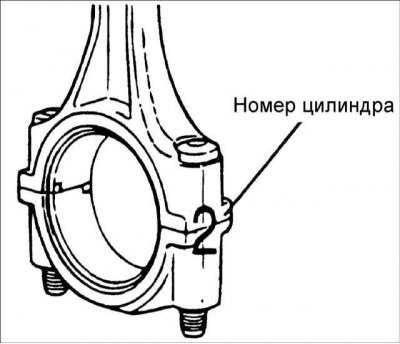
7. When installing a new connecting rod, make sure the bearing support recesses…


8. Tighten the connecting rod cap union nuts.


Tightening torque: 32–35 Nm
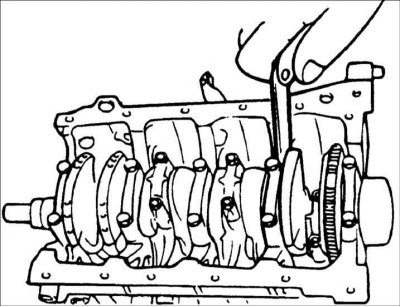
Tightening torque: 32–35 Nm


9. Using a feeler gauge inserted between the connecting rod and the crankshaft, measure the connecting rod side clearance.
  • Nominal connecting rod side clearance: 0.10–0.25 mm
  • Maximum clearance: 0.40 mm
This article is available at russian, bulgarian, belarusian, ukrainian, serbian, croatian, romanian, polish, slovak, hungarian
This article has been reviewed by: Konstantin Smirnov
Add to social network:

Previous
Accent 2: DOHC engines
Next

Valves — removal and installation
Replacing the valve guide bushing
Replacing the valve seat
Camshafts — Removal and Installation
Cylinder head — removal and installation
Crankshaft — removal and installation
Flywheel — removal and installation
Piston — removal and installation
Exhaust manifold
Intake manifold and air chamber
We recommend other articles on the topic of Hyundai manuals:

Pistons and connecting rods — removal Hyundai Elantra 1 (1990-1995, petrol)
Pistons and connecting rods — removal and installation Hyundai Getz (2002-2011)
Pistons and connecting rods — removal and installation Hyundai Sonata 3 (1993-1998)
Socket for connecting additional equipment Hyundai Santa Fe 2 (2007-2012, petrol)
Disassembly and assembly of the connecting rod and piston group Hyundai Matrix (2001-2010, petrol)

Link in different formats to this article

Visitor comments
No comments yet


How much will 17 + 26 ?


Accent 3 (2005-2010) 
  • General information
  • User manual
  • Maintenance
  • Power unit
  • Engine repair
  • Cooling and lubrication system
  • Power and exhaust system
  • Engine electrical equipment
  • Engine management
  • Transmission
  • Clutch
  • Mechanical gearbox
  • Automatic gearbox
  • Chassis
  • Front suspension
  • Rear suspension
  • Wheels and tires
  • Steering
  • Brake system
  • Body
  • Exterior (external elements)
  • Interior (internal elements)
  • Heating and ventilation
  • Electrical equipment
  • Equipment and devices
  • Electrical circuits
Accent 2 (1999-2005) 
  • User manual
  • Control devices
  • Starting engine and driving
  • Troubleshooting
  • Power unit
  • SOHC engines
  • DOHC engines
  • Lubrication system
  • Cooling system
  • Decreased toxicity
  • Fuel system
  • Ignition system
  • Transmission
  • Clutch
  • Mechanical gearbox
  • Automatic gearbox
  • Axles and drive shafts
  • Chassis
  • Car suspension
  • Steering
  • Brake system
  • Body
  • Exterior (external elements)
  • Interior (internal elements)
  • Air conditioning system
  • Electrical equipment
  • Equipment and devices
  • Power devices
Accent 1 (1994-1999) 
  • General information
  • Maintenance
  • Power unit
  • SOHC engines
  • DOHC engines
  • Cooling system
  • Intake and exhaust systems
  • Fuel supply (1.3 l, injection)
  • Fuel supply (1.5 l, injection)
  • Fuel supply (carburetor)
  • Transmission
  • Clutch
  • Manual gearbox
  • Automatic gearbox
  • Drive shafts
  • Chassis
  • Car suspension
  • Steering
  • Brake system
  • Body
  • Body elements
  • Electrical equipment
  • Equipment and devices
  • Electrical circuits
HyundaiBook.ru © 2018-2026 · Mobile version · Sitemap: EN BG BY UA RS HR RO PL SK HU · Administration · Site search · Hyundai owners Accent 1 · Accent 2 · Accent 3 · Elantra 1 · Elantra 2 · Elantra 3 · Getz · Sonata 3 · Sonata 4 · Santa Fe 2 · Tucson 1 · Tucson 2 · Matrix ·
This site uses cookies to optimize its functionality. By continuing, you agree to our terms.