


Contents: Spare wheel, unified with the other…⇓ Small spare tire ⇓ Removal and installation the spare…⇓ Replacing a flat tire ⇓ Jacking up a car ⇓
Cars can be equipped with either a small-sized spare wheel or a spare wheel that is unified with the rest of the car's wheels.
Spare wheel, unified with the other wheels of the car
The vehicle is equipped with a spare wheel with a tire of the same type, size and model as those installed on the other four wheels of the vehicle. This allows the spare wheel to be used both for replacing a damaged wheel and for periodic wheel rotation.
Small spare tire
A small-sized wheel is smaller in weight and size. A small-sized wheel is intended for short-term use only in the event of damage to a vehicle wheel. The vehicle mileage on a small-sized spare wheel should be limited to a short distance. It is prohibited to use a small-sized wheel for long-term travel over significant distances.
When using a small spare tire, the vehicle's handling stability may be impaired compared to the case when the vehicle is equipped with all four normal-sized tires. Therefore, be especially careful when driving. To avoid damage to the small spare tire or the vehicle, observe the following precautions.
- Do not exceed 80 km/h.
- Avoid driving over obstacles on the road. Also, do not drive into a mechanized car wash. Since the diameter of the small-sized wheel is smaller than the standard wheels installed on the car, the ground clearance of the car will be reduced by approximately 10-25 mm.
- It is prohibited to install snow chains on the spare wheel, as they are not suitable for this wheel.
- It is prohibited to install a small spare tire on cars of other brands and models. The small spare tire is intended only for this car model.
- No more than one small spare tire may be installed on a vehicle at a time.
Removal and installation the spare wheel
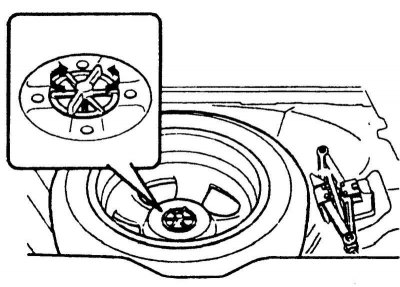
Fig. 1.141. Spare wheel mounting
To remove the spare wheel, unscrew the mounting bolt (Fig. 1.141).
To secure the spare tire in place, tighten the bolt firmly by hand to remove any play in the spare tire.
Replacing a flat tire
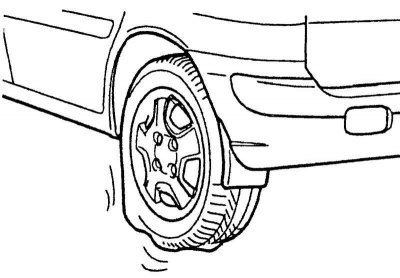
Fig. 1.142. Flat tire
The procedures described below can be used for both changing and rotating tires. When preparing to change a flat tire, make sure the selector lever is in the P (Park) position (automatic transmission) or the gearshift lever is in the reverse position (manual transmission) and the parking brake is applied.
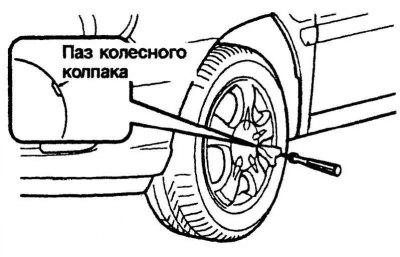
Fig. 1.143. Removing the decorative cap
Wrap a piece of cloth around the end of the tire iron to avoid damaging the surface of the caps and wheels. Insert the tire iron into the groove of the wheel cap, gently press and remove the cap (Fig. 1.143).
Prepare the spare tire and tools.
Remove the spare tire, jack, jack handle and tool bag from the trunk.
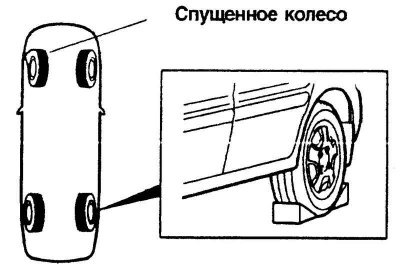
Fig. 1.144. Blocking the wheels of a car
To prevent the vehicle from moving when jacked up, place brake shoes (stop blocks) under the wheel located on the opposite side diagonally to the wheel being replaced (Fig. 1.144).
Before raising the vehicle, it is necessary to slightly loosen the wheel nuts.
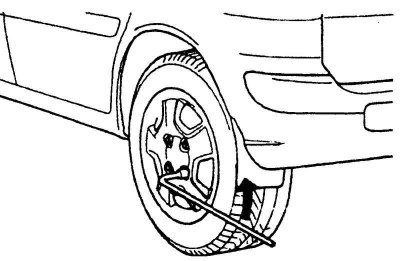
Fig. 1.145. Installing the key for unscrewing wheel nuts
To loosen the wheel nuts, turn the handle of the wrench counterclockwise. Make sure that the head of the wrench grips the wheel nut tightly. For maximum leverage, position the wrench as shown in Figure 1.145.
Then turn it, holding the wrench by the end of the handle. Do not unscrew the wheel nuts completely at this stage. Only loosen them half a turn.
Jacking up a car
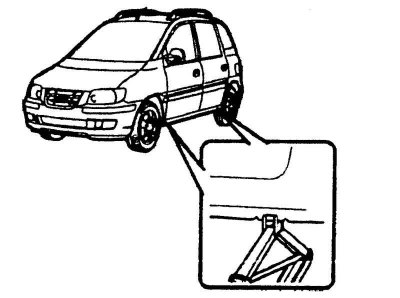
Fig. 1.146. Correct jack installation points
The jack base must be placed on a firm, level surface. The jack must be positioned as shown in Figure 1.146.
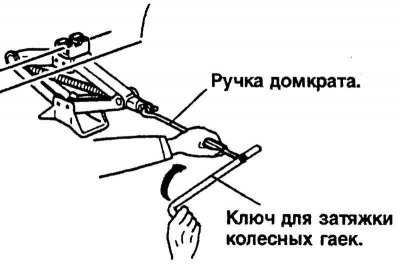
Fig. 1.147. Raising a car with a jack
Insert the lug nut wrench into the jack handle as shown in Figure 1.147.
To raise the vehicle, turn the jack handle clockwise. Once the jack begins to lift the vehicle, double-check that it is securely in place. If the jack is on soft ground or sand, you may need to place a block, flat rock, or other object underneath it to keep it from sinking into the ground. Raise the vehicle high enough to accommodate a fully inflated tire.
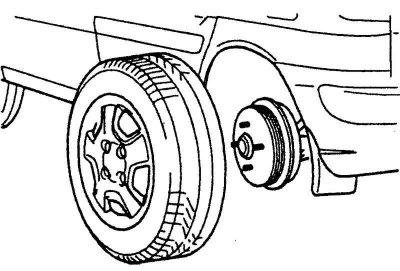
Fig. 1.148. Removing the wheel
Remove the wheel cap (optional equipment) from the wheel. Use a wrench to loosen the wheel nuts, then unscrew them by hand, remove the wheel and place it on the ground to prevent it from rolling away (Fig. 1.148).
To put the wheel on the hub, lift it, align the holes with the studs and put the wheel on them. If this is difficult, tilt the wheel slightly and align the top hole with the stud first. Then wiggle the wheel to insert the remaining studs into the holes in the wheel.
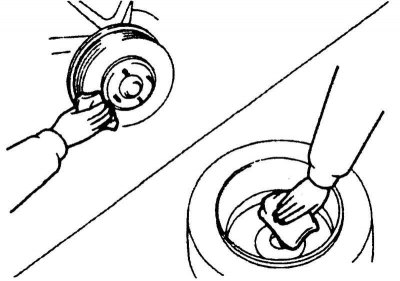
Fig. 1.149. Cleaning wheels and wheel rims
Before installing the wheel, make sure there is no foreign material on the hub or wheel (dirt, tar, gravel, etc.) that could prevent the wheel from being installed on the hub. If there is, remove it (Fig. 1.149).
If good contact is not ensured between the mating surfaces of the wheel and hub, the wheel nuts may come loose, which may result in the loss of the wheel and loss of control of the vehicle.
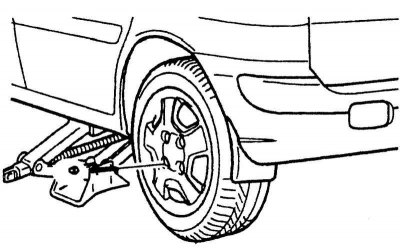
Fig. 1.150. Installing wheel nuts
To install the wheel cap, hold it on the wheel, screw the wheel nuts onto the threads and tighten them by hand. The nuts must be installed with the conical part inward (Fig. 1.150).
Wiggle the wheel to make sure it is fully seated and tighten the lug nuts again by hand.
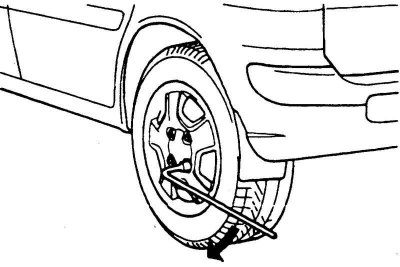
Fig. 1.151. Tightening the wheel nuts
Lower the vehicle to the ground by turning the jack handle counterclockwise. Set the key to the position shown in Figure 1.151 and tighten the wheel nuts.
Make sure that the head of the wrench fits tightly around the wheel nut. When tightening the wheel nuts, do not stand on the wheel wrench with your foot or extend it with a pipe, as this may cause the nut to be overtightened.
Tighten all wheel nuts one by one. Recheck the tightness of all nuts.
After changing a wheel, take your vehicle to a mechanic as soon as possible so that the wheel nuts can be tightened to the correct torque.
Wheel nut tightening torque.
Steel disc and aluminum alloy disc: 90-110kPa.
After installing the wheel, remove the valve cap and check the air pressure in the tire.
If the air pressure in the tire is higher than recommended, deflate it to the required value.
After changing a tire, always secure the flat tire in the trunk and store the jack, jack handle, and tools in a secure location.