


Contents: Assigning selector positions ⇓ Correct driving techniques ⇓ Overdrive mode switch ("Upshift") ⇓
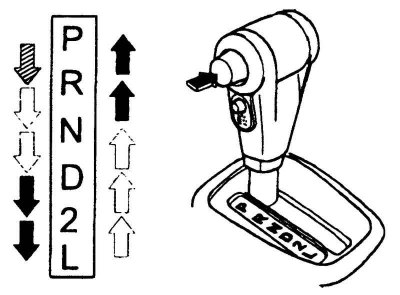
Fig. 1.135. Automatic transmission shift modes
The highly efficient automatic transmission has four forward gears and one reverse gear. In the dark, when the selector is engaged, the indicators on the panel light up automatically.
Caution! While the vehicle is moving, do not move the selector lever to the "R" or "P" position.
For optimum fuel economy, increase speed gradually. The selector will automatically shift to second, third and Overdrive mode.
Assigning selector positions
"P" - "Parking".
Use this position to hold the vehicle in place while parked or starting the engine. When parking the vehicle, apply the parking brake and move the selector lever to the "P" (Park) position.
Caution! Do not move the selector to the "P" ("Park") position until the vehicle is completely stopped. Failure to do so may result in damage to the automatic transmission.
"R" – "Reverse".
Use this position to reverse. Move the selector lever to the "R" (Reverse) position only after the car has come to a complete stop.
"N" – "Neutral position".
In this position of the selector the automatic transmission is disengaged. In this position it is possible to start the engine, however it is not recommended except in cases when the engine stalls while driving.
"D" - "Movement".
This mode is used for driving, one of the four gears is automatically engaged. Never switch the selector to position "2" or "L" if the vehicle speed exceeds 95 km / h.
(Material was obtained from an official resource HYUNDAIBOOK)
"2" - "Second gear".
Use this mode when driving on slippery roads, when driving uphill or for engine braking when going downhill. Mode "2" is automatically engaged between first and second gears. This does not mean that an upshift to third gear will occur. However, third gear may be engaged when the vehicle exceeds a certain speed to prevent the engine from exceeding the maximum permissible engine speed. When returning to normal driving conditions in manual mode, move the selector to position "D".
"L" - "First gear".
This mode is used when driving up a steep hill or when engine braking on a steep downhill. When shifting into L, the transmission will hold second gear for a while until the vehicle speed is reduced enough to engage a low gear. Do not exceed 50 mph in L.
Note: To ensure smooth and safe operation, fully depress the brake pedal before shifting the selector lever from the P (Park) or N (Neutral) position to the reverse gear position.
Note: To move the selector from the "P" (Park) position to any other position, the brake pedal must be fully depressed.
Note: You can always move the selector from the positions "R" ("Reverse"), "N" ("Neutral"), "D" ("Drive", main gear), "2" ("Second gear"), "L" ("First gear") to the position "P" ("Park"). In this case, the car must be completely stopped to avoid damaging the gearbox.
Caution: Do not press the accelerator pedal while the transmission is in reverse or one of the forward gears with the brake pedal depressed.
Caution: Always press the brake pedal when moving the selector from the "P" or "N" positions to the "R", "D", "2" or "L" positions.
Warning! Do not use the "P" (Park) position instead of the parking brake. Even when leaving the vehicle for a short time, always apply the parking brake, move the selector to the "P" (Park) position and turn off the ignition. Never leave the vehicle unattended when the engine is running.
Caution: Check the automatic transmission fluid level regularly and add fluid if necessary.
Correct driving techniques
Do not move the selector lever from the "N" or "P" position to any other position while the accelerator pedal is depressed.
While the vehicle is moving, the selector lever must not be moved to the "P" position.
Before moving the selector lever to the "R" position, make sure the vehicle is completely stopped.
Do not roll downhill in neutral. It is very dangerous. Always keep the gear engaged while the vehicle is moving.
Avoid driving with frequent acceleration and braking and do not keep your left foot on the brake pedal all the time while driving. This leads to overheating of the brakes and loss of their effectiveness. On long descents, engine braking (including low gears) should be used to prevent overheating of the brakes.
When shifting into a lower gear, apply the brakes slightly. Otherwise, the lower gear may not engage.
Always use the parking brake. Do not rely on shifting the selector lever to the "P" position to prevent the vehicle from moving.
Be especially careful when driving on slippery roads. Be especially careful when braking, accelerating and changing gears. On slippery roads, sudden changes in speed can cause the car to lose traction and control over the car.
For the most economical fuel consumption and smooth driving, turn on the "Overdrive" mode. If engine braking occurs in the "D" range or when a smooth climb requires repeated shifting from 3rd to 4th gear and back, it is recommended to turn off the "Overdrive" mode. In all other cases, the "Overdrive" mode should be turned on.
Overdrive mode switch ("Upshift")
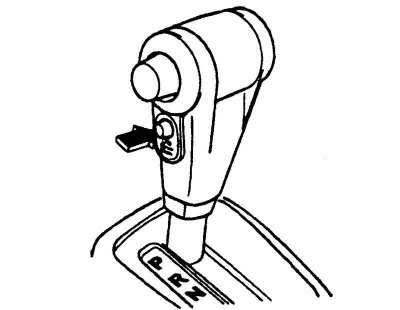
Fig. 1.136. Overdrive mode switch
When the Overdrive mode is engaged, the transmission automatically upshifts to second, third and Overdrive. If the mode is disabled, the transmission will not upshift to Overdrive. Under normal conditions, the selector should be in the D position and the Overdrive mode engaged. If you need to quickly pick up speed, fully depress the gas pedal. The transmission will automatically downshift depending on the speed and engine load.