


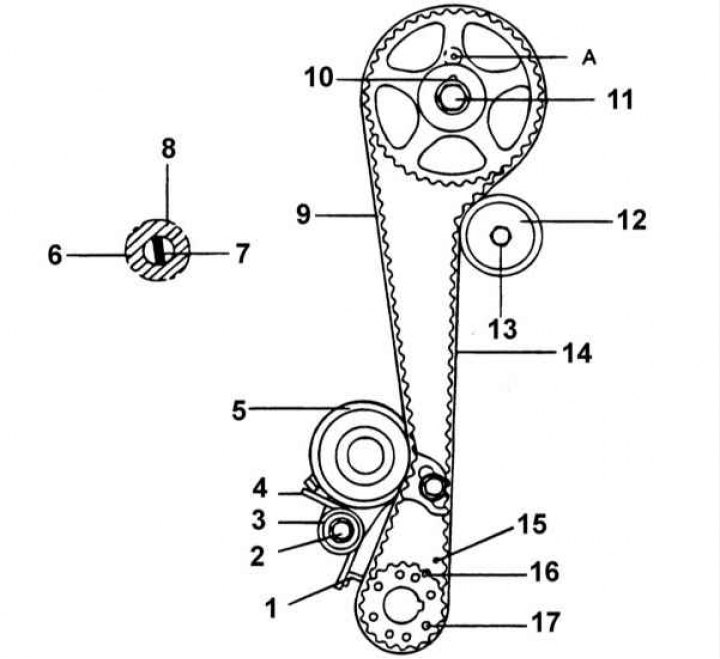
1 – front cover; 2 – bolt, 20–27 Nm; 3 – spacer sleeve of the toothed belt tensioning mechanism; 4 – tension mechanism spring; 5 – timing belt tension roller; 6 – camshaft pulley; 7 – installation mark (pointer); 8 – installation mark hole; 9 – free side of the toothed belt; 10 – mounting pin; 11 – bolt, 80–100 Nm; 12 – guide roller; 13 – bolt, 43–55 Nm; 14 – timing belt tension side; 15 – installation mark (pointer) on the front cover; 16 – timing mark on the crankshaft pulley; 17 – crankshaft pulley.
Removal
1. Loosen the water pump pulley mounting bolt.
2. Loosen the generator mounting bolt.
3. Remove the water pump pulley and belt.
4. Remove the crankshaft pulley.
5. Remove the timing belt cover.
6. Move the timing belt tensioner pulley toward the water pump and temporarily secure it in this position.
7. Remove the camshaft pulley mounting bolt.
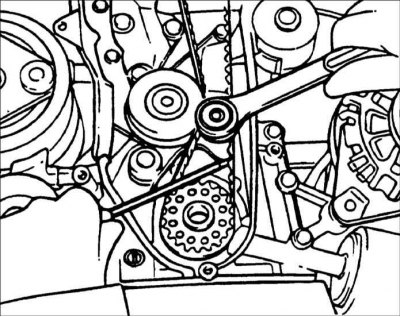
8. Remove the camshaft pulley.
9. Remove the timing belt.
Warning: Mark the direction of rotation of the timing belt to reinstall it in its original position.
10. Remove the crankshaft pulley mounting bolt. Remove the crankshaft pulley and bushing.
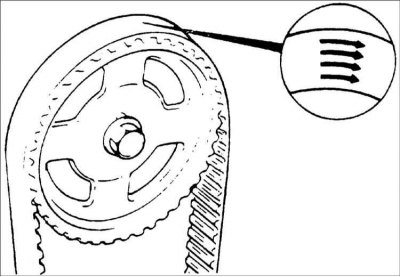
11. Remove the timing belt tensioner roller.
Examination
Pulleys and roller of the toothed belt tensioning mechanism
1. Check the camshaft and crankshaft pulleys, tensioner pulley and idler pulley for uneven wear, cracks or damage.
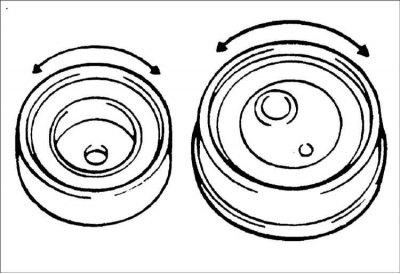
2. Check the ease and smoothness of rotation of the tensioner roller and the idle pulley, as well as the absence of extraneous noise during rotation.
Toothed belt
Warning! Do not bend the timing belt excessively or change its direction of rotation. Do not allow oil or grease to come into contact with the timing belt, as this will cause it to break.
Execution order
1. Check the timing belt for damage, wear, delamination, cracks on the teeth and at the base of the teeth, as well as for defects on the ends and back of the belt.
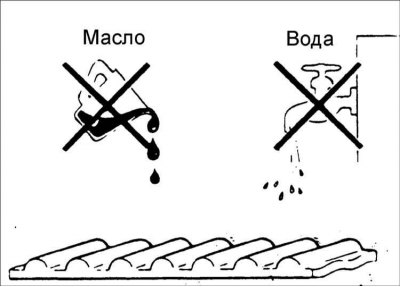
2. If the following defects are present, replace the timing belt.
Description | Defect |
| 1. Hard back surface of the toothed belt. The surface has a glossy appearance The surface is so hard that your fingernail won't leave marks on the belt | 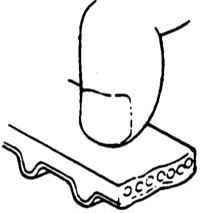 |
| 2. Cracks on the back surface of the timing belt | 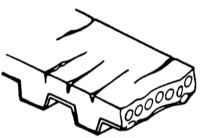 |
| 3. Cracks or delamination of the timing belt | 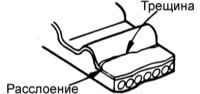 |
| 4. Severely worn teeth The side of the tooth is worn, exposing the fibers, cord and rubber base | 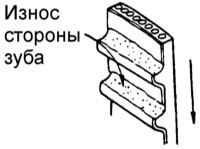 |
| 5. Teeth are heavily worn (last stage) The side of the tooth is worn out, with abrasions becoming visible and the thickness of the tooth is reduced | 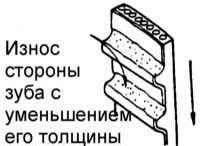 |
| 6. Cracks in the base of the teeth | 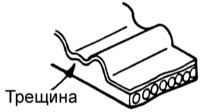 |
| 7. Missing tooth | 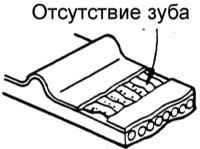 |
| 8. Severe wear on one side of the belt | |
| 9. Cracks on the side of the timing belt |
Installation
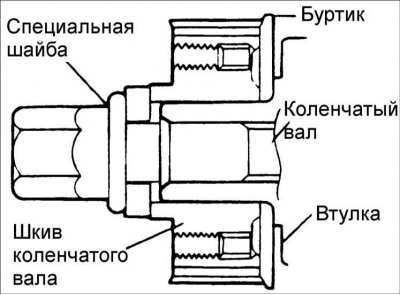
1. Install the bushing and crankshaft pulley as shown in the figure. Pay attention to the direction of their installation
Tightening torque: 140–150 Nm
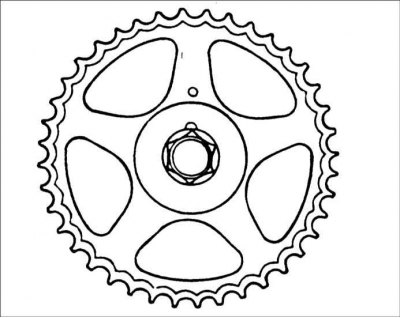
2. Install the camshaft pulley and secure it with the bolt, tightening it to the required torque.
Tightening torque: 80–100 Nm
3. Install the guide roller and secure it with the bolt, tightening it to the required torque.
Tightening torque: 43–55 Nm
4. Align the timing marks on the camshaft and crankshaft pulleys with the pointers, with the piston of the first cylinder set to TDC in the compression stroke.
 |
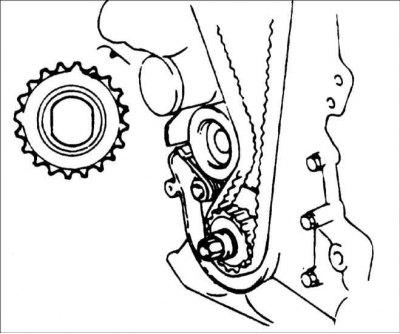 |
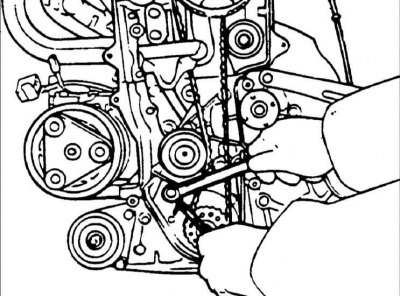
5. When installing the timing belt tensioner, first install the tensioner, spring and spacer sleeve. Temporarily tighten the bolts. Then, temporarily compress the tensioner by inserting the bolt into the elongated hole. Install the rear end of the flat spring against the front cover as shown in the figure.
6. Secure the tensioner mechanism to the water pump.
7. Install the timing belt onto the crankshaft pulley.
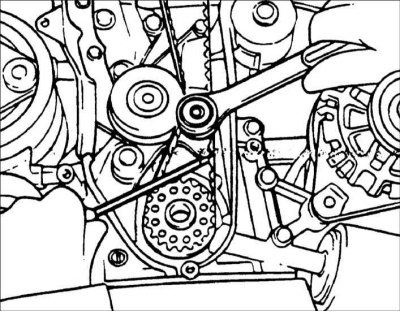
8. Install the timing belt onto the camshaft pulley, making sure that there is no slack on the tension side.
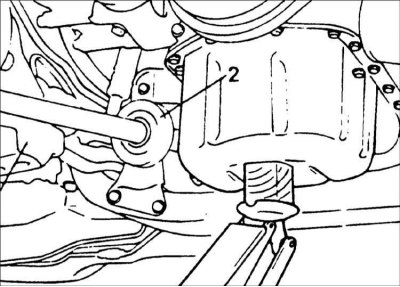
9. Loosen bolts 1 and 2 of the tensioner mechanism in the sequence shown in the figure, this will release the spring of the toothed belt tensioner mechanism.
10. Tighten tensioner mounting bolts 1 and 2 in the same order.
11. Turn the engine crankshaft clockwise two full revolutions and align the mark on the crankshaft timing belt pulley with the pointer on the engine cylinder block. Check that the mark on the camshaft pulley is aligned with the pointer on the cylinder head cover.
Warning! Do not turn the engine crankshaft counterclockwise.
12. In the same order, loosen bolts 1 and 2 securing the timing belt tensioner mechanism.
13. Tighten tensioner mounting bolts 1 and 2 in the same order.
Tightening torque: 20–27 Nm
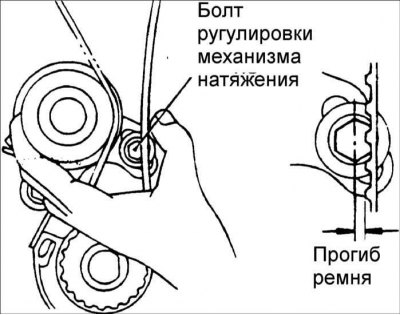
14. Recheck the toothed belt tension. When pressing the tensioned branch of the toothed belt with a force of 49 N, the toothed belt should bend to the center of the head of the tensioner mounting bolt.
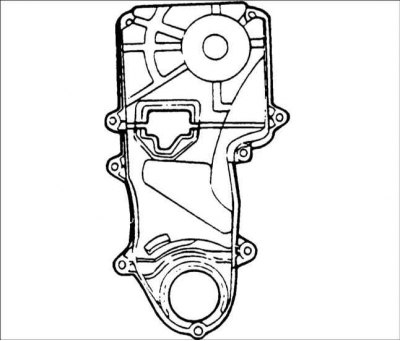
15. Install the timing belt covers.
Tightening torque: 8–10 Nm
16. Install the crankshaft pulley.
Tightening torque: 140–150 Nm
17. Install the fan drive poly V-belt and adjust its tension.
18. Install the water pump pulley.
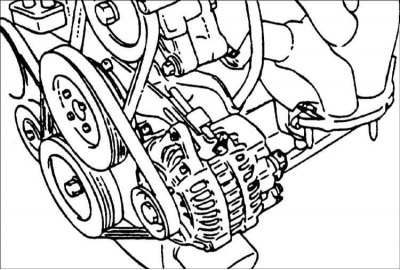
19. Install the poly V-belt and adjust its tension.