


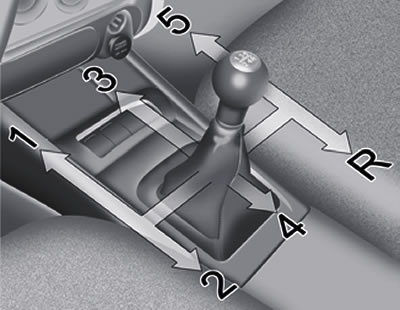
Note:
- Engage reverse gear only after the vehicle has come to a complete stop, after holding the gear shift lever in the neutral position for at least 3 seconds.
- In cold weather, gear shifting may be difficult until the oil in the gearbox sump warms up, which is normal and does not adversely affect the operation of the gearbox.
- If it is difficult to engage 1st gear or reverse gear (position "R") when the vehicle is completely stopped, move the gearshift lever to the neutral position and release the clutch pedal. Press the clutch pedal again and move the lever to position "1" or "R".
- Do not keep your hand on the gear shift lever while the vehicle is moving. This may result in premature wear of the shift forks.
Caution: When shifting from 5th to 4th gear, be careful not to accidentally engage 2nd gear when moving the lever laterally. Such a sharp downshift will cause an unacceptable jump in engine speed, causing the tachometer needle to move into the red zone. This overspeeding of the engine can cause damage to the engine.
Clutch pedal actions
When changing gears, fully depress the clutch pedal and release it smoothly. The clutch pedal should be pressed again only after it has completely returned to its original position. Do not keep your foot on the clutch pedal while driving. This will cause accelerated wear of the clutch. Do not use clutch slippage to hold the vehicle on a slope, which will also cause accelerated wear. To hold the vehicle, apply the parking brake. Avoid frequent and sharp pressing of the clutch pedal.
(The original source of the article is the website: HYUNDAIBOOK.ru)
Recommended driving speeds for gear shifting
| Gear shifting | Recommended speed, km/h |
| I—II | 20 |
| II—III | 40 |
| III—IV | 55 |
| IV—V | 75 |
To ensure optimum fuel economy and driving performance, it is recommended to shift gears at the speeds indicated above.
Correct driving techniques
Never shift into neutral while driving downhill. This is extremely dangerous. Only descend with the gear engaged.
When driving downhill, do not maintain the desired speed by constantly braking. This will cause the brakes to overheat and become less effective. On a long descent, use engine braking by slowing down and engaging one of the lower gears, which will allow you to maintain the desired speed.
Reduce your speed before shifting into lower gears to prevent a dangerous surge in engine speed.
For better vehicle control, reduce your speed in strong crosswinds.
Engage reverse gear only after the vehicle has come to a complete stop. Otherwise, it may cause damage to the gearbox. To engage reverse gear, fully depress the clutch pedal, move the gearshift lever to the neutral position, wait at least three seconds, and move the lever to the reverse position.
Exercise extreme caution when driving on slippery surfaces, especially when braking, accelerating and changing gears. If the speed of movement changes abruptly on a slippery surface, the drive wheels may lose traction and the vehicle will go out of control.
Warning:
- Reduce speed before turns. Avoid making sharp turns of the steering wheel, especially when changing lanes abruptly or making sharp turns. Always wear your seat belts. In the event of an accident, the likelihood of a fatal outcome is greatly increased if seat belts are not fastened
- If you lose control of your vehicle at high speed, the risk of the vehicle overturning increases significantly.
- Loss of control often occurs when two or more wheels leave the hard surface and land on soft ground, and the driver turns the steering wheel sharply to return the vehicle to the road.
- If your vehicle has left the roadway, do not make any sudden steering movements and reduce speed before returning the vehicle to the traffic lane.
- Never exceed the speed limit indicated on road signs.
- Do not press the accelerator pedal sharply when starting off. In conditions of poor tire traction on dirt or snow-covered ground, this will cause the drive wheels to slip and, as a result, cause serious damage to the gearbox. In such cases, use other methods, in particular towing.