
HyundaiBook.ru
Repair Chevrolet Repair Honda Repair Toyota Repair Land Rover Repair VAZ Repair Renault Repair Nissan
English Русский
Български
Беларускі
Український
Српски
Hrvatski
Română
Polski
Slovenský
Magyar
ArticlesSitemapContacts  


  Accent   Elantra   Getz   Grandeur   Sonata   Santa Fe   Tucson   Others
Elantra 1 (1990-1995, petrol) Elantra 2 (1995-2000, petrol) Elantra 3 (2000-2006)
  • Main
  • Elantra
  • XD (2000-2006)
  • User manual
  • Starting the engine and driving
  • Traction Control System (TSC)

Traction Control System (TSC) (Hyundai Elantra XD)

0
Contents: Preventing slippage ⇓ Driving with PPS ⇓ Turning PPS on and off ⇓ System indicator lights ⇓
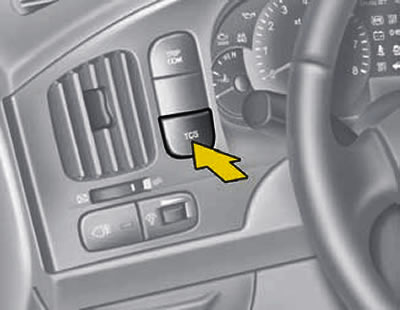
The traction control system (TCS) limits the degree of slippage of the drive…


The traction control system (TCS) limits the degree of slippage of the drive wheels on slippery road surfaces, thereby facilitating the acceleration of the vehicle. In addition, it provides sufficient traction on the drive wheels and vehicle control when cornering under acceleration.

Preventing slippage


The system limits the slippage of the drive wheels when starting off and when cornering under acceleration on a slippery road, thereby preventing a reduction in the traction force of the drive wheels.

Driving with PPS


The PPS system does not act directly on the brakes. Reduce speed before entering a turn.
Note: Flashing of the TCS indicator lamp indicates that the TCS has come into operation. It also indicates that the road is slippery or that acceleration is too abrupt. In this situation, ease off the accelerator pedal and maintain a moderate speed.


Warning: PPS only provides assistance in driving a vehicle. Its presence does not cancel out the need to take all safety precautions when driving in difficult weather conditions or on slippery roads.


Turning PPS on and off


When the system is switched on, the corresponding indicator lamp in the instrument cluster flashes.

When the system is switched off by pressing the switch, the PPS control lamp lights up continuously. When switched off, the slip control is stopped.

This should be taken into account when driving. To turn the system on, press the switch again. The control lamp should go out.

Note:
  • 1) Stop the engine, start it again: the PPS will turn on automatically.
  • 2) During normal operation of the PPS, a slight vibration may be felt in the car, which is caused by the system's effect on the brakes and is not something unusual.
  • 3) When starting the engine, a clicking sound is heard from the engine compartment, which indicates that the traction control system is being checked.
  • 4) When starting off on liquid mud or freshly fallen snow, the engine speed may not increase when the accelerator pedal is pressed as a result of the PPS action.


System indicator lights


When the ignition key is turned to the "ON" or "START" position, the indicator lights should come on and go out after three seconds.

If the lamps do not light or do not go out after 3 seconds, have them checked by an authorized dealer.

If there is any malfunction in the system, the "TCS-OFF" control lamp lights up.

[The original version is stored on the website: HyundaiBook.ru]

If the "TCS-OFF" indicator light is on or flashing, stop the vehicle in a safe place and turn off the engine.

After this, start the engine again and make sure that the "TCS-OFF" indicator lamp does not light.


If the light remains on after the engine is started, have the system checked by an authorized Hyundai dealer.

Note:
  • 1) If the "TCS-OFF" indicator lamp lights up, the traction control system is automatically switched off for safety reasons.
  • 2) This function does not work if the driver turns off the system himself.
This article is available at russian, bulgarian, belarusian, ukrainian, serbian, croatian, romanian, polish, slovak, hungarian
This article has been reviewed by: Konstantin Smirnov
Add to social network:

Previous
Elantra 3: Starting the engine and driving
Next

Anti-lock braking system
Automatic transmission (1.8/2.0 DOHC)
Automatic transmission (1.6 DOHC)
Shifting gears in a manual transmission
Starting and stopping an engine with a turbocharger and air cooler
Correct braking techniques
Economical driving
Driving in winter
Driving at high speed
Outdoor lighting
We recommend other articles on the topic of Hyundai manuals:

Automatic transmission and ignition switch control system Hyundai Accent 1 (1994-1999)
Control of heating and ventilation system Hyundai Getz (2002-2011)
Anti-lock braking system (ABS) and traction control system (TCS) Hyundai Sonata 4 (2001-2012, petrol)
Distributed fuel injection control system Hyundai Santa Fe 2 (2007-2012, petrol)
Hydroelectronic control unit of the anti-lock braking system… Hyundai Tucson 1 (2005-2010)
Traction Control System (TCS) Hyundai Matrix (2001-2010, petrol)

Link in different formats to this article

Visitor comments
No comments yet


How much will 22 + 46 ?


Elantra 3 (2000-2006) 
  • User manual
  • Control devices
  • Audio system
  • Starting the engine and driving
  • Faults en route
  • Maintenance and care
  • Technical information
  • Power unit
  • Gasoline engines
  • Diesel engines
  • Lubrication system
  • Cooling system
  • Fuel system (gasoline)
  • Fuel system (diesel)
  • Decreased toxicity
  • Ignition system
  • Transmission
  • Clutch
  • Mechanical gearbox
  • Automatic gearbox
  • Drive shafts and axles
  • Chassis
  • Car suspension
  • Steering
  • Brake system
  • Body
  • Exterior (external elements)
  • Interior (internal elements)
  • Air conditioning system
  • Electrical equipment
  • Equipment and devices
  • Headlights and lighting
  • Power devices
  • Electrical circuits
Elantra 2 (1995-2000, petrol) 
  • General information
  • Maintenance
  • Power unit
  • Engine repair
  • Cooling system
  • Intake and exhaust system
  • Fuel system
  • Transmission
  • Clutch
  • Manual gearbox
  • Automatic gearbox
  • Drive shafts and axles
  • Chassis
  • Front suspension
  • Rear suspension
  • Steering
  • Brake system
  • Body
  • Body elements
  • Electrical equipment
  • Equipment and devices
  • Electrical diagrams
Elantra 1 (1990-1995, petrol) 
  • General information
  • Introduction to the guide
  • Maintenance
  • Power unit
  • Minor engine repair
  • Engine overhaul
  • Lubrication system
  • Cooling system
  • Fuel injection system
  • Ignition system
  • Exhaust system
  • Transmission
  • Clutch
  • Manual gearbox
  • Automatic gearbox
  • Drive shafts
  • Chassis
  • Front suspension
  • Rear suspension
  • Steering
  • Wheels and tires
  • Troubleshooting
  • Brake system
  • Body
  • Body elements
  • Electrical equipment
  • Equipment and devices
  • Power devices
  • Heating and air conditioning
  • Electrical circuits
HyundaiBook.ru © 2018-2026 · Mobile version · Sitemap: EN BG BY UA RS HR RO PL SK HU · Administration · Site search · Hyundai owners Accent 1 · Accent 2 · Accent 3 · Elantra 1 · Elantra 2 · Elantra 3 · Getz · Sonata 3 · Sonata 4 · Santa Fe 2 · Tucson 1 · Tucson 2 · Matrix ·
This site uses cookies to optimize its functionality. By continuing, you agree to our terms.