


Contents: Oil pump ⇓ Oil temperature ⇓
In an engine, many bearings and moving parts require lubrication. Engine oil must be supplied to these areas under pressure created by the oil pump. The pump draws oil through a mesh oil receiver and pushes it through the main oil filter. If the filter element becomes clogged with dirt when the filter replacement is delayed, the safety valve comes into operation. It opens and the oil supply is ensured, bypassing the filter. Unfiltered oil leads to increased wear of the bearings. From the filter, oil is supplied through the openings of the cylinder block to the lubrication points of the crankshaft and cylinder head with camshafts. The oil flows back through the holes into the oil sump and is sucked in by the oil pump for the next cycle.
Oil pump
At full throttle, 30 liters of oil are pumped through the engine in one minute.
The operating principle of the pumps of 1.6 l and 1.8 l engines differs from the 2.0 l engine:
- •The 1.6L and 1.8L engines are equipped with gear-type oil pumps. Two external gears simply push oil from the suction side to the discharge side.
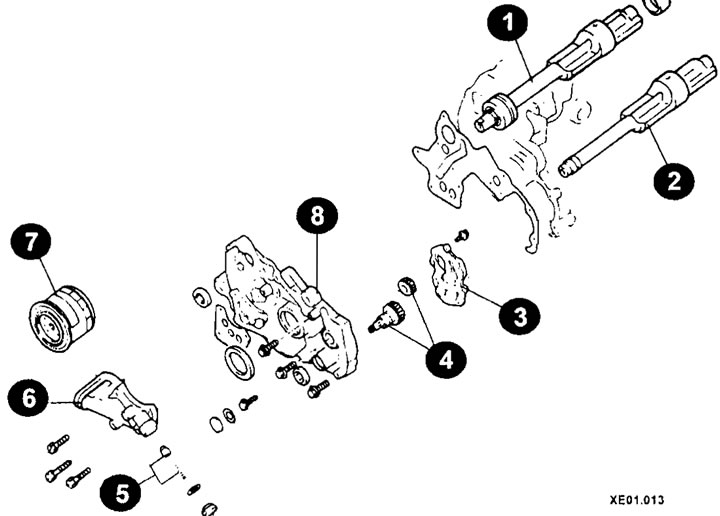
Mounting elements of the oil pump and balance shafts of 1.6 l and 1.8 l engines manufactured since 1993
1 - right balance shaft;
2 - left balance shaft;
3 - oil pump cover;
4 - oil pump gear;
5 - elements of the pressure reducing valve;
6 — oil filter bracket;
7 - oil filter;
8 — front engine cover.
- The 2.0L engine is equipped with a rotary oil pump. It uses an external gear inside an internal gear (these are the two rotors). Due to the special shape and eccentric position of the internal gear, it is achieved that when both gears rotate relative to each other, cavities with vacuum are formed in new places all the time. This way, the engine oil is sucked in. From the rotating gears, the oil is pushed to the outlet of the pump and from there into the lubrication channels. The rotary pump is driven directly by the crankshaft.
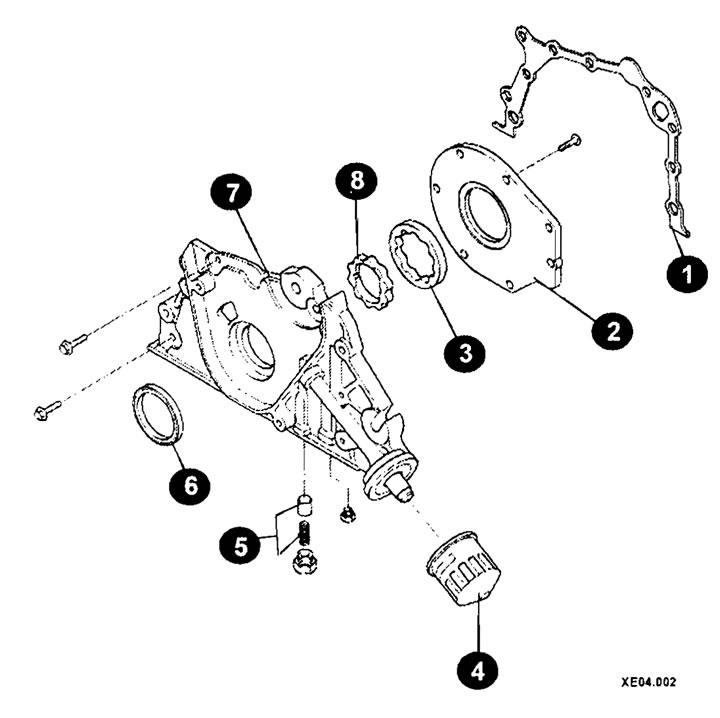
2.0L Engine Oil Pump Components
1 - gasket;
2 - lid;
3 - external gear of the oil pump;
4 - oil filter;
5 - elements of the pressure reducing valve;
6 — oil seal;
7 - front cover (oil pump housing);
8 - internal gear.
Oil temperature
For proper engine operation, oil temperature is important.
Too low oil temperature is harmful to the engine. In this case, the oil does not fully demonstrate its lubricating properties. Therefore, it is not recommended to accelerate the engine above 3500 rpm until the oil temperature reaches 60°C. For cars, it is considered that it takes about twice as long for the oil to reach operating temperature as for the coolant.