
HyundaiBook.ru
Repair Chevrolet Repair Honda Repair Toyota Repair Land Rover Repair VAZ Repair Renault Repair Nissan
English Русский
Български
Беларускі
Український
Српски
Hrvatski
Română
Polski
Slovenský
Magyar
ArticlesSitemapContacts  


  Accent   Elantra   Getz   Grandeur   Sonata   Santa Fe   Tucson   Others
Elantra 1 (1990-1995, petrol) Elantra 2 (1995-2000, petrol) Elantra 3 (2000-2006)
  • Main
  • Elantra
  • J1 (1990-1995)
  • Power unit
  • Minor engine repair
  • Gas distribution mechanism — device

Gas distribution mechanism — device (Hyundai Elantra J1)

0
Contents: Cylinder head and camshaft ⇓ Hydraulic pusher ⇓
It takes a short time for a variable valve internal combustion engine to suck in the fuel mixture and expel the exhaust gases. The camshaft cannot open the valves instantly, nor can the valve springs close them instantly. Therefore, the cams are shaped in such a way that the intake valve opens already at the end of the intake stroke and closes only when the piston, after the end of the intake stroke, rushes upward again for compression. The exhaust valve opens before the end of the working stroke and closes when the working mixture begins to be sucked in during the piston stroke. Both valves open simultaneously for a split second when the piston is at top dead center (TDC) and transitions from the exhaust stroke to the intake stroke. This period of time is called valve overlap.

Cylinder head and camshaft


The cylinder head is, to a certain extent, the engine cover. It contains valves and also has channels for the working mixture and exhaust gases. The head is cast from an aluminum-based alloy and, like the cylinder block, is cooled internally by circulating coolant.

At the very top of the cylinder head are the camshafts. With the help of cams, the valves open and close at certain positions of the piston in the engine cylinder.

The intermediate element between the camshaft and the valves are the rocker arms or tappets. Each tappet or rocker arm is located above a valve and two valve springs. The cams do not touch the tappets exactly in the middle, but slightly offset, causing the valves to rotate slightly around their axis with each downward press. This ensures that the valve is sealed in the cylinder head seat.
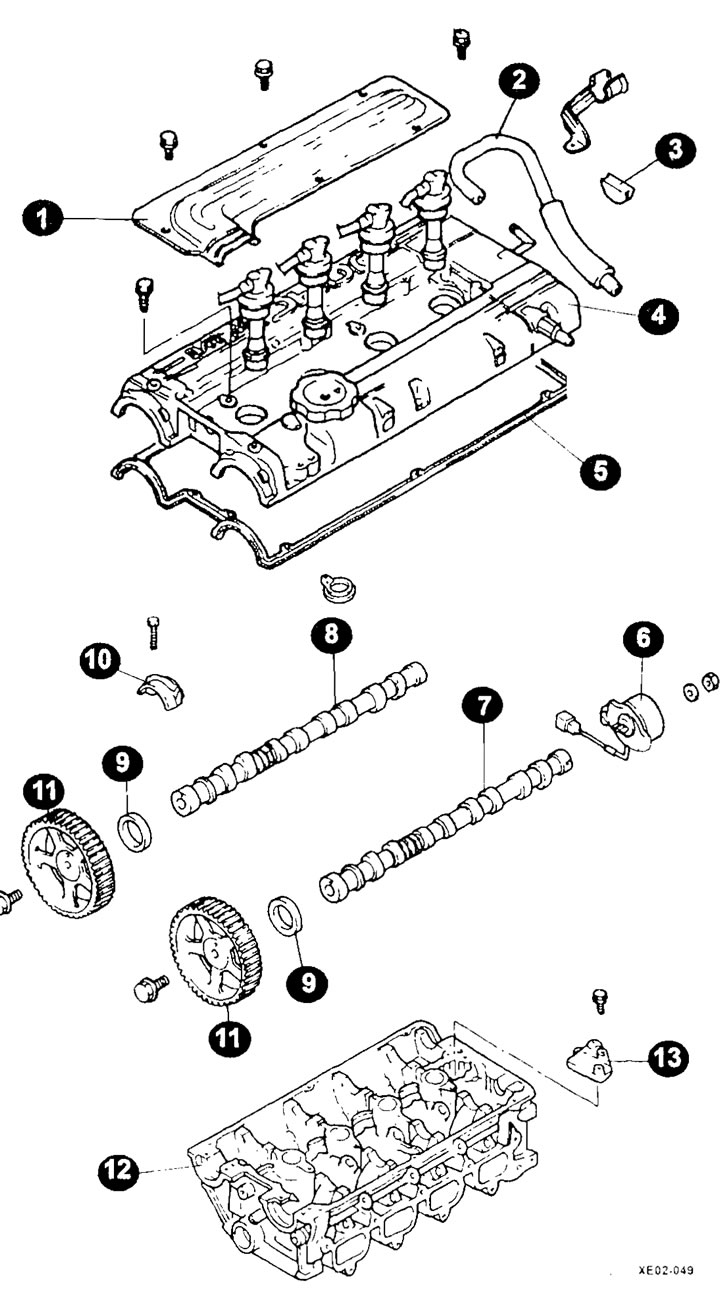


Cylinder head components for 1.6- and…

Cylinder head components for 1.6- and 1.8-liter engines
1 — casing;
2 — hose;
3 - semicircular seal;
4 — cylinder head cover;
5 - gasket;
6 — camshaft angle sensor;
7 — intake camshaft;
8 — exhaust camshaft;
9 — oil seal;
10 — front camshaft bearing cover;
11 — camshaft gear;
12 — cylinder head;
13 — lubrication system channel housing.
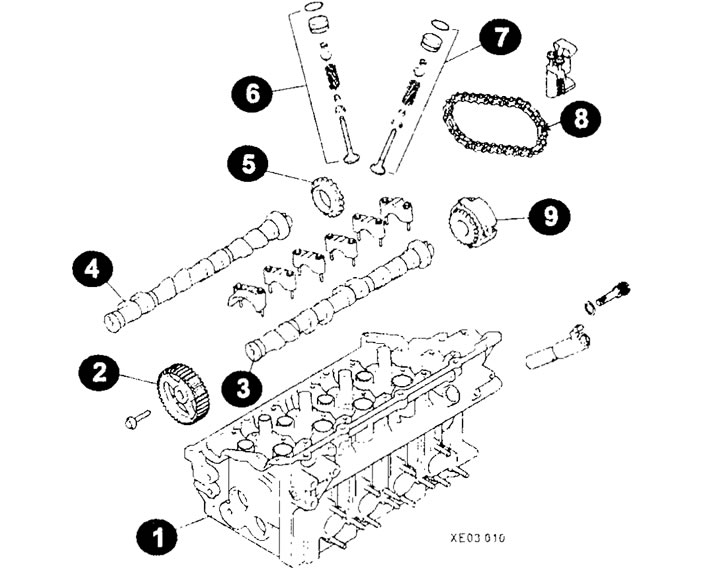

Cylinder head components for 2.0L engine

Cylinder head components for 2.0L engine
1 - cylinder head;
2 - gear wheel;
3 — exhaust camshaft;
4 — intake camshaft;
5 - star;
6 - elements of the intake valve;
7 - exhaust valve elements;
8 — chain;
9 — crankshaft rotation angle sensor.


Hydraulic pusher


With hydraulic valve clearance adjustment, there is no need to monitor these clearances, but it is necessary that the closed valves fit tightly against the valve seats, and at the same time the necessary tightness is ensured.


The article is borrowed from an online resource [HyundaiBook.ru]

Note: Knocking sounds, similar to those caused by damaged bearings, may be produced by an engine with hydraulic tappets when first started after a long period of inactivity. This effect occurs when oil leaks from the hydraulic tappets and this causes a gap in the valve train to form again. But there is no reason to worry: the noise disappears after a while and the valve drive works silently again. If the hydraulic tappet knocks for a long time or even when the engine is warm, it needs to be checked.
This article is available at russian, bulgarian, belarusian, ukrainian, serbian, croatian, romanian, polish, slovak, hungarian
This article has been reviewed by: Konstantin Smirnov
Add to social network:

Previous
Elantra 1: Minor engine repair
Next

Belt/chain drives of the engine — device
General information and technical parameters of engines
Crank mechanism — device
Lubrication system — features of the device
General description of minor repairs
Hydraulic tappets — check
Camshaft drive belt 1.6 l engine 1992 release — removal and installation
We recommend other articles on the topic of Hyundai manuals:

Tensioning the toothed belt (when using the device) Hyundai Accent 1 (1994-1999)
Three-point seat belt with inertia locking mechanism Hyundai Getz (2002-2011)
Adjusting the downshift servo mechanism Hyundai Sonata 3 (1993-1998)
Child restraint device (child seat) Hyundai Santa Fe 2 (2007-2012, petrol)
Gas distribution mechanism drive-device Hyundai Tucson 1 (2005-2010)
Cooling system device Hyundai Matrix (2001-2010, petrol)

Link in different formats to this article

Visitor comments
No comments yet


How much will 32 + 49 ?


Elantra 3 (2000-2006) 
  • User manual
  • Control devices
  • Audio system
  • Starting the engine and driving
  • Faults en route
  • Maintenance and care
  • Technical information
  • Power unit
  • Gasoline engines
  • Diesel engines
  • Lubrication system
  • Cooling system
  • Fuel system (gasoline)
  • Fuel system (diesel)
  • Decreased toxicity
  • Ignition system
  • Transmission
  • Clutch
  • Mechanical gearbox
  • Automatic gearbox
  • Drive shafts and axles
  • Chassis
  • Car suspension
  • Steering
  • Brake system
  • Body
  • Exterior (external elements)
  • Interior (internal elements)
  • Air conditioning system
  • Electrical equipment
  • Equipment and devices
  • Headlights and lighting
  • Power devices
  • Electrical circuits
Elantra 2 (1995-2000, petrol) 
  • General information
  • Maintenance
  • Power unit
  • Engine repair
  • Cooling system
  • Intake and exhaust system
  • Fuel system
  • Transmission
  • Clutch
  • Manual gearbox
  • Automatic gearbox
  • Drive shafts and axles
  • Chassis
  • Front suspension
  • Rear suspension
  • Steering
  • Brake system
  • Body
  • Body elements
  • Electrical equipment
  • Equipment and devices
  • Electrical diagrams
Elantra 1 (1990-1995, petrol) 
  • General information
  • Introduction to the guide
  • Maintenance
  • Power unit
  • Minor engine repair
  • Engine overhaul
  • Lubrication system
  • Cooling system
  • Fuel injection system
  • Ignition system
  • Exhaust system
  • Transmission
  • Clutch
  • Manual gearbox
  • Automatic gearbox
  • Drive shafts
  • Chassis
  • Front suspension
  • Rear suspension
  • Steering
  • Wheels and tires
  • Troubleshooting
  • Brake system
  • Body
  • Body elements
  • Electrical equipment
  • Equipment and devices
  • Power devices
  • Heating and air conditioning
  • Electrical circuits
HyundaiBook.ru © 2018-2026 · Mobile version · Sitemap: EN BG BY UA RS HR RO PL SK HU · Administration · Site search · Hyundai owners Accent 1 · Accent 2 · Accent 3 · Elantra 1 · Elantra 2 · Elantra 3 · Getz · Sonata 3 · Sonata 4 · Santa Fe 2 · Tucson 1 · Tucson 2 · Matrix ·
This site uses cookies to optimize its functionality. By continuing, you agree to our terms.