HyundaiBook.ru
Repair Chevrolet Repair Honda Repair Toyota Repair Land Rover Repair VAZ Repair Renault Repair Nissan
English Русский
Български
Беларускі
Український
Српски
Hrvatski
Română
Polski
Slovenský
Magyar
ArticlesSitemapContacts  


  Accent   Elantra   Getz   Grandeur   Sonata   Santa Fe   Tucson   Others
Elantra 1 (1990-1995, petrol) Elantra 2 (1995-2000, petrol) Elantra 3 (2000-2006)
  • Main
  • Elantra
  • J1 (1990-1995)
  • Power unit
  • Minor engine repair
  • Camshaft drive belt 1.6 l engine 1992 release — removal and installation

Camshaft drive belt 1.6 l engine 1992 release — removal and installation (Hyundai Elantra J1)

0
Contents: Examination ⇓ Installation ⇓
Disconnect the ground cable from the battery.

Remove the alternator and power steering belts.

By loosening bolt (1) and rotating bolt (2), loosen the tension of the air conditioner compressor belt tensioner.
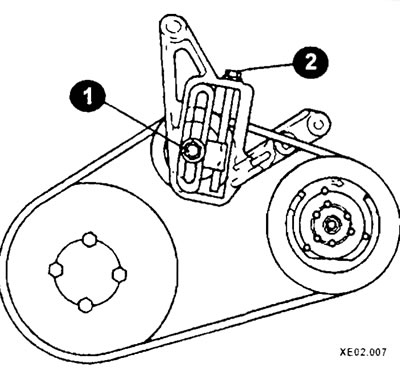
By loosening bolt (1) and rotating bolt (2), loosen the tension of the air…


Remove the tensioner and belt.

Remove the water pump and power steering pulleys.

Remove the crankshaft pulley.

Remove the upper and lower camshaft drive belt covers.

Label and disconnect the spark plug wires.

Remove the cylinder block cover and its gasket.
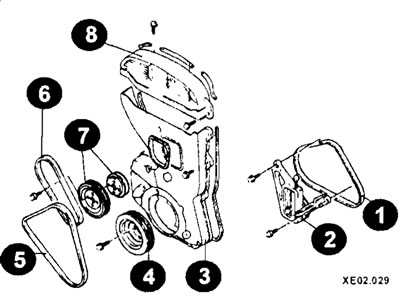
Front elements of the 1.6L engine

Front elements of the 1.6L engine
1 - air conditioning compressor drive belt;
2 - tensioning device;
3 - bottom cover;
4 — crankshaft pulley;
5 — alternator drive belt;
6 — coolant pump drive belt;
7 — coolant pump pulley;
8 — top cover.


Turn the crankshaft clockwise until all marks are aligned. The marks on the camshaft gears must be aligned with the top surface of the cylinder head, and the keys in the center of the camshaft gears must be facing upward. In this case, the piston of the 1st cylinder will be at TDC of the compression stroke.
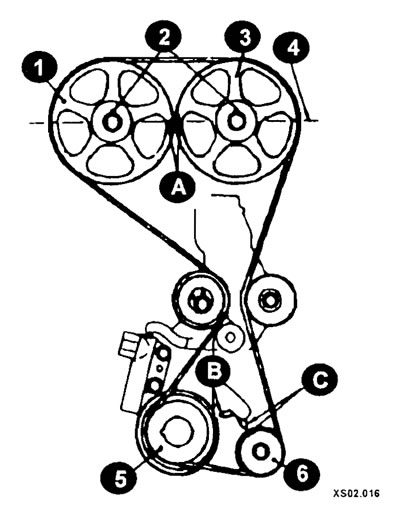


Timing Belt Alignment Marks

Timing Belt Alignment Marks
A, B, C - installation marks;
1 - exhaust camshaft gear;
2 - keys;
3 - intake camshaft gear;
4 — cylinder head;
5 - crankshaft gear;
6 - oil pump gear.


Remove the tensioner.

Remove the timing belt.

Caution: If this belt is to be reinstalled, it must be marked with an arrow indicating the direction of rotation.
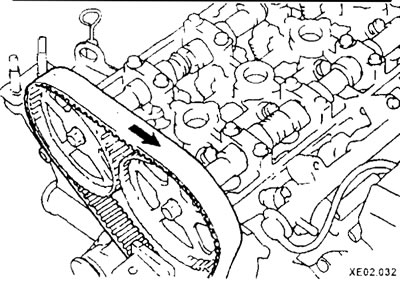

Caution: If this belt is to be reinstalled, it must be marked with an arrow…


Remove the tensioner pulley.

Examination


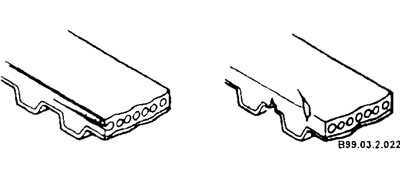
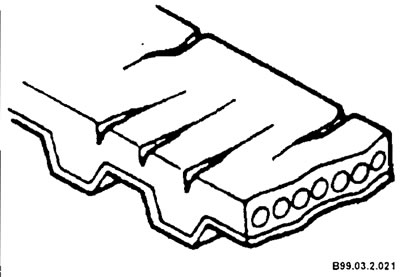
Visually inspect the condition of the timing belt. If any of the following defects are found, replace the belt.
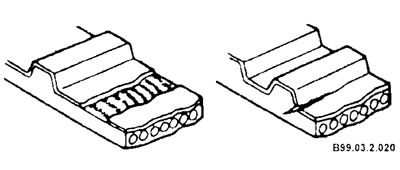
The teeth are broken or cracked at the base

The teeth are broken or cracked at the base

Possible causes of defects:
  • camshaft or distributor seizure;
  • the crankshaft and/or camshaft seals are damaged.

The back side of the belt is badly worn or has cracks

The back side of the belt is badly worn or has cracks

Possible causes of defects:
  • tension roller jamming;
  • engine overheating;
  • the belt is catching on the cover.


The side surface of the belt is worn out. The edges of the belt are rounded,…

The side surface of the belt is worn out. The edges of the belt are rounded, the cord threads are frayed and protrude outward

Possible causes of defects:
  • incorrect belt installation;
  • the side surfaces of the tension roller are nicked or heavily worn.
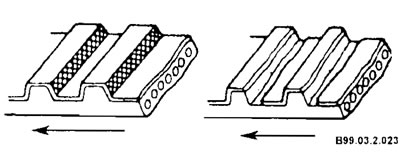

Wear of teeth. The outer coating on the thrust surface of the teeth is worn…

Wear of teeth. The outer coating on the thrust surface of the teeth is worn off, the rubber layer underneath is worn and has a whitish color

Possible causes of defects:
  • poor belt cover seal;
  • water pump leak;
  • camshaft malfunction;
  • distributor malfunction;
  • excessive belt tension.


Oil, coolant or water getting on the belt

Oil, coolant or water getting on the belt

Possible causes of defects:
  • poor sealing in the oil seals;
  • water pump leak;
  • poor sealing of the belt cover.


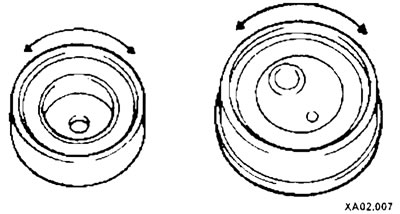
Check the tensioner and idler pulleys for wear and damage


Check the wear of the gears and tensioner. The teeth of the wheel must have a clear profile, must not be rounded, and the gullies between the teeth must be clean.

Inspect the tensioner for wear and damage. Carefully inspect the push rod tip for signs of wear.
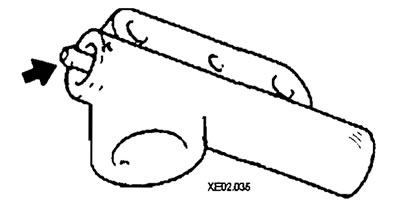
Inspect the tensioner for wear and damage. Carefully inspect the push rod tip…


Measure the length of the pushrod projection. It should be 12 mm. If this parameter does not match, replace the tensioner.
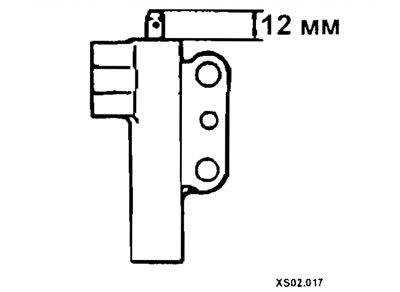
Measure the length of the pushrod projection. It should be 12 mm. If this…


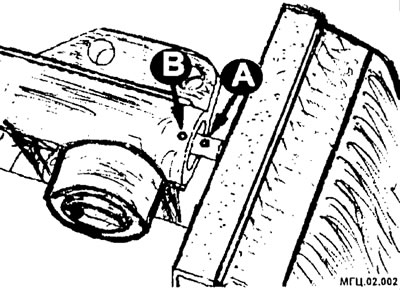
Before installing the timing belt, it is necessary to press the pusher into the tensioner so that the holes (A) and (B) coincide, and insert the process wire.

Before installing the timing belt, it is necessary to press the pusher into the…


Installation


Installation is carried out in the reverse order, taking into account the following: • Correctly install the gear wheels (1, 2) and flange (3) of the crankshaft (4).
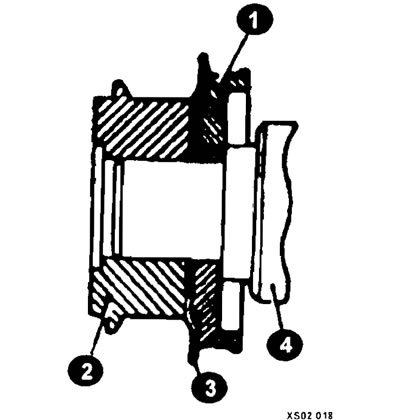
Installation is carried out in the reverse order, taking into account the…


Adjust the position of the tension roller, while the holes for the pins (1) should be to the left of the bolt (2), and the roller bracket should rest against the tensioner (3).
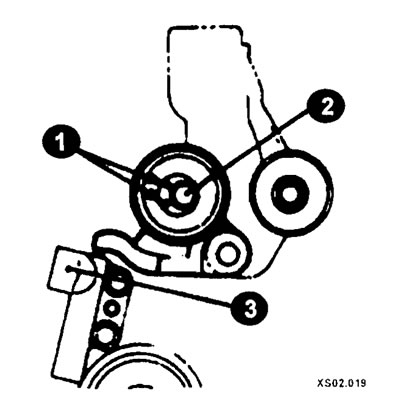
Adjust the position of the tension roller, while the holes for the pins (1)…


Turn the inlet (I) and outlet (II) valve gears so that their keys (1) and (2) face upward. Then align the alignment marks (A).
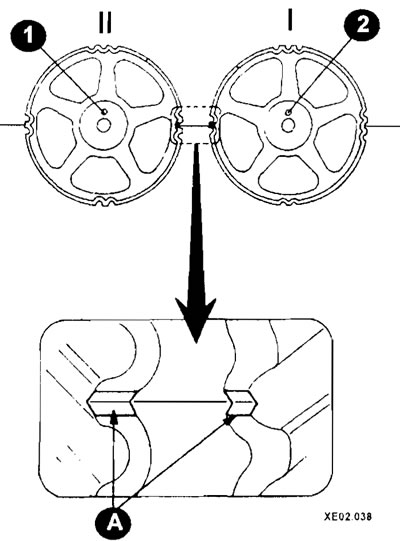
Turn the inlet (I) and outlet (II) valve gears so that their keys (1) and (2)…


Caution: Do not mix up the gear wheels, as marks (1) and (2) are offset from the key.
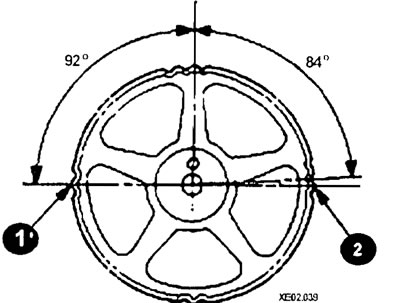


Caution: Do not mix up the gear wheels, as marks (1) and (2) are offset from…


Install the crankshaft and oil pump gears so that the timing marks (B) and (C) are positioned as shown in the figure.
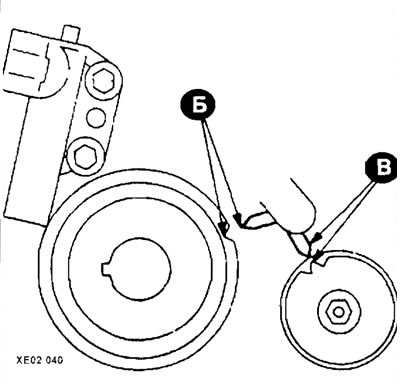
Install the crankshaft and oil pump gears so that the timing marks (B) and (C)…


The toothed belt is put on in the following sequence:
  • crankshaft gear;
  • tensioner;
  • oil pump gear;
  • idler pulley;
  • intake valve camshaft gear;
  • exhaust valve camshaft gear (before installing, it is necessary to turn this gear wheel one tooth clockwise until the installation mark on the cylinder head is aligned).
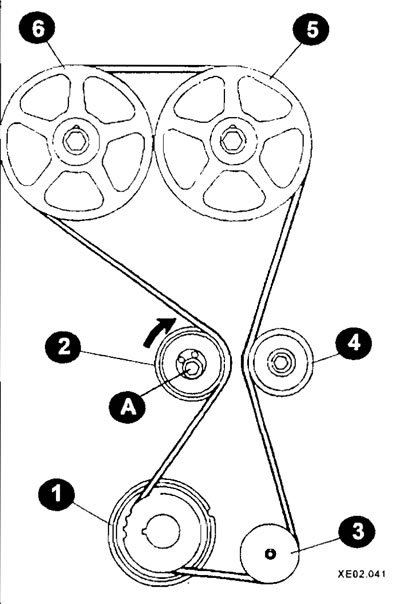
Timing Belt Installation Sequence

Timing Belt Installation Sequence


Turn the tensioner (2) in the direction of the arrow to slightly tighten the belt and tighten the central bolt (A).


Turn the crankshaft first 1/4 turn counterclockwise, then in the opposite direction until all timing marks are aligned (TDC).

After removing the plug from the rear cover of the timing belt, screw the special device into the hole until it stops against the tensioner bracket.
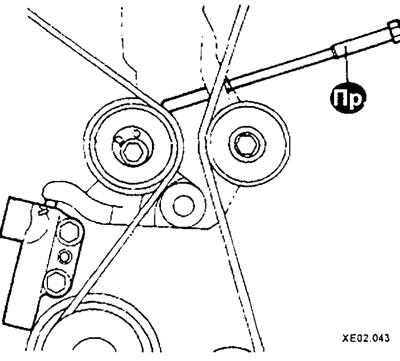
After removing the plug from the rear cover of the timing belt, screw the…


After loosening the central bolt of the tensioner, tighten the toothed belt.

While holding the tensioner pulley with a fixture and torque wrench, tighten the center bolt to the specified torque.
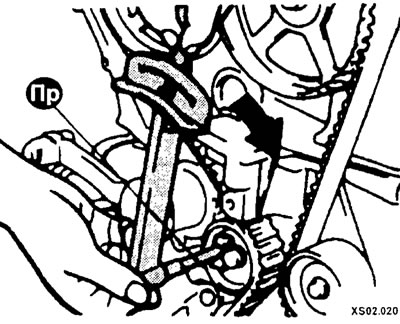
While holding the tensioner pulley with a fixture and torque wrench, tighten…


Screw the tool in until it contacts the tensioner bracket.
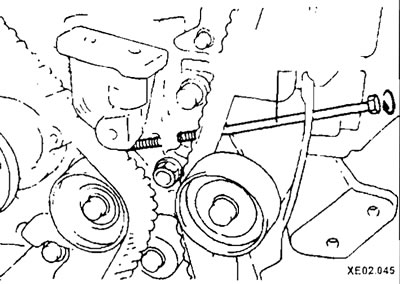
Screw the tool in until it contacts the tensioner bracket.


After this, turn the device another 2.5-3 turns. In this case, the tensioning device pusher should sink to the required value (4±0.5 mm).
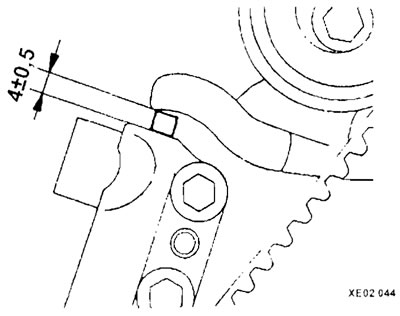


After this, turn the device another 2.5-3 turns. In this case, the tensioning…


Insert the plug (1) into the hole in the rear timing belt cover.
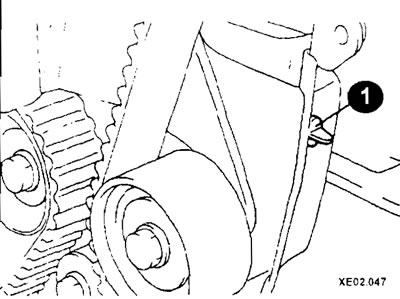
Insert the plug (1) into the hole in the rear timing belt cover.


Install the timing belt covers and tighten the mounting bolts. Do not mix up the cover mounting bolts - they are of different lengths (the length of the bolts is shown in the figure).
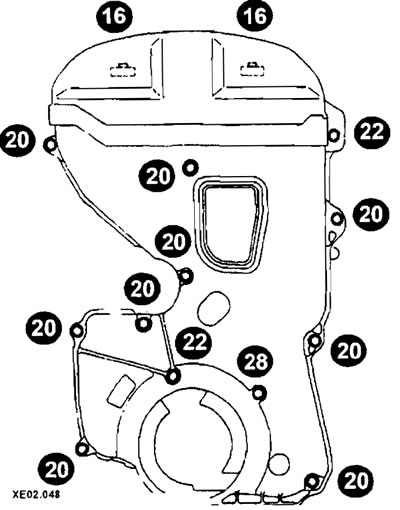
Install the timing belt covers and tighten the mounting bolts. Do not mix up…
This article is available at russian, bulgarian, belarusian, ukrainian, serbian, croatian, romanian, polish, slovak, hungarian
This article has been reviewed by: Konstantin Smirnov
Add to social network:

Previous
Elantra 1: Minor engine repair
Next

Hydraulic tappets — check
General description of minor repairs
Lubrication system — features of the device
Crank mechanism — device
Gas distribution mechanism — device
Camshaft drive belt and balance shaft drive belt for 1.6 and 1.8 L engines — removal and installation
2.0L Engine Timing Belt — Checking Tension/Adjusting
Timing Belt 2.0 Liter Engine — Replacement
Cylinder head — replacement and installation of gasket (all engines)
Replacing the cylinder head gasket in 1.6L and 1.8L engines
We recommend other articles on the topic of Hyundai manuals:

Checking and adjusting the drive belt tension Hyundai Accent 1 (1994-1999)
Checking the tension of the power steering pump drive belt Hyundai Getz (2002-2011)
Single Camshaft Engine — Specifications, Faults Hyundai Sonata 3 (1993-1998)
Adjusting the power steering and air conditioning pump drive belt Hyundai Santa Fe 2 (2007-2012, petrol)
Adjusting the drive belt tension Hyundai Tucson 1 (2005-2010)
Table 8.3. Compressor drive belt tension Hyundai Matrix (2001-2010, petrol)

Link in different formats to this article

Visitor comments
No comments yet


How much will 25 + 10 ?


Elantra 3 (2000-2006) 
  • User manual
  • Control devices
  • Audio system
  • Starting the engine and driving
  • Faults en route
  • Maintenance and care
  • Technical information
  • Power unit
  • Gasoline engines
  • Diesel engines
  • Lubrication system
  • Cooling system
  • Fuel system (gasoline)
  • Fuel system (diesel)
  • Decreased toxicity
  • Ignition system
  • Transmission
  • Clutch
  • Mechanical gearbox
  • Automatic gearbox
  • Drive shafts and axles
  • Chassis
  • Car suspension
  • Steering
  • Brake system
  • Body
  • Exterior (external elements)
  • Interior (internal elements)
  • Air conditioning system
  • Electrical equipment
  • Equipment and devices
  • Headlights and lighting
  • Power devices
  • Electrical circuits
Elantra 2 (1995-2000, petrol) 
  • General information
  • Maintenance
  • Power unit
  • Engine repair
  • Cooling system
  • Intake and exhaust system
  • Fuel system
  • Transmission
  • Clutch
  • Manual gearbox
  • Automatic gearbox
  • Drive shafts and axles
  • Chassis
  • Front suspension
  • Rear suspension
  • Steering
  • Brake system
  • Body
  • Body elements
  • Electrical equipment
  • Equipment and devices
  • Electrical diagrams
Elantra 1 (1990-1995, petrol) 
  • General information
  • Introduction to the guide
  • Maintenance
  • Power unit
  • Minor engine repair
  • Engine overhaul
  • Lubrication system
  • Cooling system
  • Fuel injection system
  • Ignition system
  • Exhaust system
  • Transmission
  • Clutch
  • Manual gearbox
  • Automatic gearbox
  • Drive shafts
  • Chassis
  • Front suspension
  • Rear suspension
  • Steering
  • Wheels and tires
  • Troubleshooting
  • Brake system
  • Body
  • Body elements
  • Electrical equipment
  • Equipment and devices
  • Power devices
  • Heating and air conditioning
  • Electrical circuits
HyundaiBook.ru © 2018-2026 · Mobile version · Sitemap: EN BG BY UA RS HR RO PL SK HU · Administration · Site search · Hyundai owners Accent 1 · Accent 2 · Accent 3 · Elantra 1 · Elantra 2 · Elantra 3 · Getz · Sonata 3 · Sonata 4 · Santa Fe 2 · Tucson 1 · Tucson 2 · Matrix ·
This site uses cookies to optimize its functionality. By continuing, you agree to our terms.