
HyundaiBook.ru
Repair Chevrolet Repair Honda Repair Toyota Repair Land Rover Repair VAZ Repair Renault Repair Nissan
English Русский
Български
Беларускі
Український
Српски
Hrvatski
Română
Polski
Slovenský
Magyar
ArticlesSitemapContacts  


  Accent   Elantra   Getz   Grandeur   Sonata   Santa Fe   Tucson   Others
Elantra 1 (1990-1995, petrol) Elantra 2 (1995-2000, petrol) Elantra 3 (2000-2006)
  • Main
  • Elantra
  • J1 (1990-1995)
  • Power unit
  • Minor engine repair
  • General description of minor repairs

General description of minor repairs (Hyundai Elantra J1)

0
Caution: This section describes some maintenance procedures and engine repairs that can be performed without removing the engine from the vehicle.


Wash the engine compartment and the outside of the engine with a suitable degreaser before performing any operations. This will make the job easier and help prevent dirt from getting into the engine's internal cavities.

Depending on what components you intend to remove/repair, it may be helpful to remove the hood to allow easier access to the engine as repairs are made. Cover the wings with something to avoid damaging the painted surfaces. There are special covers available, but old bedspreads or blankets can work just fine for this purpose.
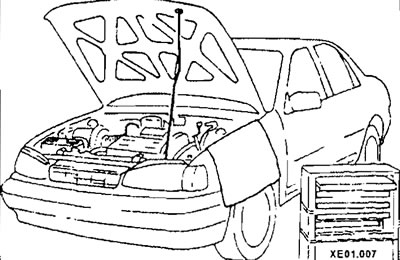
Depending on what components you intend…


When leaks occur in the vacuum, exhaust, oil or cooling systems that require replacement of gaskets or seals, most of the required work can be performed on the engine while it is in the vehicle. The intake and exhaust manifold gaskets, crankcase gasket, camshaft seals and cylinder head gasket are relatively easily accessible without removing the engine.

External engine components such as the intake and exhaust manifolds, crankcase, water pump, oil pump, starter, alternator and fuel system components can be removed for repairs without removing the engine from the vehicle.


Since the cylinder head can be removed without removing the entire engine, camshaft and valve train maintenance can be performed without removing the engine. The camshaft drive belt can also be replaced.

In emergency situations caused by a lack of necessary equipment, repair or replacement of piston rings, pistons, connecting rods and bearings can be performed without removing the engine from the vehicle. In this case, you will need a lift or overpass. To remove the above elements, it is necessary to remove the oil pan.
This article is available at russian, bulgarian, belarusian, ukrainian, serbian, croatian, romanian, polish, slovak, hungarian
This article has been reviewed by: Konstantin Smirnov
Add to social network:

Previous
Elantra 1: Minor engine repair
Next

Lubrication system — features of the device
Crank mechanism — device
Gas distribution mechanism — device
Belt/chain drives of the engine — device
General information and technical parameters of engines
Hydraulic tappets — check
Camshaft drive belt 1.6 l engine 1992 release — removal and installation
Camshaft drive belt and balance shaft drive belt for 1.6 and 1.8 L engines — removal and installation
2.0L Engine Timing Belt — Checking Tension/Adjusting
Timing Belt 2.0 Liter Engine — Replacement
We recommend other articles on the topic of Hyundai manuals:

General information and malfunctions of the exhaust gas cleaning… Hyundai Accent 1 (1994-1999)
General information about the brake system Hyundai Getz (2002-2011)
General information — technical specifications Hyundai Sonata 3 (1993-1998)
Dimensions and general appearance of the car Hyundai Santa Fe 2 (2007-2012, petrol)
Keys — General Information Hyundai Tucson 1 (2005-2010)
General information about the lubrication system Hyundai Matrix (2001-2010, petrol)

Link in different formats to this article

Visitor comments
No comments yet


How much will 14 + 17 ?


Elantra 3 (2000-2006) 
  • User manual
  • Control devices
  • Audio system
  • Starting the engine and driving
  • Faults en route
  • Maintenance and care
  • Technical information
  • Power unit
  • Gasoline engines
  • Diesel engines
  • Lubrication system
  • Cooling system
  • Fuel system (gasoline)
  • Fuel system (diesel)
  • Decreased toxicity
  • Ignition system
  • Transmission
  • Clutch
  • Mechanical gearbox
  • Automatic gearbox
  • Drive shafts and axles
  • Chassis
  • Car suspension
  • Steering
  • Brake system
  • Body
  • Exterior (external elements)
  • Interior (internal elements)
  • Air conditioning system
  • Electrical equipment
  • Equipment and devices
  • Headlights and lighting
  • Power devices
  • Electrical circuits
Elantra 2 (1995-2000, petrol) 
  • General information
  • Maintenance
  • Power unit
  • Engine repair
  • Cooling system
  • Intake and exhaust system
  • Fuel system
  • Transmission
  • Clutch
  • Manual gearbox
  • Automatic gearbox
  • Drive shafts and axles
  • Chassis
  • Front suspension
  • Rear suspension
  • Steering
  • Brake system
  • Body
  • Body elements
  • Electrical equipment
  • Equipment and devices
  • Electrical diagrams
Elantra 1 (1990-1995, petrol) 
  • General information
  • Introduction to the guide
  • Maintenance
  • Power unit
  • Minor engine repair
  • Engine overhaul
  • Lubrication system
  • Cooling system
  • Fuel injection system
  • Ignition system
  • Exhaust system
  • Transmission
  • Clutch
  • Manual gearbox
  • Automatic gearbox
  • Drive shafts
  • Chassis
  • Front suspension
  • Rear suspension
  • Steering
  • Wheels and tires
  • Troubleshooting
  • Brake system
  • Body
  • Body elements
  • Electrical equipment
  • Equipment and devices
  • Power devices
  • Heating and air conditioning
  • Electrical circuits
HyundaiBook.ru © 2018-2026 · Mobile version · Sitemap: EN BG BY UA RS HR RO PL SK HU · Administration · Site search · Hyundai owners Accent 1 · Accent 2 · Accent 3 · Elantra 1 · Elantra 2 · Elantra 3 · Getz · Sonata 3 · Sonata 4 · Santa Fe 2 · Tucson 1 · Tucson 2 · Matrix ·
This site uses cookies to optimize its functionality. By continuing, you agree to our terms.