


Contents: Checking the technical condition ⇓ Assembly ⇓
Hyundai engines are equipped with a circulation cooling system. A centrifugal pump is used to circulate the coolant. The engine cooling system consists of a cooling jacket, a radiator with an electric fan, a centrifugal water pump, a thermostat and hoses. The cooling system works with a separate expansion tank.
The coolant circuit is thermostatically controlled. When the engine is cold, the coolant circulates only in the cylinder head, as well as in the cylinder block and heat exchanger. As the engine warms up, the thermostat opens the large circuit of the cooling system. The coolant is supplied by a constantly running pump through the radiator of the cooling system. The coolant passes through the radiator from top to bottom and is cooled by the air passing between the radiator fins.
When the coolant temperature is in the range between +92...+97°C, the thermal switch turns on the radiator electric fan. The electric fan is driven by an electric motor and operates until the coolant temperature drops below +84...+91°C.
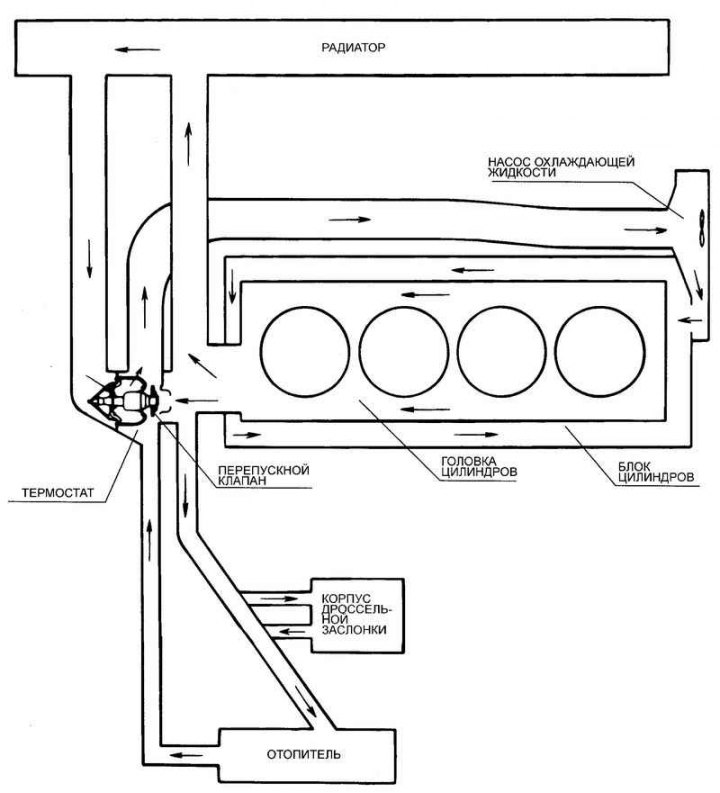
Fig. 2.171. Cooling system diagram
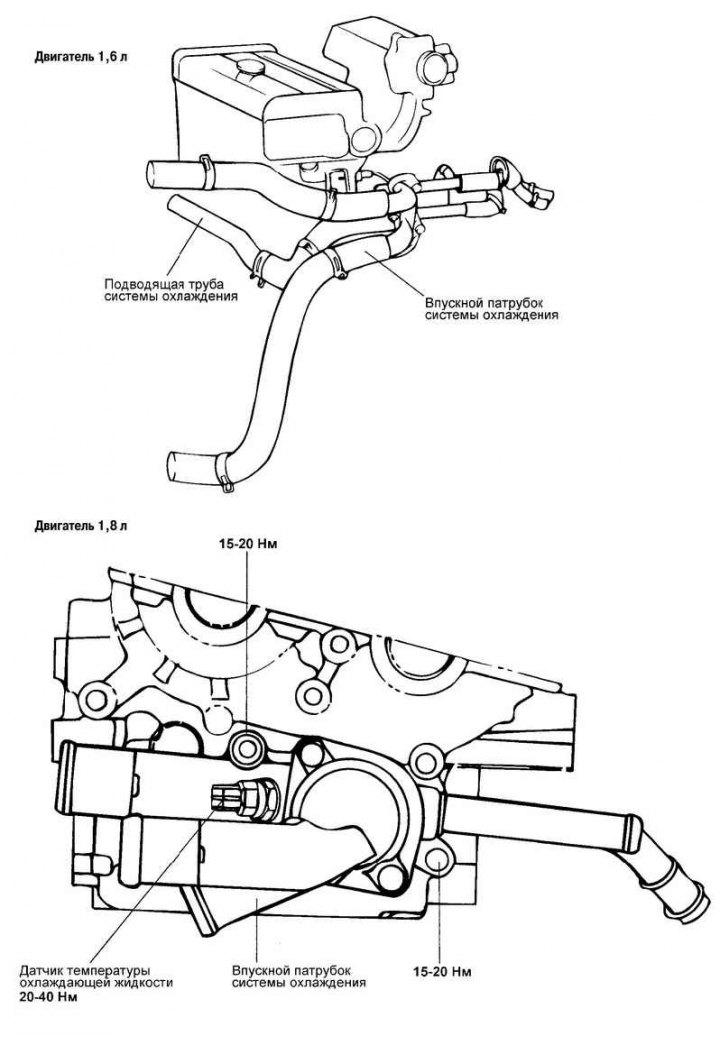
Fig. 2.172. Cooling system components
Warning! The radiator electric fan may turn on even when the ignition is off. Due to the heat in the engine compartment, this may happen several times.
Thanks to the fan not running constantly, the useful engine power increases and fuel consumption decreases.
The housingless thermostat of the cooling system has a solid temperature-sensitive filler.
The radiator of the cooling system is tubular-plate, aluminum, with plastic tanks. The cooling liquid is poured into the system through the filler neck of the expansion tank, the plug of which has inlet and outlet valves.
Checking the technical condition
Check the cooling system pipes and hoses for cracks, damage and reduced flow area.
Replace defective parts if necessary.
Assembly
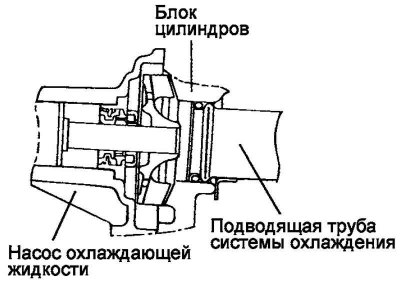
Fig. 2.173. Scheme of installation of the supply pipeline
Insert the sealing ring into the groove at the end of the supply pipe, moisten the sealing ring with coolant and connect the supply pipe to the cylinder block (Fig. 2.173).
Make sure there is a yellow mark on the supply hose and connect the end of the hose with the yellow mark to the end of the supply pipe with the yellow mark.
Note: Do not apply oil or grease to the sealing ring of the supply pipe.
Note: The supply pipe must be inserted into the socket in the cylinder block until it stops.
Note: Removed sealing rings are not reusable and must be replaced with new ones.