HyundaiBook.ru
Repair Chevrolet Repair Honda Repair Toyota Repair Land Rover Repair VAZ Repair Renault Repair Nissan
English Русский
Български
Беларускі
Український
Српски
Hrvatski
Română
Polski
Slovenský
Magyar
ArticlesSitemapContacts  


  Accent   Elantra   Getz   Grandeur   Sonata   Santa Fe   Tucson   Others
Elantra 1 (1990-1995, petrol) Elantra 2 (1995-2000, petrol) Elantra 3 (2000-2006)
  • Main
  • Elantra
  • J1 (1990-1995)
  • Chassis
  • Brake system
  • Bleeding the brake system

Bleeding the brake system (Hyundai Elantra J1)

0
Bleeding the brake system is required if the piping system has been opened or air has entered the system in some other way. The presence of air is manifested by the softness of the brake pedal when it is pressed.

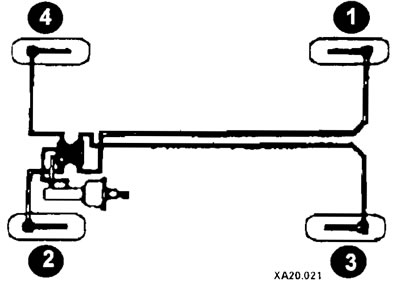
To bleed the entire system, bleed each wheel brake separately in the following sequence:
  • 1. Rear right.
  • 2. Front left.
  • 3. Rear left.
  • 4. Front right.

Sequence of bleeding the brake system

Sequence of bleeding the brake system


If only one caliper or wheel cylinder was replaced or repaired, it is sufficient to bleed the corresponding brake cylinder.

Before removing air, add brake fluid to the MAX mark in the reservoir.
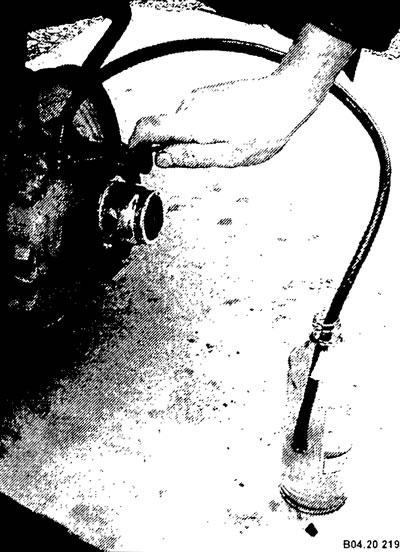
Before removing air, add brake fluid to…


Remove the cap from the brake cylinder bleeder nipple and connect a clean transparent hose, the other end of which is lowered into a bottle half filled with brake fluid. Place the bottle at least 30 cm above the air release valve.


Have the assistant press the brake pedal until pressure builds up in the brake system.

When the pressure is reached, keep the pedal pressed.

Open the brake caliper bleed nipple half a turn with a key. The brake fluid will drain into the container.

When the fluid pressure drops, close the nipple immediately.

Repeat the above steps again.

Continue the air removal process until no more air bubbles are released from the liquid flowing into the container.

After removing the air, tighten the nipple with a force of about 10 Nm.

Remove the hose and place the cap on the fitting.

Also remove air from the cylinders of the remaining wheels, following the sequence of actions.

After removing the air, fill the tank again to the MAX mark and close it with the lid.

Attention: During pumping (air removal), always monitor the fluid level in the brake reservoir.
This article is available at russian, bulgarian, belarusian, ukrainian, serbian, croatian, romanian, polish, slovak, hungarian
This article has been reviewed by: Konstantin Smirnov
Add to social network:

Previous
Elantra 1: Brake system
Next

Wheel brake cylinder — disassembly and assembly
Rear Brake Cylinders — Removal and Installation
Rear wheel drum brake shoes — removal and installation
Rear drum brakes
Rear Disc Brake Caliper — Disassembly and Assembly
Adjusting the brake light switch, brake pedal height
Parking brake — adjustment
Brake Master Cylinder/Vacuum Booster — Removal and Installation
Master Brake Cylinder — Disassembly and Assembly
Inspection and replacement of hydraulic tubes and hoses
We recommend other articles on the topic of Hyundai manuals:

Bleeding the brake system Hyundai Accent 1 (1994-1999)
Bleeding the hydraulic brake drive system Hyundai Getz (2002-2011)
Bleeding the brake system Hyundai Sonata 3 (1993-1998)
Bleeding the brake hydraulic system Hyundai Santa Fe 2 (2007-2012, petrol)
Bleeding the power steering system Hyundai Tucson 1 (2005-2010)
Bleeding the brake hydraulic system Hyundai Matrix (2001-2010, petrol)

Link in different formats to this article

Visitor comments
No comments yet


How much will 16 + 27 ?


Elantra 3 (2000-2006) 
  • User manual
  • Control devices
  • Audio system
  • Starting the engine and driving
  • Faults en route
  • Maintenance and care
  • Technical information
  • Power unit
  • Gasoline engines
  • Diesel engines
  • Lubrication system
  • Cooling system
  • Fuel system (gasoline)
  • Fuel system (diesel)
  • Decreased toxicity
  • Ignition system
  • Transmission
  • Clutch
  • Mechanical gearbox
  • Automatic gearbox
  • Drive shafts and axles
  • Chassis
  • Car suspension
  • Steering
  • Brake system
  • Body
  • Exterior (external elements)
  • Interior (internal elements)
  • Air conditioning system
  • Electrical equipment
  • Equipment and devices
  • Headlights and lighting
  • Power devices
  • Electrical circuits
Elantra 2 (1995-2000, petrol) 
  • General information
  • Maintenance
  • Power unit
  • Engine repair
  • Cooling system
  • Intake and exhaust system
  • Fuel system
  • Transmission
  • Clutch
  • Manual gearbox
  • Automatic gearbox
  • Drive shafts and axles
  • Chassis
  • Front suspension
  • Rear suspension
  • Steering
  • Brake system
  • Body
  • Body elements
  • Electrical equipment
  • Equipment and devices
  • Electrical diagrams
Elantra 1 (1990-1995, petrol) 
  • General information
  • Introduction to the guide
  • Maintenance
  • Power unit
  • Minor engine repair
  • Engine overhaul
  • Lubrication system
  • Cooling system
  • Fuel injection system
  • Ignition system
  • Exhaust system
  • Transmission
  • Clutch
  • Manual gearbox
  • Automatic gearbox
  • Drive shafts
  • Chassis
  • Front suspension
  • Rear suspension
  • Steering
  • Wheels and tires
  • Troubleshooting
  • Brake system
  • Body
  • Body elements
  • Electrical equipment
  • Equipment and devices
  • Power devices
  • Heating and air conditioning
  • Electrical circuits
HyundaiBook.ru © 2018-2026 · Mobile version · Sitemap: EN BG BY UA RS HR RO PL SK HU · Administration · Site search · Hyundai owners Accent 1 · Accent 2 · Accent 3 · Elantra 1 · Elantra 2 · Elantra 3 · Getz · Sonata 3 · Sonata 4 · Santa Fe 2 · Tucson 1 · Tucson 2 · Matrix ·
This site uses cookies to optimize its functionality. By continuing, you agree to our terms.