


Apply the parking brake and loosen the self-locking nut slightly.
Mark the position of the wheel rim on the wheel hub with paint.
Place the rear of the vehicle on jack stands.
Remove the wheel.
Release the parking brake.
Unscrew the nut and remove the brake drum with the outer wheel bearing.
Mark the mounting position of the return springs.
Disconnect the return springs using a suitable tool. The spring may be under high tension.
Remove the installation lever and installation element.
Rotate the spring retaining cup 90° by squeezing it firmly with pliers.
Remove the front brake shoe, first disconnecting the lower spring from it.
Disconnect the parking brake cable from the handbrake lever by pushing the rear brake shoe down.
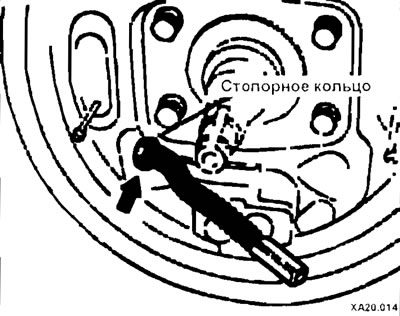
To remove the parking brake cable, compress the spring and remove the retaining ring, then disconnect the cable from the brake shield.
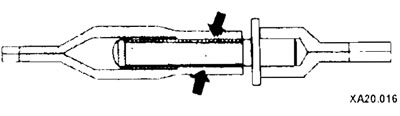
Remove the dust boot from the wheel brake cylinder. If there is moisture behind the dust boot, replace the wheel brake cylinder.
Install the dust boot onto the working brake cylinder.
Installation
Before installation:
Clean the brake drum and brake caliper with alcohol. Replace the brake cylinder that is wet with brake fluid. Ream brake drums that have scratches and grooves.
Transfer the parking brake lever from the old to the new brake shoe by releasing the lock washer and removing the thrust washer.

Measure the brake drum diameter in at least 2 places. Replace the left and right brake drums and brake shoes when they reach the wear limit or when they wear unevenly.
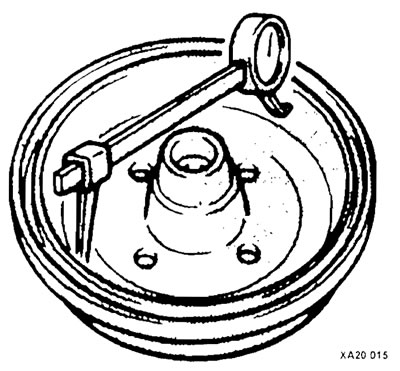
Check the compatibility of the brake drum and brake shoes by applying a layer of chalk to the inside surface of the brake drum and rubbing it with a brake shoe (see fig MCG 20.003).
Coat the contact areas between the brake pads and the brake shield, the brake pads and the retaining pins, and the rear surface of the piston with a thin layer of heat-reducing grease, after cleaning them thoroughly.
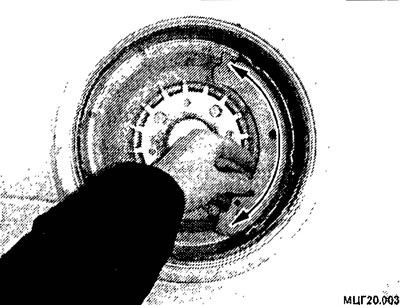
Also lightly lubricate the threads and contact points of the mounting element.
Place the parking brake lever and install the thrust washer, then the lock washer.
Apply high temperature grease to the threaded part and the inner surface of the coupling.
To do this, tighten the spring with pliers and insert the retaining ring, and connect the parking brake cable to the brake shield guide.
Connect the parking brake cable to the lever.
Install the brake shoe and secure it with the retaining pins, cups and springs. At the same time, fix the spring cup by turning it 90°.
Install the return springs into the brake shoes using brake spring pliers.
Check the operation of the automatic setting device: when the parking brake lever is moved forward and backward on the rear brake shoe, the setting screw should turn. If it does not turn, repeat the installation.
Turn the setting roller to the position of the shortest adjustable length.
Using the adjusting screw, set the outside diameter of the brake pads to the required value. The parking brake lever must be released.
Install the brake drum.
Pack the inner race of the outer bearing with bearing grease.
Install the hub bearing and tighten the new hub nut to the required torque.
Taking into account the marks made earlier, install the wheels and screw in the wheel nuts.
Lower the car and tighten the nuts diagonally,
Install the grease cap and fill it with bearing grease. By pressing the brake pedal, perform the basic setting of the clearance in the rear wheel brakes. Before the clearance is set, clicking sounds can be heard in the brakes.
Adjust the parking brake.
While driving, try braking at medium speed.