
HyundaiBook.ru
Repair Chevrolet Repair Honda Repair Toyota Repair Land Rover Repair VAZ Repair Renault Repair Nissan
English Русский
Български
Беларускі
Український
Српски
Hrvatski
Română
Polski
Slovenský
Magyar
ArticlesSitemapContacts  


  Accent   Elantra   Getz   Grandeur   Sonata   Santa Fe   Tucson   Others
Elantra 1 (1990-1995, petrol) Elantra 2 (1995-2000, petrol) Elantra 3 (2000-2006)
  • Main
  • Elantra
  • J1 (1990-1995)
  • Transmission
  • Automatic gearbox
  • Checking the working fluid (oil) level

Checking the working fluid (oil) level (Hyundai Elantra J1)

0
For normal operation of the automatic transmission, it is very important to maintain the prescribed oil level. Therefore, the check should be carried out exactly after 3-4 months. The measuring rod is located in the engine compartment. ATF fluid is also added here.

Caution: The check must be performed on an automatic transmission warmed up to operating temperature (60°C). At temperatures above or below operating temperature, the fluid level may be above or below the normal level (thermal expansion of ATE liquid).


Therefore, correct measurement results are only achieved within the specified temperature range.

Warm up the engine (gearbox oil temperature should be approximately 60°C).

Place the unloaded vehicle on a level surface.

Set the gearshift lever to position P (neutral), apply the parking brake.

During the test, the engine should be running at idle speed.

Remove the dipstick and wipe it with a clean, lint-free cloth, or better yet, a piece of leather. Then insert the rod completely, pull it out again and read the reading.

When the gearbox is warm, the fluid level should be at the "HOT" mark on the dipstick.
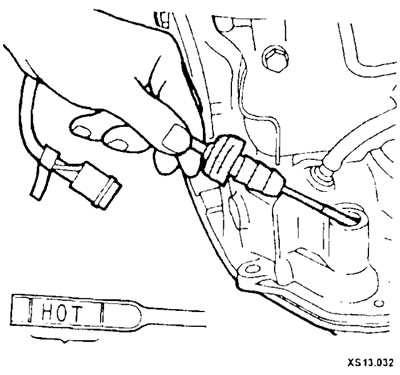
When the gearbox is warm, the fluid…


If you notice a drop in fluid level, check the outside for leaks and, if any are found, eliminate them.


The liquid is poured through a clean funnel with a fine mesh.

Caution: Do not pour liquid into the container. If too much liquid is poured in, the automatic system may malfunction. When pouring liquid, it is necessary to drain or suck out excess liquid using a syringe or bulb.


At the same time, check the old fluid on the dipstick for smell and color. Burnt pads give off a burnt smell. Contaminated fluid may cause transmission control problems.

All permitted liquids can be mixed. Do not use any additives or supplements.

If there is no fluid in the gearbox, it is prohibited to start the engine or tow the vehicle.

After checking or adding fluid, insert the oil dipstick.

Press the brake pedal and slowly move the gear shift lever through all positions.
This article is available at russian, bulgarian, belarusian, ukrainian, serbian, croatian, romanian, polish, slovak, hungarian
This article has been reviewed by: Konstantin Smirnov
Add to social network:

Previous
Elantra 1: Automatic gearbox
Next

Automatic transmission — removal and installation
General description of automatic transmission
Oil filter — replacement
Gearbox fluid replacement
Checking the operation of the automatic transmission
Starter Lock Mechanism — Check
Mode Switch Lock Mechanism — Check
We recommend other articles on the topic of Hyundai manuals:

Checking the working fluid level Hyundai Accent 1 (1994-1999)
Checking the fluid level in the automatic transmission Hyundai Getz (2002-2011)
Checking the working fluid level Hyundai Sonata 3 (1993-1998)
Checking the fluid level in the power steering reservoir Hyundai Santa Fe 2 (2007-2012, petrol)
Checking the fluid level in the power steering reservoir Hyundai Tucson 1 (2005-2010)
Checking the fluid level in the power steering reservoir Hyundai Matrix (2001-2010, petrol)

Link in different formats to this article

Visitor comments
No comments yet


How much will 19 + 16 ?


Elantra 3 (2000-2006) 
  • User manual
  • Control devices
  • Audio system
  • Starting the engine and driving
  • Faults en route
  • Maintenance and care
  • Technical information
  • Power unit
  • Gasoline engines
  • Diesel engines
  • Lubrication system
  • Cooling system
  • Fuel system (gasoline)
  • Fuel system (diesel)
  • Decreased toxicity
  • Ignition system
  • Transmission
  • Clutch
  • Mechanical gearbox
  • Automatic gearbox
  • Drive shafts and axles
  • Chassis
  • Car suspension
  • Steering
  • Brake system
  • Body
  • Exterior (external elements)
  • Interior (internal elements)
  • Air conditioning system
  • Electrical equipment
  • Equipment and devices
  • Headlights and lighting
  • Power devices
  • Electrical circuits
Elantra 2 (1995-2000, petrol) 
  • General information
  • Maintenance
  • Power unit
  • Engine repair
  • Cooling system
  • Intake and exhaust system
  • Fuel system
  • Transmission
  • Clutch
  • Manual gearbox
  • Automatic gearbox
  • Drive shafts and axles
  • Chassis
  • Front suspension
  • Rear suspension
  • Steering
  • Brake system
  • Body
  • Body elements
  • Electrical equipment
  • Equipment and devices
  • Electrical diagrams
Elantra 1 (1990-1995, petrol) 
  • General information
  • Introduction to the guide
  • Maintenance
  • Power unit
  • Minor engine repair
  • Engine overhaul
  • Lubrication system
  • Cooling system
  • Fuel injection system
  • Ignition system
  • Exhaust system
  • Transmission
  • Clutch
  • Manual gearbox
  • Automatic gearbox
  • Drive shafts
  • Chassis
  • Front suspension
  • Rear suspension
  • Steering
  • Wheels and tires
  • Troubleshooting
  • Brake system
  • Body
  • Body elements
  • Electrical equipment
  • Equipment and devices
  • Power devices
  • Heating and air conditioning
  • Electrical circuits
HyundaiBook.ru © 2018-2026 · Mobile version · Sitemap: EN BG BY UA RS HR RO PL SK HU · Administration · Site search · Hyundai owners Accent 1 · Accent 2 · Accent 3 · Elantra 1 · Elantra 2 · Elantra 3 · Getz · Sonata 3 · Sonata 4 · Santa Fe 2 · Tucson 1 · Tucson 2 · Matrix ·
This site uses cookies to optimize its functionality. By continuing, you agree to our terms.