HyundaiBook.ru
Repair Chevrolet Repair Honda Repair Toyota Repair Land Rover Repair VAZ Repair Renault Repair Nissan
English Русский
Български
Беларускі
Український
Српски
Hrvatski
Română
Polski
Slovenský
Magyar
ArticlesSitemapContacts  


  Accent   Elantra   Getz   Grandeur   Sonata   Santa Fe   Tucson   Others
Accent 1 (1994-1999) Accent 2 (1999-2005) Accent 3 (2005-2010)
  • Main
  • Accent
  • LC (1999-2005)
  • Chassis
  • Steering
  • Steering gear without power steering

Steering gear without power steering (Hyundai Accent LC)

0
Contents: Removal ⇓ Disassembly ⇓ Examination ⇓ Assembly ⇓ Installation ⇓
1 – steering rod end; 2 – clamp; 3 –…

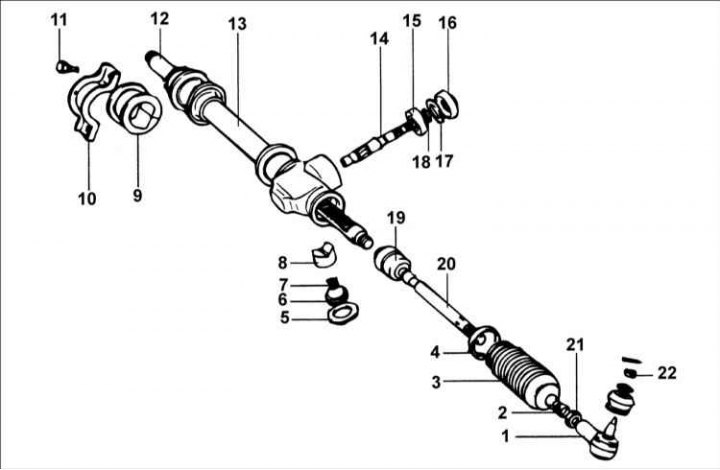
1 – steering rod end; 2 – clamp; 3 – corrugated protective cover; 4 – clamp; 5 – lock nut, 50–70 Nm; 6 – cork; 7 – spring; 8 – emphasis; 9 – rubber support; 10 – bracket; 11 – bolt, 12 – toothed rack; 13 – steering gear; 14 – steering gear shaft; 15 – gear; 16 – sealing ring; 17 – bearing; 18 – retaining ring; 19 – joint, 80–100 N·m; 20 – steering rod; 21 – lock nut, 50–55 Nm; 22 – nut, 16–34 Nm.


Removal


1. Remove the front wheel.
1. Remove the front wheel.


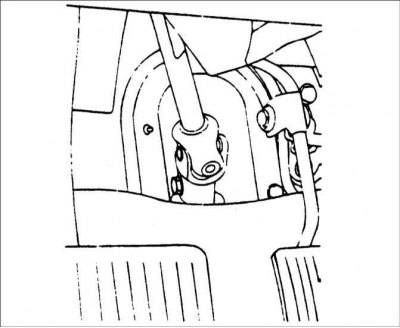
2. Remove the bolt connecting the universal joint and the steering gear shaft.
2. Remove the bolt connecting the…


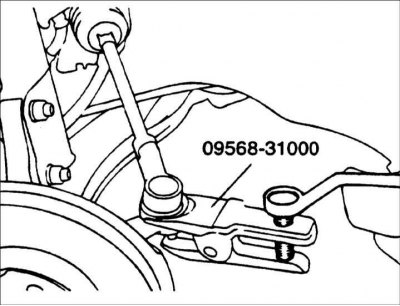
3. Remove the cotter pins and unscrew the nuts securing the ball joint pins of the steering rod ends to the steering knuckles. Use puller 09568–31000 to push the ball joint pins of the steering rod ends off the steering knuckles.


3. Remove the cotter pins and unscrew…


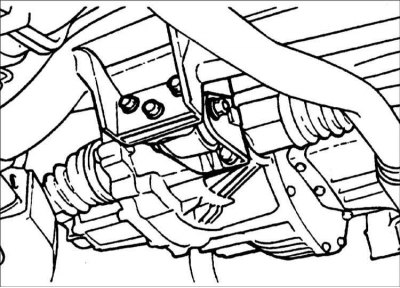
4. Remove the rear engine mount.

5. Remove the bolts and steering gear mounting brackets.
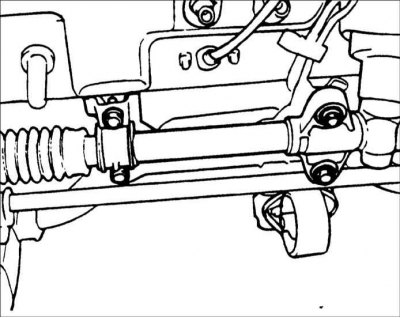
5. Remove the bolts and steering gear…


6. Move the steering gear and remove it from the right side of the car.

Disassembly


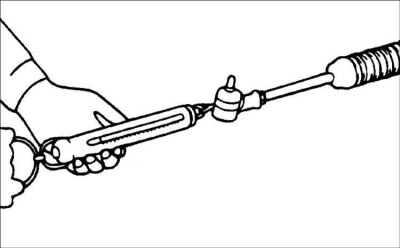
Before disassembling, measure the torque required to turn the steering gear shaft in the middle position of the toothed rack.

1. Clean the steering gear and secure it in a vice with soft jaws.

Warning: When securing the steering gear in a vice, wrap the steering gear in a cloth and be careful not to damage it when the vice is tightened.


2. Remove the steering rod.
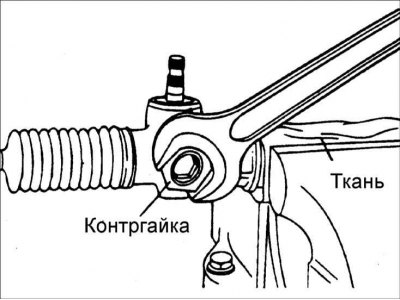
2. Remove the steering rod.


3. Unscrew the plug lock nut.
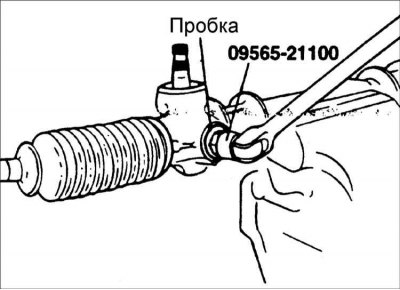


3. Unscrew the plug lock nut.


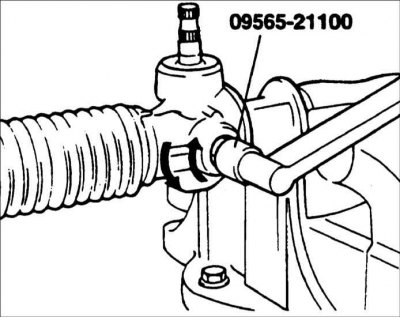
4. Using special tool 09565–21100, remove the plug.
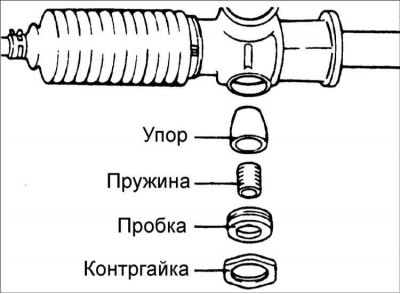
4. Using special tool 09565–21100,…


5. Remove the spring, rubber gasket and stop.

6. Remove the protective cover.
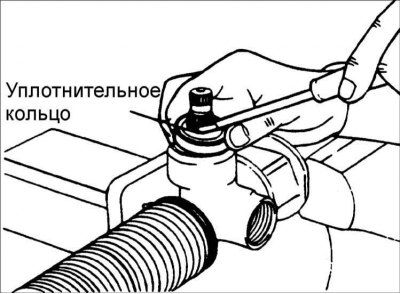
6. Remove the protective cover.


7. Remove the sealing ring from the steering gear housing.
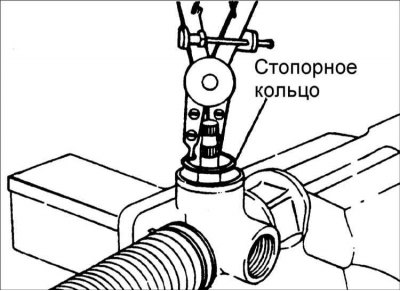
7. Remove the sealing ring from the…


8. Remove the retaining ring from the steering gear housing and remove the gear together with the bearing.
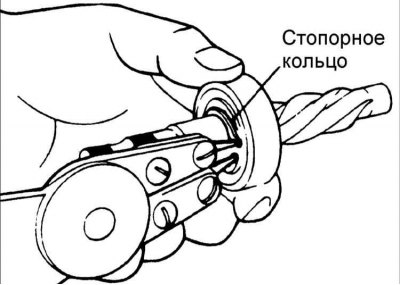


8. Remove the retaining ring from the…


9. Remove the bearing cap retaining ring from the gear.
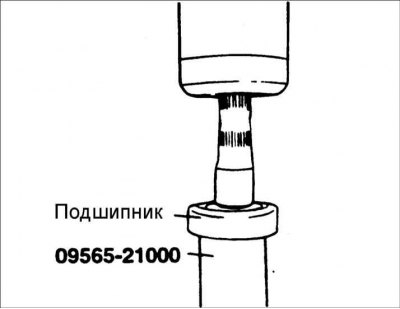
9. Remove the bearing cap retaining…


10. Using special tool 09565–21000, remove the bearing from the gear.

11. Remove the protective cover.
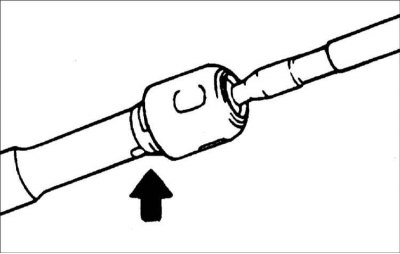
11. Remove the protective cover.


12. Using a chisel, unscrew the right steering rod mounting nut.
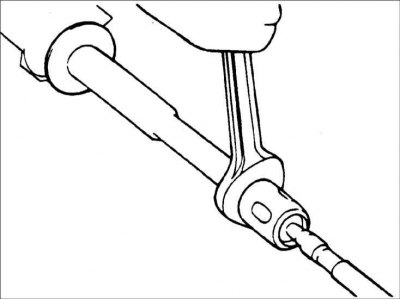
12. Using a chisel, unscrew the right…


13. Move the toothed rack completely to the transmission housing and secure the toothed rack in a vice with the jaws covered with soft material. Loosen the fastening and remove the steering rod from the steering gear.


14. Remove the rack from the steering gear housing after removing the pinion.
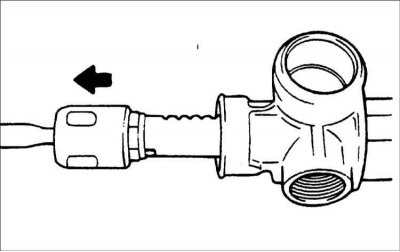
14. Remove the rack from the steering…


Warning! To avoid damaging the rack teeth, remove the rack from the left side.


Examination


Check the steering gear components in the locations shown in the figure.
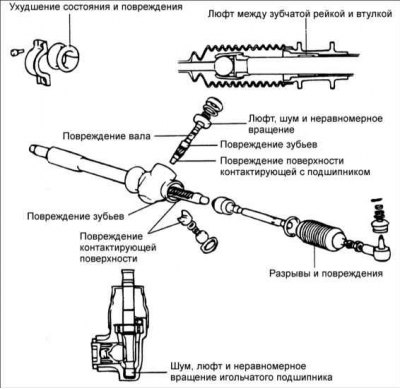
Check the steering gear components in…


Assembly


1. Before assembly, wash all parts in solvent.
1. Before assembly, wash all parts in…


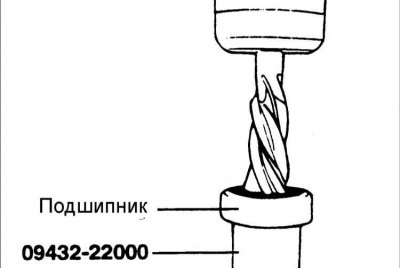
2. Using special tool 09432–22000, press the bearing into the gear.


2. Using special tool 09432–22000,…


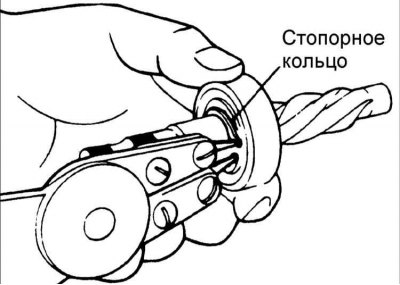
3. Install the snap ring on the gear.

4. Lubricate the rack, pinion, bushing, bearing and other sliding surfaces.

Recommended lubricant: SAE J310a, NLGI No.2

Warning! Do not block the air passage in the crankcase bushing with lubricant.


5. After installing the rack into the steering gear housing, install the pinion in the hole, aligning it with the rack.
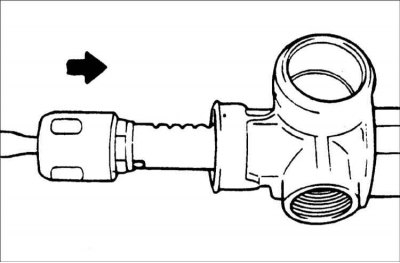
5. After installing the rack into the…


Warning: Make sure the rack is inserted into the steering gear housing on the left side.


Warning: Wipe off excess grease.
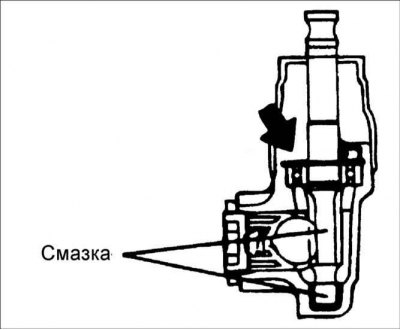

Warning: Wipe off excess grease.


6. Select and install the appropriate type of snap ring to minimize axial play in the gear.


7. Before installing the sealing ring, lubricate its working edge.
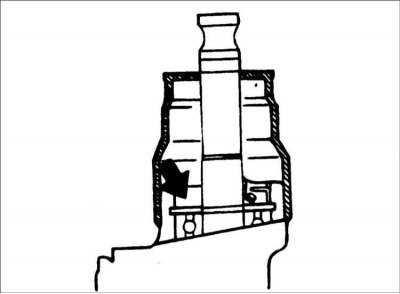
7. Before installing the sealing ring,…


Warning: A new sealing ring must be used during installation.


8. Install the stop, rubber gasket and spring.
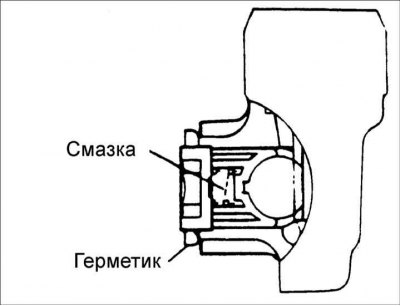
8. Install the stop, rubber gasket and…


Warning: Lubricate the cup portion of the stop.


9. Using special tool 09565–21000, screw in the plug.

Tighten the plug to a torque of 11 N·m, then turn it further by an angle of 30°–60°. Secure the plug in place with a lock nut.

Locknut tightening torque: 50–70 Nm
Locknut tightening torque: 50–70 Nm


Warning! Adjust the position of the plug with the steering gear in neutral position.


Warning: Apply a bead of sealant between the lock nut and the steering gear housing.


10. Install the tie rod end and protective boot. Secure the boot with new clamps.

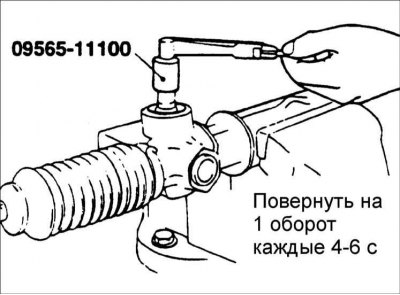
11. Measure the preload with the protective boot and lubricant by turning the pinion with the special tool 09565-11100 one revolution every 4-6 s. Also measure the starting force of the toothed rack.

Total gear preload:
  • ±180° or less from neutral position: 0.4–1.1 N·m
  • ±180° or more from neutral position: 0.3–1.6 N·m
  • Starting force of toothed rack: 50–300 N

Warning! Pinion preload must be measured over the entire length of the steering gear stroke.

Warning! Pinion preload must be…

Installation


Installation


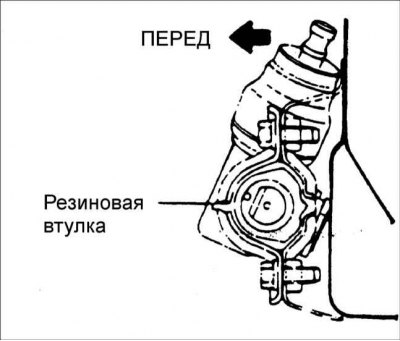
1. Install the rubber bushing on the steering gear as shown in the figure.

2. Install the pinion gear into the mesh and the steering gear and pinion assembly to the crossmember.

Warning! Make sure that the steering gear and pinion are not warped or damaged when installing. Be careful not to over-tighten the connections, as this will warp the steering gear and pinion and increase steering effort.


3. Tighten the connecting bolt.

Tightening torque: 15–20 Nm

4. Secure the steering rods to the steering knuckle.

Tightening torque of the steering rod ball joint nut: 16–34 N·m

Warning: Align the groove of the nut with the hole for the cotter pin and tighten the nut to the specified torque.


5. Adjust the wheel alignment angles.

6. Make sure the protective cover is not twisted and secure it with a clamp.
This article is available at russian, bulgarian, belarusian, ukrainian, serbian, croatian, romanian, polish, slovak, hungarian
This article has been reviewed by: Konstantin Smirnov
Add to social network:

Previous
Accent 2: Steering
Next

Steering column tilt adjustment mechanism
Steering column/steering shaft
Technical data of steering
General information about steering
Steering rod — removal and installation
Checking the steering wheel play on cars with power steering
Checking the front wheel steering angle
Checking the torque of the ball joint of the steering rod end
Checking the steering wheel turning force on vehicles with power steering
We recommend other articles on the topic of Hyundai manuals:

Steering gear cuffs — removal and installation Hyundai Elantra 1 (1990-1995, petrol)
Steering gear without power steering Hyundai Getz (2002-2011)
Checking the power steering belt tension Hyundai Sonata 3 (1993-1998)
Checking the fluid level in the power steering reservoir Hyundai Santa Fe 2 (2007-2012, petrol)
Power steering gear — device Hyundai Tucson 1 (2005-2010)
Checking the fluid level in the power steering reservoir Hyundai Matrix (2001-2010, petrol)

Link in different formats to this article

Visitor comments
No comments yet


How much will 46 + 35 ?


Accent 3 (2005-2010) 
  • General information
  • User manual
  • Maintenance
  • Power unit
  • Engine repair
  • Cooling and lubrication system
  • Power and exhaust system
  • Engine electrical equipment
  • Engine management
  • Transmission
  • Clutch
  • Mechanical gearbox
  • Automatic gearbox
  • Chassis
  • Front suspension
  • Rear suspension
  • Wheels and tires
  • Steering
  • Brake system
  • Body
  • Exterior (external elements)
  • Interior (internal elements)
  • Heating and ventilation
  • Electrical equipment
  • Equipment and devices
  • Electrical circuits
Accent 2 (1999-2005) 
  • User manual
  • Control devices
  • Starting engine and driving
  • Troubleshooting
  • Power unit
  • SOHC engines
  • DOHC engines
  • Lubrication system
  • Cooling system
  • Decreased toxicity
  • Fuel system
  • Ignition system
  • Transmission
  • Clutch
  • Mechanical gearbox
  • Automatic gearbox
  • Axles and drive shafts
  • Chassis
  • Car suspension
  • Steering
  • Brake system
  • Body
  • Exterior (external elements)
  • Interior (internal elements)
  • Air conditioning system
  • Electrical equipment
  • Equipment and devices
  • Power devices
Accent 1 (1994-1999) 
  • General information
  • Maintenance
  • Power unit
  • SOHC engines
  • DOHC engines
  • Cooling system
  • Intake and exhaust systems
  • Fuel supply (1.3 l, injection)
  • Fuel supply (1.5 l, injection)
  • Fuel supply (carburetor)
  • Transmission
  • Clutch
  • Manual gearbox
  • Automatic gearbox
  • Drive shafts
  • Chassis
  • Car suspension
  • Steering
  • Brake system
  • Body
  • Body elements
  • Electrical equipment
  • Equipment and devices
  • Electrical circuits
HyundaiBook.ru © 2018-2026 · Mobile version · Sitemap: EN BG BY UA RS HR RO PL SK HU · Administration · Site search · Hyundai owners Accent 1 · Accent 2 · Accent 3 · Elantra 1 · Elantra 2 · Elantra 3 · Getz · Sonata 3 · Sonata 4 · Santa Fe 2 · Tucson 1 · Tucson 2 · Matrix ·
This site uses cookies to optimize its functionality. By continuing, you agree to our terms.