


Contents: Installing a child seat in the…⇓ Installing a child seat on the…⇓ Using a child restraint system with…⇓ Fastening a child seat with a safety…⇓ Shelf behind the rear seat ⇓ Fastening a child seat with a safety…⇓ Installing a child seat with the…⇓ Installing a child seat ⇓ The procedure for installing child…⇓
Children should be placed in the rear seat and their bodies should be securely supported to minimize the risk of injury in the event of an accident, sudden braking or sudden maneuvers. According to accident statistics, restraint systems work more reliably when children are transported in the back seat rather than the front seat. Older children must wear a seat belt. You are required by law to ensure that children are kept securely. When transporting young children, place them in a restraint system (in a child seat). If restraints are not properly secured, children may be injured or killed in an accident. Young children and infants must be transported in a child or infant seat. Before purchasing a child seat, make sure it fits your car seat and your child's build. The installation of the child seat must be carried out in strict accordance with the manufacturer's instructions.
Warning:
- The child restraint system must be installed in the rear seat of the vehicle. Installing a child or infant seat in the front passenger seat is prohibited.
- In the event of an accident and deployment of a passenger airbag, this could result in serious injury or death to a child in an infant or child seat. Therefore, install the child seat only in the rear seat of your vehicle.
- Since the child seat and its belt can become very hot in the sun when the vehicle is parked and locked, check the temperature of the upholstery and metal parts of the seat belt before placing your child in it.
- If you don't need a child seat, place it in the luggage compartment or secure it with a standard seat belt so that it won't be thrown forward during sudden braking or an accident.
- If the child's height does not allow him to be placed in a child seat, place him in the back seat and fasten him with a standard seat belt with shoulder and lap straps. Do not allow him to occupy the front passenger seat under any circumstances.
- Always ensure that the shoulder strap of the standard lumbar-shoulder belt passes through the middle of the child's shoulder and is never located on the neck or behind the back. For a more correct position of the shoulder strap, place the child closer to the middle of the seat. The lumbar strap of the lumbar-shoulder belt should be positioned as low as possible on the child's hips and should fit as snugly as possible.
- If you are unable to fit the seat belt correctly to your child, we recommend installing a standard booster cushion in the rear seat of your vehicle to help raise your child and ensure the seat belt fits correctly.
- Never allow your child to stand or kneel on the seat.
- Never use a baby carrier or child seat that attaches to the back of a car seat, as they do not provide adequate protection in the event of an accident.
- It is not allowed to pick up a child while the vehicle is moving. This could cause serious injury to the child in the event of an accident or sudden braking. When a child is in the arms of an adult, he or she is deprived of all means of protection in the event of an accident, even if the adult is wearing a seat belt.
- If a child restraint system is not properly secured, the risk of serious injury or death to the child in an accident is greatly increased.
Installing a child seat in the middle of the rear seat
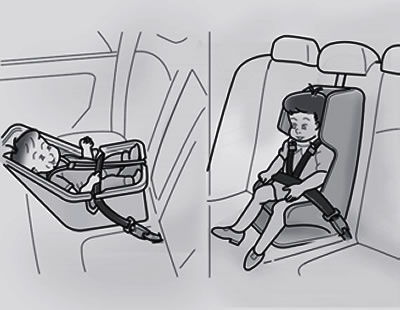
2-point seat belt without retractor |
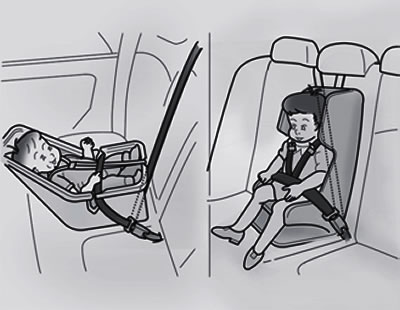
3-point seat belt |
In the middle place of the rear seat, the child seat is secured with a standard seat belt, as shown in the pictures. After installing the child seat, make sure it is securely fastened with the seat belt by tugging the seat back and forth and from side to side.
If the seat moves, tighten the seat belt. After that, attach the safety belt (if it exists) by the child seat attachment hook and tighten the strap to secure the seat. Install the child seat in strict accordance with the manufacturer's instructions.
Installing a child seat on the outboard rear seats
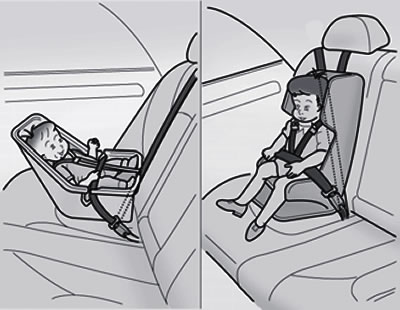
On the side rear seat
To install a child seat on the outboard rear seat, pull the standard seat belt out of the reel. Install the child seat, fasten the seat belt and allow the reel to take up the slack. Make sure the lap strap of the seat belt fits snugly against the child seat and the shoulder strap is positioned so that it does not rest on the child's head or neck. After installing the child seat, check that it is securely fastened by trying to move the seat in all directions.
If you need to tighten the seat belt, take up the slack by pulling the belt towards the reel.
Note:
- Before installing a child seat, read the manufacturer's instructions included with it.
- If the seat belt does not operate as described above, have the system checked immediately by an authorized Hyundai dealer.
Warning: It is not permitted to install any child restraint system in the front passenger seat. In the event of an accident that causes a passenger airbag to deploy, it could cause serious injury or death to a child in an infant or child seat. Install child restraint systems only in the rear seat of the vehicle.
Using a child restraint system with a safety belt
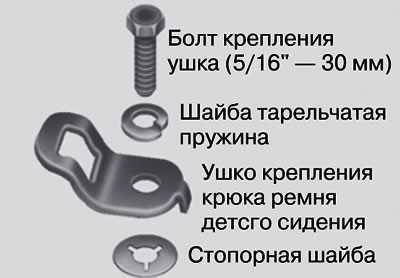
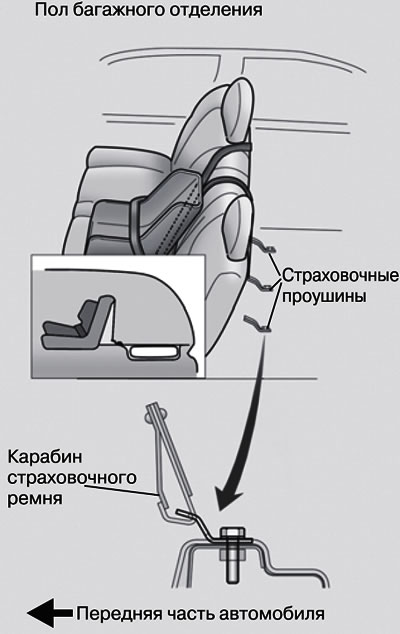
It is strongly recommended that young children or infants be transported only in a child or infant seat. Such a seat must be of the correct size for the child's height and installed in accordance with the manufacturer's instructions. It is also recommended to install the child seat in the back seat of the car, which will significantly increase the safety of the child. Your vehicle is equipped with three child seat tether hook mounting eyes for installing the child seat.
Fastening a child seat with a safety belt (for 4-door models)
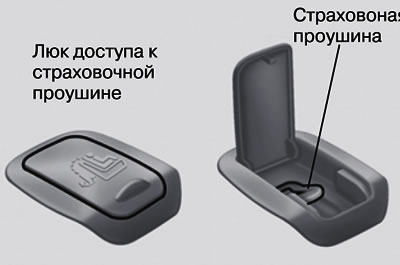
The safety belt is attached to one of the eyes located on the shelf behind the rear seat.
Shelf behind the rear seat
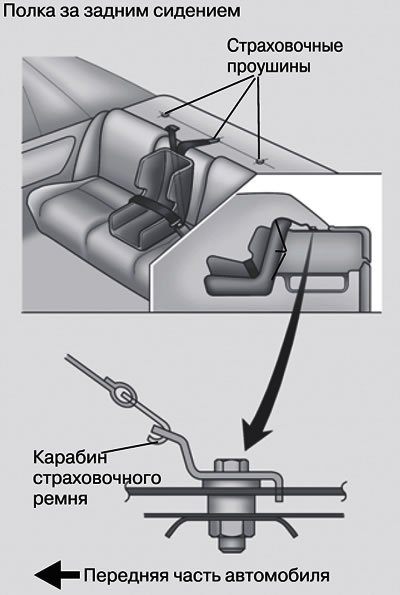
1. Open one of the tether eyes behind the rear seat.
2. Place the child seat belt over the back of the rear seat. On vehicles with adjustable rear head restraints, route the tether strap between the head restraint posts.
3. Attach the safety strap to the eyelet in the luggage compartment and tighten the strap.
Warning: For safety reasons, the child seat must be installed in the rearmost position and with the backrest in an upright, non-reclining position.
Fastening a child seat with a safety belt (for 5-door models)
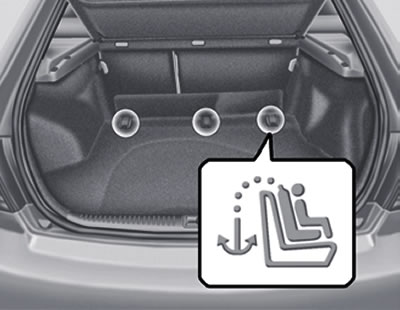
The safety belt is attached to one of the eyes installed on the floor of the luggage compartment.
This symbol indicates the location of the safety eyes.
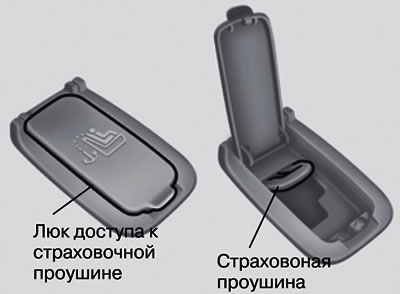
1. Open the access hatch to the safety eye in the luggage compartment floor.
2. Place the child seat belt over the back of the rear seat. On vehicles with adjustable rear head restraints, route the tether strap between the head restraint posts.
3. Attach the safety strap to the eyelet in the luggage compartment and tighten the strap.
Installing a child seat with the ISOFIX system and a safety belt
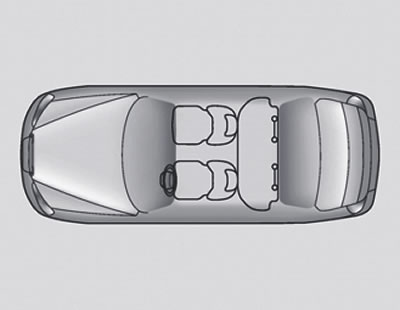
The ISOFIX system allows you to install a child seat in the usual way, without having to secure it with a standard seat belt. This system provides a safer and more secure position of the child seat, as well as its easier and faster installation.
There are two ISOFIX mountings on both sides of the rear seat, and eyelets for attaching a safety belt in the luggage compartment. The child seat is attached to the fastening points until it clicks into place (check the reliability of the fixation by pulling on the seat), after which the safety belt is attached to the corresponding eyelet in the luggage compartment. The installation and use of the child seat must be carried out in accordance with the instructions supplied with the ISOFIX seat.
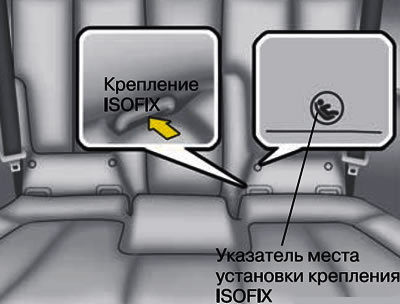
Note: The installation of an ISOFIX child seat is only permitted if it is certified for this vehicle in accordance with the ECE-44 standard. Before installing an ISOFIX seat purchased for another vehicle, check with an authorized dealer whether it is suitable and recommended for your Hyundai vehicle.
Installing a child seat
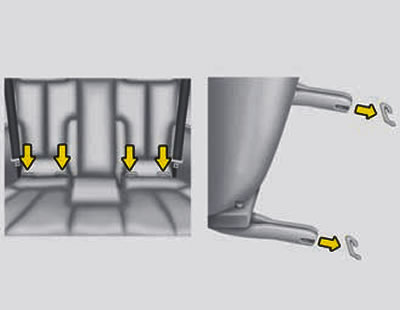
1. Insert the child seat anchors into the ISOFIX mounting points until they click into place.
2. Attach the tether strap hook to the eyelet and tighten the strap to secure the seat as described in the section "Securing a child seat with a tether strap".
Warning:
- Do not install a child seat with the ISOFIX system in the middle rear seat. ISOFIX mountings are available only on the outer rear seats. Do not install an ISOFIX child seat in the middle of the rear seat by attempting to use the ISOFIX anchorage for other purposes. If a child seat is installed in the middle of the rear seat, the ISOFIX anchorage may not be strong enough to hold the child seat securely in the event of an accident and may fail, causing serious injury or death.
- Do not secure more than one child seat to the same tether anchor or lower child seat anchor. If overloaded, the mounting or safety attachment may fail, causing serious injury or death.
- Install ISOFIX seats or seats compatible with the ISOFIX anchorage system only in the locations provided for this purpose, as shown in the illustration.
- Strictly follow the installation instructions and use rules for the child seat as given in the seat manufacturer's instructions.
Material was obtained from an official resource HYUNDAIBOOK.ru
The procedure for installing child restraint systems on car seats
Install only child seats of officially approved design and appropriate for the child's size.
Install child seats according to the table below.
| Body weight and age group | Place of installation of a child seat | ||
| Front passenger seat | Rear side seats | Middle part of the rear seat | |
| 0: Up to 10 kg (up to 9 months) | X | U | U |
| 0+: Up to 13 kg (up to 2 years) | X | U | U |
| I: from 9 to 18 kg (from 9 months to 4 years) | X | U, L1 | U |
| II and III: from 15 to 36 kg (from 4 to 12 years old) | X | UF | UF |
U: The location is suitable for installing "universal" child restraints (child seats), corresponding to the weight category that the child falls into.
UF: The place is suitable for installing "universal" devices for children (child seats), in which the child is positioned facing the direction of travel of the vehicle and corresponding to the weight category into which the child falls.
L1: Suitable for the system "Romer ISOFIX GR1" (E1 R44-03301133), accepted for this weight category.
X: Mounting location not suitable for this weight category.