


Contents: Checking the wheel turning angles ⇓ Checking the steering wheel turning…⇓ Checking the return of the steering…⇓
Checking the wheel turning angles
1. Using special equipment (A), measure the steering angles of the steered wheels and compare them with the nominal values.
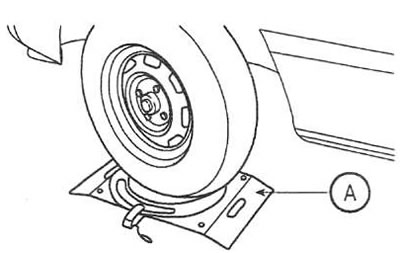
2. If the measured value differs from the nominal value, check and adjust the wheel alignment.
Checking the steering wheel turning force
3. Set the steering wheel to neutral position.
4. Start the engine and increase the crankshaft speed to 1000±100 rpm.
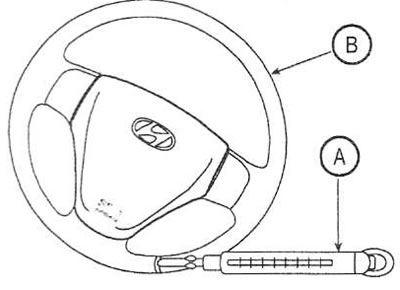
5. Using a spring dynamometer (A), measure the steering wheel turning force (B) by turning it 1.25 turns in both directions. Nominal value: no more than 34 N.
6. Check for any sudden change in steering effort when turning the steering wheel.
7. If the measured value differs from the nominal value, check the integrity of the dust boots of the tips and ball joints, the tension of the steering gear pinion and the turning force of the tips and steering rods.
The original can be found on the resource: www.HyundaiBook.ru
Checking the return of the steering wheel to the neutral position
8. While driving, make several sharp turns of the steering wheel to the left and right to check for the presence of a return torque.
9. While driving at 35 km/h, turn the steering wheel 90° and release it after 1-2 seconds. Make sure the steering wheel returns to neutral or close to it ( ±20°) position.
Note: If you turn the steering wheel too quickly, you may need to apply more force. This is not a malfunction and is caused by insufficient power steering pump performance.