


Contents: Removal ⇓ Installation ⇓
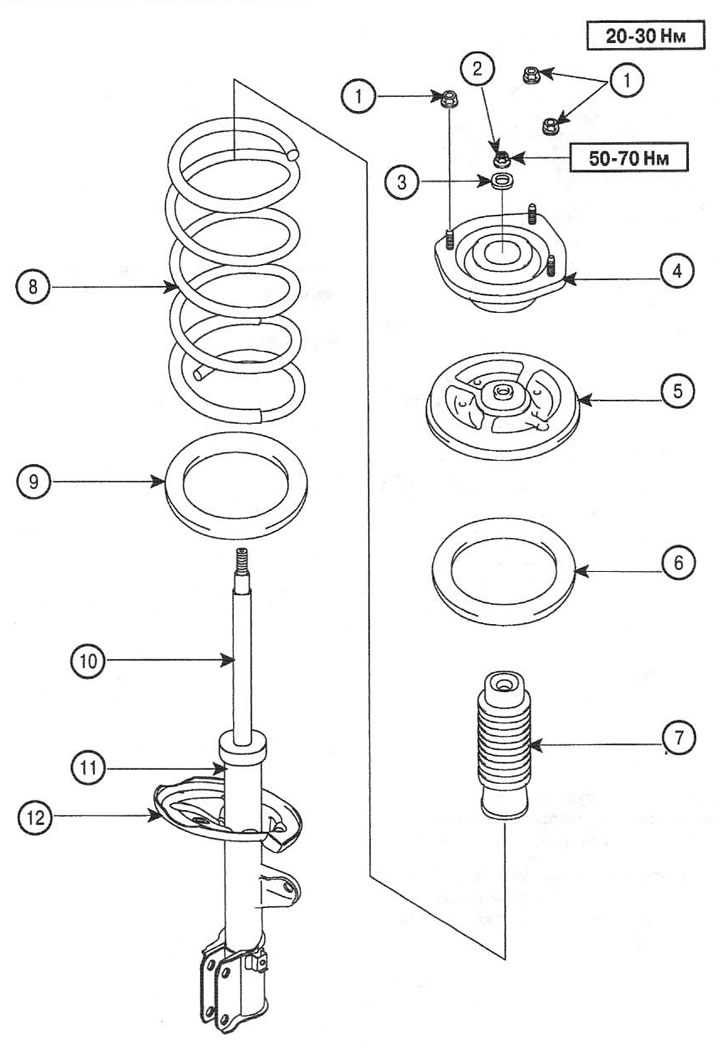
1. Nuts; 2. Self-locking nut; 3. Washer; 4. Rack support; 5. Upper spring support; 6. Rubber gasket of the upper spring support; 7. Dust cover and compression buffer; 8. Spring; 9. Rubber gasket of the lower spring support; 10. Shock absorber rod; 11. Shock absorber housing; 12. Lower spring support
Removal
1. Remove the front wheel. Tightening torque of the nuts: 80-110 Nm.
2. Loosen the screws securing the brake hose (1) and wheel speed sensor wire (2) to the rack (3). Tightening torque: 9-14 Nm.
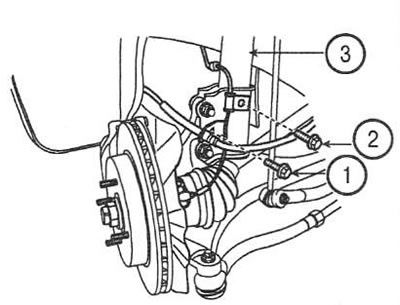
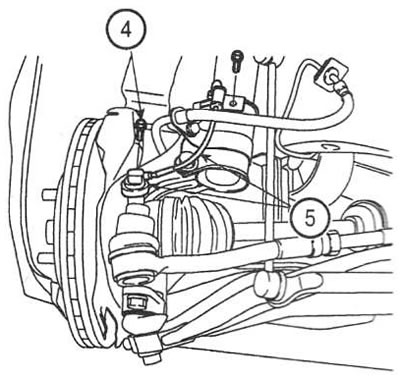
3. Loosen the screw (4) and remove the wheel speed sensor (5). Tightening torque: 13-17 Nm.
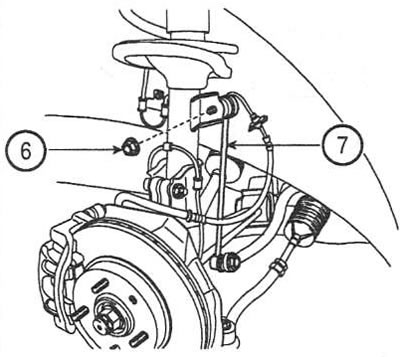
4. Unscrew the nut (6) and disconnect the upper joint of the anti-roll bar (7) from the shock absorber strut. Tightening torque 35-45 Nm.
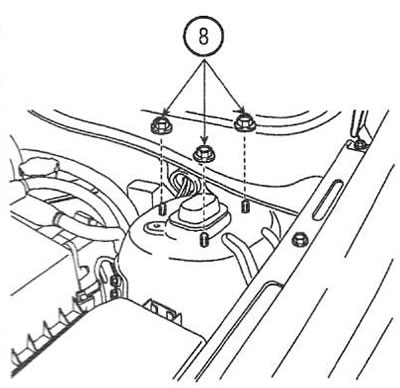
5. Unscrew the nuts (8) securing the upper support of the rack. Tightening torque: 20-30 Nm.
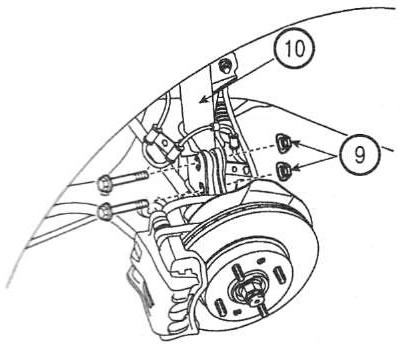
6. Unscrew the bolts (9) securing the shock absorber strut to the steering knuckle and remove the shock absorber strut (10). Tightening torque: 100-120 Nm.
Installation
7. Installation is carried out in the reverse order of removal.
Caution: To ensure correct installation of the shock absorber strut, depending on whether the vehicle is equipped with hydraulic power steering, position the mounting nuts as shown in the illustration.
This is due to the fact that changing the position of the upper support of the shock absorber strut changes the longitudinal tilt angle of the wheel rotation axis. When the longitudinal tilt angle of the wheel rotation axis increases, the moment (force) that returns the wheel to the position of straight-line movement increases.
This moment, usually called the stabilizing moment, increases the force on the steering wheel, therefore, for cars with or without power steering, different shock absorber strut installation angles are used and, accordingly, its upper support is installed differently. With power steering, the support is shifted back relative to the direction of the car's movement (in the figure, the center is shown by the crosshairs).
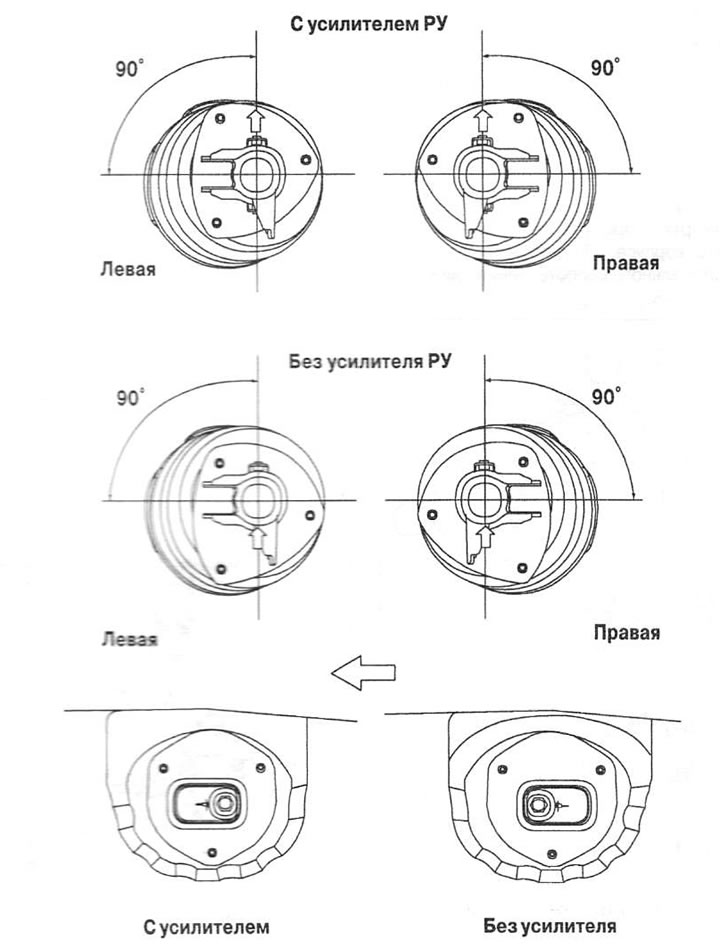
The arrow shows the direction of the vehicle's movement