


Contents: Disassembly ⇓ Assembly ⇓
Disassembly
Remove the generator.
Remove the three through bolts and disconnect the drive-side support flange from the stator.
Carefully clamp the rotor in a vice and unscrew the central pulley bolt. Remove the pulley with the fan impeller and spacer sleeve.
Remove the rectifier from the rear cover of the generator.
Early models of the generator
- Unsolder the three wires on the stator winding coming from the rectifier, holding the connection terminal with pliers.
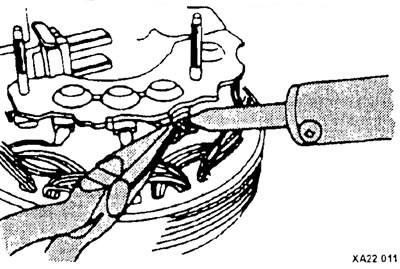
- To replace carbon brushes if wear has reached the wear limits (length about 5 mm or less), unsolder the supply wires.
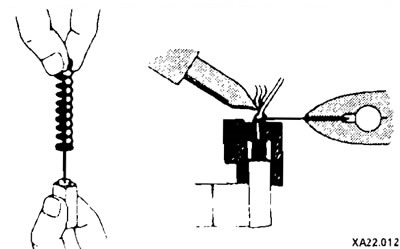
Late models of the generator
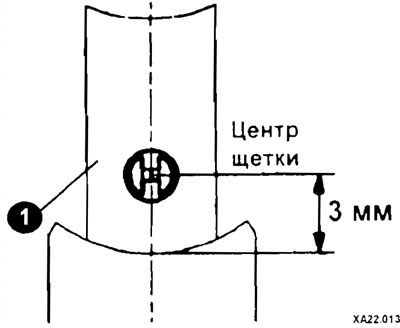
If the brush (1) is worn down to the center of the mark (3 mm from the center of the brush holder), replace the brush holder assembly.
- Check both rotor bearings for free rotation or replace them. To replace the rear bearing, a removal and pressing tool is required.
Assembly
In early models of the generator:
- Insert the brushes and springs into the brush holder and solder the leads. Trim the long ends.
- To prevent solder from penetrating into the brush lead wires during soldering, hold the brush leads with pliers.
Check that the new brushes move easily in the brush holder.
[The original version is stored on the website www.hyundaibook.ru]
Place the rear part on the rotor and close. Place the front support flange with the spacer sleeve and place the coupling sleeve.
Install the fan impeller with the pulley and spring ring, tightening the nut to 60 Nm.
Insert into the generator housing, bending the ends of the rectifier connection wires so that they do not touch the rotor. When assembling, keep the brushes in a compressed position.
Secure the housing with three through bolts.
Check the ease of rotation of the generator by hand.
Install the generator.
Connect the ground wire to the battery.
If available, set the time on the clock and enter the security code into the radio.
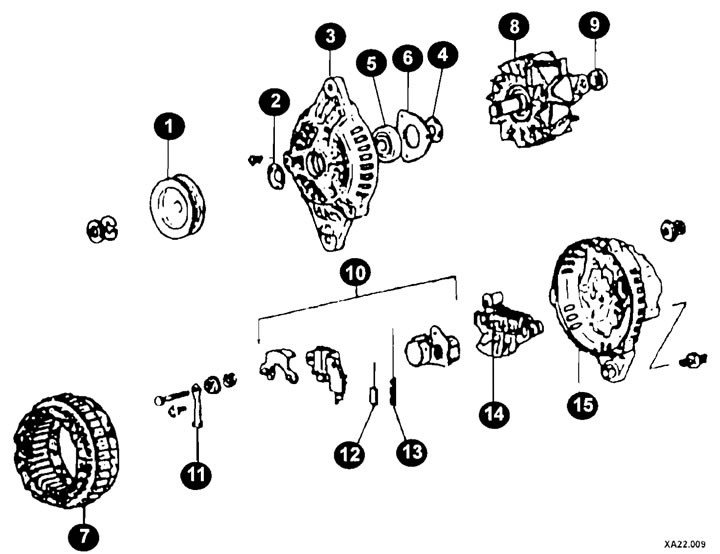
Generator components of early car models
1 - belt pulley;
2, 4 - oil seal;
3 - support flange;
5 - bearing on the drive side;
6 - bearing retaining plate;
7 - stator;
8 - rotor;
9 - rotor bearing;
10 - brush holder/voltage regulator;
11 - connection terminals;
12 - carbon brush;
13 - spring;
14 - rectifier;
15 - back cover.
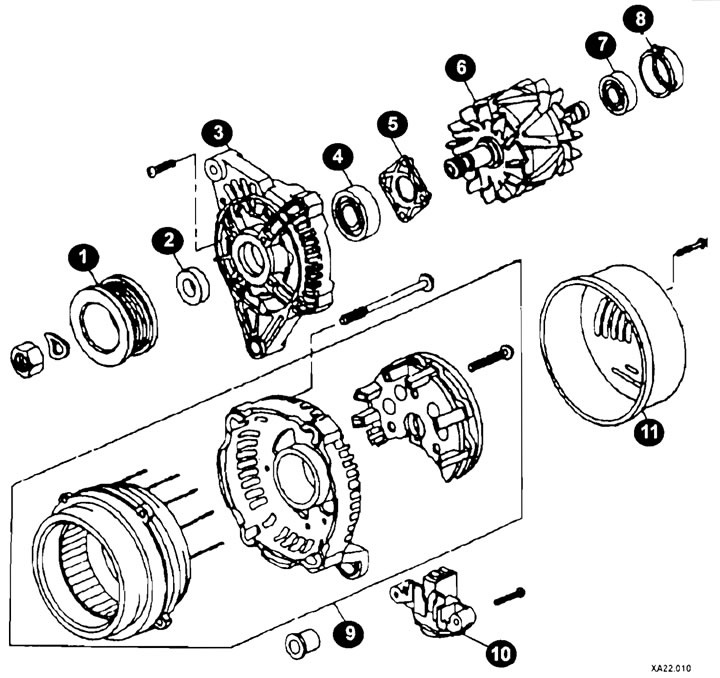
Late model car generator components
1 - pulley;
2 - oil seal;
3 - flange;
4 - bearing;
5 - bearing holder;
6 - stator;
7 - bearing;
8 - bearing cap;
9 - stator with rectifier block;
10 - brush holder;
11 - rear cover of the generator.
Generator carbon brushes wear out on average after 120 thousand km. To replace them, you need to disassemble the generator.