


Contents: Using the clutch ⇓ Correct driving techniques ⇓ To remove the key from the ignition ⇓ Recommended speeds for gear shifting ⇓
The position of the gearshift lever is traditional for five forward gears, as shown in the figure.
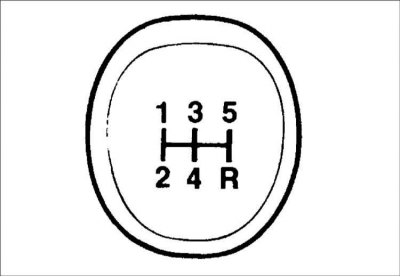
Gear shift lever positions
Warning! When engaging reverse gear, after the vehicle has come to a complete stop, hold the gearshift lever in neutral for at least 3 seconds. Then move the lever to the reverse gear position.
Warning! When shifting the lever from 5th gear to 4th gear, be careful not to engage 2nd gear by mistake. Such abrupt gear shifting may cause excessive engine speed increase (tachometer needle in the red zone) and may result in engine damage.
Using the clutch
Before engaging a gear, depress the clutch pedal fully and then release it slowly. Press the clutch pedal again only after it has returned to its original position. Do not keep your foot on the clutch pedal while the vehicle is moving. This may cause wear on the clutch disc. Do not use the clutch to hold the vehicle on a slope. Use the parking brake for this purpose. Avoid releasing the clutch pedal abruptly or repeatedly.
Correct driving techniques
Do not roll downhill in neutral. It is very dangerous. Always keep the gear engaged.
Avoid driving in a manner that requires sudden braking and do not keep your left foot on the brake pedal all the time while driving. This will cause the brakes to overheat and become ineffective. On long descents, engine braking (including downshifting) should be used to prevent the brakes from overheating.
When shifting into a lower gear, apply the brakes slightly. This will help prevent the engine from over-revving, which can cause damage.
In strong crosswinds, reduce your vehicle speed. This will improve its handling.
Before engaging reverse gear, make sure the vehicle is completely stopped. Otherwise, you may damage the gearbox. To move the lever to the reverse position, first depress the clutch pedal, move the lever to the neutral position, wait 3 seconds, and then move the lever to the reverse position.
Be especially careful when driving on slippery roads, braking, accelerating and changing gears. On slippery roads, sudden changes in vehicle speed can cause the vehicle to lose traction and control over the vehicle.
Warning! Losing control of the vehicle at high speeds significantly increases the risk of the vehicle rolling over.
Warning: Loss of control often occurs when two or more wheels leave the road and the driver attempts to steer the vehicle back onto the road.
Warning! If your car has left the road track, avoid turning the steering wheel sharply. Instead, slow down the car before re-entering the road.
To remove the key from the ignition
1. Turn the ignition key to the "ACC" ("Accessories") position.
2. Simultaneously press and turn the ignition key counterclockwise from the "ACC" ("Accessory") position to the "LOCK" ("Lock") position.
3. The ignition key can only be removed from the ignition switch in the "LOCK" position.
Recommended speeds for gear shifting
For economical driving, it is recommended to shift gears at the speeds indicated below.
| Broadcast | Recommended speed |
| from 1st to 2nd or from 2nd to 1st | 20 km/h |
| from 2nd to 3rd or from 3rd to 2nd | 40 km/h |
| from 3rd to 4th or from 4th to 3rd | 55 km/h |
| from 4th to 5th or from 5th to 4th | 75 km/h |