


2. Start the engine and wait until the coolant temperature reaches 80-95°C.
3. Stop the engine and disconnect the high tension wires from the spark plugs.
4. Remove the spark plugs.
5. Turn the crankshaft with the handle to remove foreign particles from the engine cylinders.
6. Install the compression gauge into the spark plug hole.
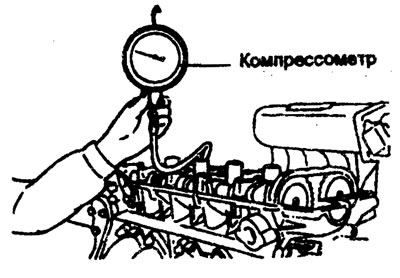
7. Press the gas pedal to fully open the throttle valve.
The article is based on information website www.hyundaibook.ru
8. Turn the crankshaft with the handle and read the compression gauge readings.
- Standard value (at 250-400 rpm.) — 15 kg/cm²
- Limit value - 14 kg/cm² (1.37 MPa)
9. Repeat the operations specified in paragraphs. 6-8 on all cylinders and make sure that the compression in each of the cylinders is within the above limit and the difference in readings does not exceed:
- Limit - Maximum 1.0 kg/cm² (100 kPa) between individual cylinders
10. If the compression in one of the cylinders is below the norm or the difference in the compression value in different cylinders is higher than the limit value, add a small amount of oil into the cylinder through the spark plug hole and repeat the operations specified in paragraphs. 6-9.
1) If adding oil results in increased compression, a possible reason for the decrease in compression is an increase in the gap between the piston rings and the cylinder wall due to their wear.
2) If the compression remains unchanged after adding oil, then the possible cause of low compression is valve sticking, poor valve seating, or gas leakage through leaks in the cylinder head gasket.
Tightening torque
- Spark plug - 20-30 Nm