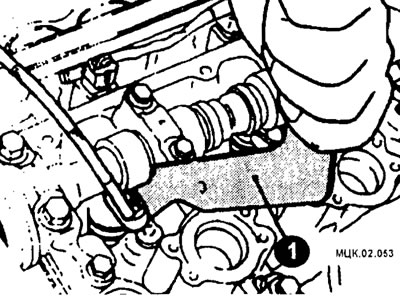
The gap compensator does not require maintenance. If necessary, the gap compensators are checked in the following order.
Remove the cylinder head cover.
Press the rocker arm against the valve clearance compensator.
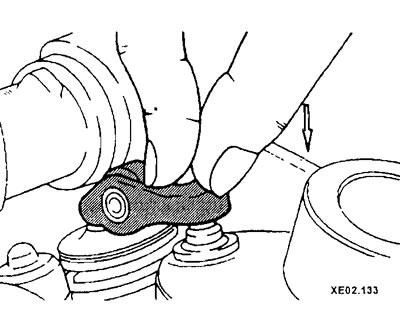
The gap compensator is then in order if it is not compressed and there is stiff resistance when pressing the rocker arm.
Otherwise, the compensator is defective and requires replacement.
If the valve clearance compensator is slightly compressed and elastic, air has probably entered it.
In this case, you need to check the oil level in the engine. If the level is too high, drain or suck out the oil, and if the level is low, top up the oil. If the oil level is normal, check the mesh and mesh seal in the oil pan; replace if damaged.
Remove air from the valve clearance compensator by warming up the engine and driving the car at low speed. Turn off the engine and wait a few minutes. Then repeat this process several times within one hour.
Hydraulic tappets - replacement
Turn the crankshaft so that the pistons are below TDC so that the valves cannot hit the pistons when replacing the hydraulic lifters. In some positions the valve rocker arms are lifted by the camshaft lobes and therefore the hydraulic tappets cannot be removed. In these cases, the crankshaft must be positioned so that the valve rocker arms remain not raised.
Using tool (1), move the valve down and remove the valve rocker arm with roller tappet.
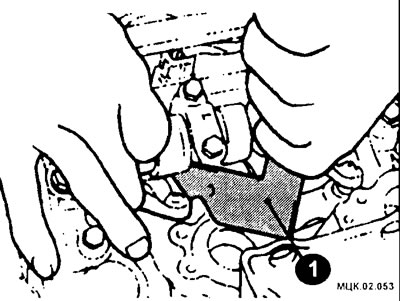
Remove the hydraulic heater from the cylinder head.
Install a new hydraulic lifter with air bled from it.
Using the same tool (1), lower the valve down and install the valve rocker arm with roller tappet.
Note: When installing the roller valve rocker arm, first install its shoulder on the upper part of the hydraulic tappet, then, pressing the valve down, move the rest of the rocker arm onto the upper end of the valve stem.