
HyundaiBook.ru
Repair Chevrolet Repair Honda Repair Toyota Repair Land Rover Repair VAZ Repair Renault Repair Nissan
English Русский
Български
Беларускі
Український
Српски
Hrvatski
Română
Polski
Slovenský
Magyar
ArticlesSitemapContacts  


  Accent   Elantra   Getz   Grandeur   Sonata   Santa Fe   Tucson   Others
Elantra 1 (1990-1995, petrol) Elantra 2 (1995-2000, petrol) Elantra 3 (2000-2006)
  • Main
  • Elantra
  • J1 (1990-1995)
  • Power unit
  • Minor engine repair
  • Engine Brackets — Checking, Replacing and Adjusting

Engine Brackets — Checking, Replacing and Adjusting (Hyundai Elantra J1)

0
Contents: Examination ⇓ Replacing engine mounts ⇓
Engine mounts rarely require attention, however, broken or damaged mounts should be replaced immediately, otherwise the increased stress placed on engine components may cause rapid wear or damage.

Examination


During the inspection, the engine should be raised slightly to remove the weight from the brackets.

Raise the vehicle and support it securely on jack stands, then place a jack under the engine crankcase. Place a large block of wood between the crankcase and the jack, then raise the engine slightly to take the weight off the brackets.
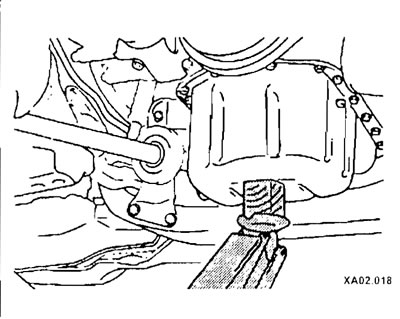
Raise the vehicle and support it…


Caution: Do not stand under the engine when its weight is supported only by the jack!


Check the rubber bracket supports to see if the rubber is cracked, hardened, or separating from the metal parts. Sometimes the rubber breaks right down the center.

Check for relative movement between the bracket plates and the engine or frame (use a large screwdriver or pry bar to try to move the brackets). If movement is detected, lower the engine and tighten the bracket bolts.
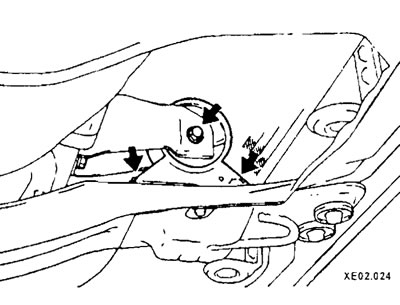
Check for relative movement between the…


A protective compound should be applied to the rubber bearings to prevent the rubber from deteriorating.


Replacing engine mounts
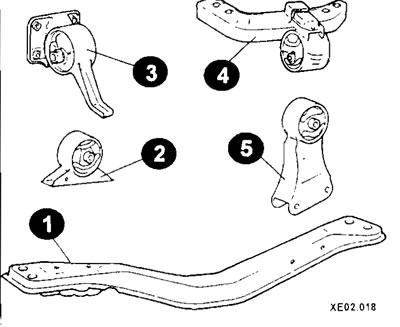


Engine mounts

Engine mounts
1 - central beam;
2 - front support;
3 - rear support;
4 - right support;
5 - left support.


Disconnect the negative battery cable, then jack up the vehicle and support it securely on jack stands (if it hasn't been done yet).

Unscrew the bolts and nuts, detach the bracket from the central beam.

Raise the engine slightly with a jack or winch. Loosen the bolts between the supports and the engine, remove the supports.

Installation is carried out by performing the above steps in reverse order. Use a special hardening compound on the threads of the bracket bolts and tighten these bolts securely.

Remember that the front and rear hubs are different shapes.
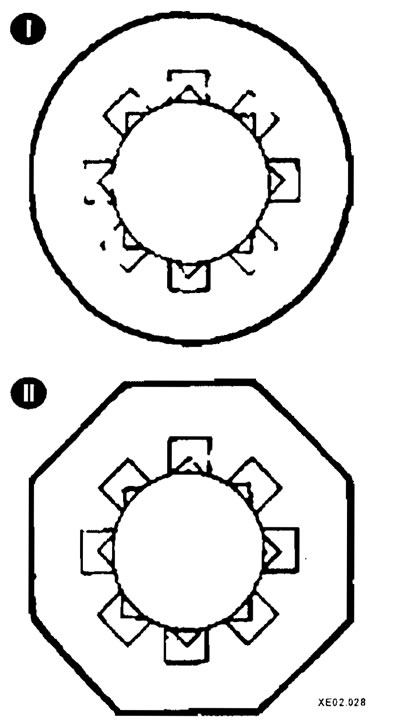
I - front hub;

I - front hub;
II - rear hub.
This article is available at russian, bulgarian, belarusian, ukrainian, serbian, croatian, romanian, polish, slovak, hungarian
This article has been reviewed by: Konstantin Smirnov
Add to social network:

Previous
Elantra 1: Minor engine repair
Next

Front camshaft oil seal — replacement (2.0 liter engines)
Intake/Exhaust Manifold — Removal and Installation
Valve Clearance Adjustment — 2.0 Liter Engines (2001-2005)
Hydraulic tappet (hydraulic valve clearance compensator)
Valve springs, crackers and seals — replacement (method without removing the cylinder head)
We recommend other articles on the topic of Hyundai manuals:

Checking and adjusting the drive belt tension Hyundai Accent 1 (1994-1999)
Checking and replacing engine coolant Hyundai Getz (2002-2011)
Checking the engine oil level Hyundai Sonata 3 (1993-1998)
Checking and replacing engine coolant Hyundai Santa Fe 2 (2007-2012, petrol)
Checking and adjusting valve clearances Hyundai Tucson 1 (2005-2010)
Checking and adjusting the valve drive clearance Hyundai Matrix (2001-2010, petrol)

Link in different formats to this article

Visitor comments
No comments yet


How much will 31 + 41 ?


Elantra 3 (2000-2006) 
  • User manual
  • Control devices
  • Audio system
  • Starting the engine and driving
  • Faults en route
  • Maintenance and care
  • Technical information
  • Power unit
  • Gasoline engines
  • Diesel engines
  • Lubrication system
  • Cooling system
  • Fuel system (gasoline)
  • Fuel system (diesel)
  • Decreased toxicity
  • Ignition system
  • Transmission
  • Clutch
  • Mechanical gearbox
  • Automatic gearbox
  • Drive shafts and axles
  • Chassis
  • Car suspension
  • Steering
  • Brake system
  • Body
  • Exterior (external elements)
  • Interior (internal elements)
  • Air conditioning system
  • Electrical equipment
  • Equipment and devices
  • Headlights and lighting
  • Power devices
  • Electrical circuits
Elantra 2 (1995-2000, petrol) 
  • General information
  • Maintenance
  • Power unit
  • Engine repair
  • Cooling system
  • Intake and exhaust system
  • Fuel system
  • Transmission
  • Clutch
  • Manual gearbox
  • Automatic gearbox
  • Drive shafts and axles
  • Chassis
  • Front suspension
  • Rear suspension
  • Steering
  • Brake system
  • Body
  • Body elements
  • Electrical equipment
  • Equipment and devices
  • Electrical diagrams
Elantra 1 (1990-1995, petrol) 
  • General information
  • Introduction to the guide
  • Maintenance
  • Power unit
  • Minor engine repair
  • Engine overhaul
  • Lubrication system
  • Cooling system
  • Fuel injection system
  • Ignition system
  • Exhaust system
  • Transmission
  • Clutch
  • Manual gearbox
  • Automatic gearbox
  • Drive shafts
  • Chassis
  • Front suspension
  • Rear suspension
  • Steering
  • Wheels and tires
  • Troubleshooting
  • Brake system
  • Body
  • Body elements
  • Electrical equipment
  • Equipment and devices
  • Power devices
  • Heating and air conditioning
  • Electrical circuits
HyundaiBook.ru © 2018-2026 · Mobile version · Sitemap: EN BG BY UA RS HR RO PL SK HU · Administration · Site search · Hyundai owners Accent 1 · Accent 2 · Accent 3 · Elantra 1 · Elantra 2 · Elantra 3 · Getz · Sonata 3 · Sonata 4 · Santa Fe 2 · Tucson 1 · Tucson 2 · Matrix ·
This site uses cookies to optimize its functionality. By continuing, you agree to our terms.