
HyundaiBook.ru
Repair Chevrolet Repair Honda Repair Toyota Repair Land Rover Repair VAZ Repair Renault Repair Nissan
English Русский
Български
Беларускі
Український
Српски
Hrvatski
Română
Polski
Slovenský
Magyar
ArticlesSitemapContacts  


  Accent   Elantra   Getz   Grandeur   Sonata   Santa Fe   Tucson   Others
Accent 1 (1994-1999) Accent 2 (1999-2005) Accent 3 (2005-2010)
  • Main
  • Accent
  • X3 (1994-1999)
  • Power unit
  • SOHC engines
  • Rocker arms, shafts and hydraulic clearance compensator

Rocker arms, shafts and hydraulic clearance compensator (Hyundai Accent X3)

0
Contents: Removal ⇓ Examination ⇓ Testing the hydraulic clearance…⇓ Installation ⇓
Rocker arms, shafts and hydraulic clearance compensator


Removal


1. Remove the suction hose and PCV valve.

2. Remove the timing belt cover.

3. Remove the rocker arm cover.
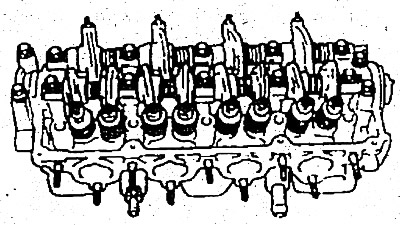
3. Remove the rocker arm cover.


4. Loosen the flange bolts, remove the rocker shaft, rocker arms, and rocker shaft springs as an assembly.

5. Remove the bolts, rocker arms, and rocker arm shaft springs from the shaft.

Examination


Rocker arms


1. Check the roller rotation. If it rotates unevenly or is worn, replace it.
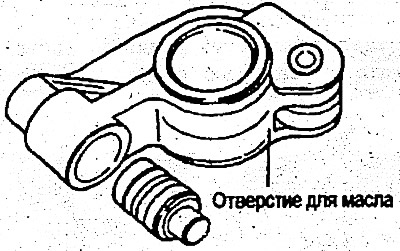
1. Check the roller rotation. If it rotates unevenly or is worn, replace it.


2. Check the surface of the rocker arms. Replace if damaged or deformed.


3. Check the surface of the hydraulic clearance compensator that contacts the valve stem. If worn or damaged, replace the compensator.

Rocker shaft


1. Check the rocker shafts for damage? Replace if necessary.

[Original version of the article on the website HYUNDAIBOOK.RU]

2. Check if the oil hole is clogged.

Automatic gap compensator


1. Insert the air bleed wire into the hole of the automatic compensator and move the plunger up and down 4-5 times.
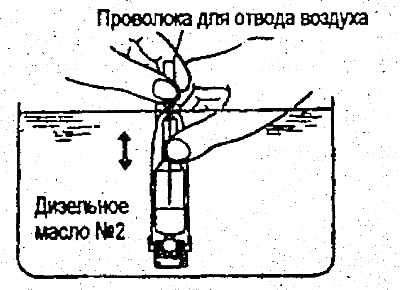
1. Insert the air bleed wire into the hole of the automatic compensator and…


2. Remove the air bleed wire and use your finger to move the plunger.

If the plunger moves even slightly, repeat steps 1 and 2. If the plunger moves even after repeating steps 1 and 2 multiple times, replace the automatic clearance compensator.

Caution: Do not attempt to disassemble the automatic clearance adjuster. Use clean oil to clean it.


Testing the hydraulic clearance compensator for leaks


1. Install the hydraulic clearance compensator in a special device (09246-32300), as shown in the figure.
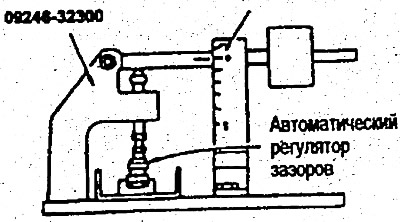
1. Install the hydraulic clearance compensator in a special device…


2. After the plunger has dropped slightly, measure the subsequent rate of descent.


The standard value of the rate of descent is 20-50 seconds/2.5 mm

(Diesel oil No.2 or equivalent) - Temperature 27°C

3. If the leak test cannot be performed, check the compensator as follows.
  • 1) Check if there is any abnormal noise when the engine is idling at normal operating temperature.
  • 2) If the noise is abnormal, bleed the air from the automatic clearance adjuster.
  • 3) After releasing the air, check if there is any abnormal noise when the engine is idling at normal operating temperature.
  • 4) If the noise is still abnormal, replace the automatic hydraulic clearance compensator.

Installation


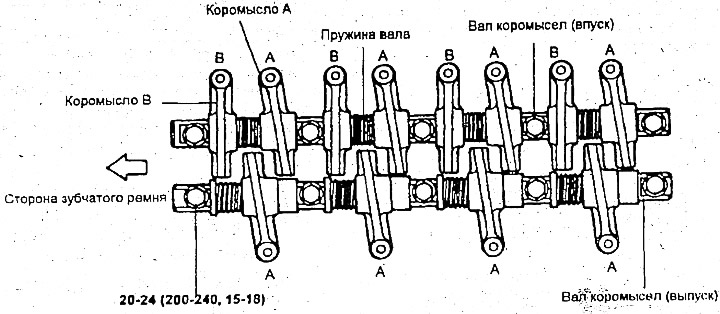
1. Install the rocker arms and rocker shaft springs onto the rocker shaft. Install the rocker shaft into the cylinder head.
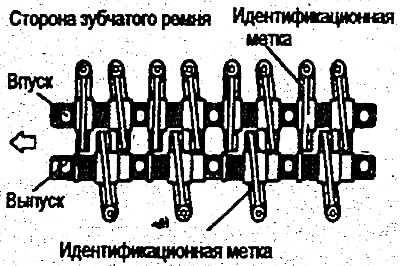
1. Install the rocker arms and rocker shaft springs onto the rocker shaft.…


Tighten the rocker arm shaft mounting bolts to the specified torque.

Tightening torque: Rocker shaft mounting bolt - 20-24 Nm

2. When installing rocker arms, shafts, springs, pay attention to the difference between type A and type B rocker arms. Only type A rocker arms are installed on the exhaust side. (See the figure above at the beginning of that section).

3. Install the rocker cover and tighten the bolts to the specified torque.
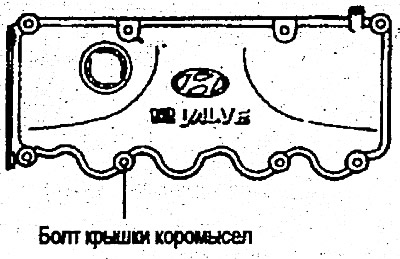


3. Install the rocker cover and tighten the bolts to the specified torque.


Tightening torque: Rocker cover bolt - 8-10 Nm

Warning:
1. Grease should be applied to the top surface of the cylinder head and cover. The surface to be applied is shown in the figure.
2. It is necessary to apply a certain amount of lubricant to prevent it from leaking out.
3. Use special grade grease or equivalent Three bond N1212D aluminum color or equivalent.
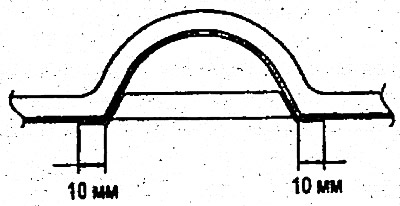

3. Use special grade grease or equivalent Three bond N1212D aluminum color or…


4. Install the timing belt cover.

Tightening torque: Timing belt cover bolt - 10-12 Nm

5. Install the air cleaner.

6. Install the suction hose and PCV hose.
This article is available at russian, bulgarian, belarusian, ukrainian, serbian, croatian, romanian, polish, slovak, hungarian
This article has been reviewed by: Konstantin Smirnov
Add to social network:

Previous
Accent 1: SOHC engines
Next

Timing belt — removal, inspection and installation
Engine and gearbox assembly
Removal the engine
Engine mount
Tensioning the toothed belt (when using the device)
Camshaft — removal, inspection and installation
Cylinder head — removal, inspection and installation
Valves and valve springs — removal, inspection and installation
Front cover, oil pump — removal, inspection and installation
Piston and connecting rod — removal, inspection and installation
We recommend other articles on the topic of Hyundai manuals:

Hydraulic tappet (hydraulic valve clearance compensator) Hyundai Elantra 1 (1990-1995, petrol)
Hydraulic valve clearance compensators Hyundai Getz (2002-2011)
Rocker arms and their shafts — components Hyundai Sonata 3 (1993-1998)
Power Steering Hydraulic Hoses Hyundai Santa Fe 2 (2007-2012, petrol)
Drive shafts and final drive — technical specifications Hyundai Tucson 1 (2005-2010)
Table 2.6. Search for causes of hydraulic compensator… Hyundai Matrix (2001-2010, petrol)

Link in different formats to this article

Visitor comments
No comments yet


How much will 48 + 28 ?


Accent 3 (2005-2010) 
  • General information
  • User manual
  • Maintenance
  • Power unit
  • Engine repair
  • Cooling and lubrication system
  • Power and exhaust system
  • Engine electrical equipment
  • Engine management
  • Transmission
  • Clutch
  • Mechanical gearbox
  • Automatic gearbox
  • Chassis
  • Front suspension
  • Rear suspension
  • Wheels and tires
  • Steering
  • Brake system
  • Body
  • Exterior (external elements)
  • Interior (internal elements)
  • Heating and ventilation
  • Electrical equipment
  • Equipment and devices
  • Electrical circuits
Accent 2 (1999-2005) 
  • User manual
  • Control devices
  • Starting engine and driving
  • Troubleshooting
  • Power unit
  • SOHC engines
  • DOHC engines
  • Lubrication system
  • Cooling system
  • Decreased toxicity
  • Fuel system
  • Ignition system
  • Transmission
  • Clutch
  • Mechanical gearbox
  • Automatic gearbox
  • Axles and drive shafts
  • Chassis
  • Car suspension
  • Steering
  • Brake system
  • Body
  • Exterior (external elements)
  • Interior (internal elements)
  • Air conditioning system
  • Electrical equipment
  • Equipment and devices
  • Power devices
Accent 1 (1994-1999) 
  • General information
  • Maintenance
  • Power unit
  • SOHC engines
  • DOHC engines
  • Cooling system
  • Intake and exhaust systems
  • Fuel supply (1.3 l, injection)
  • Fuel supply (1.5 l, injection)
  • Fuel supply (carburetor)
  • Transmission
  • Clutch
  • Manual gearbox
  • Automatic gearbox
  • Drive shafts
  • Chassis
  • Car suspension
  • Steering
  • Brake system
  • Body
  • Body elements
  • Electrical equipment
  • Equipment and devices
  • Electrical circuits
HyundaiBook.ru © 2018-2026 · Mobile version · Sitemap: EN BG BY UA RS HR RO PL SK HU · Administration · Site search · Hyundai owners Accent 1 · Accent 2 · Accent 3 · Elantra 1 · Elantra 2 · Elantra 3 · Getz · Sonata 3 · Sonata 4 · Santa Fe 2 · Tucson 1 · Tucson 2 · Matrix ·
This site uses cookies to optimize its functionality. By continuing, you agree to our terms.