HyundaiBook.ru
Repair Chevrolet Repair Honda Repair Toyota Repair Land Rover Repair VAZ Repair Renault Repair Nissan
English Русский
Български
Беларускі
Український
Српски
Hrvatski
Română
Polski
Slovenský
Magyar
ArticlesSitemapContacts  


  Accent   Elantra   Getz   Grandeur   Sonata   Santa Fe   Tucson   Others
Accent 1 (1994-1999) Accent 2 (1999-2005) Accent 3 (2005-2010)
  • Main
  • Accent
  • LC (1999-2005)
  • Power unit
  • Fuel system
  • Malfunction Indicator Lamp (MIL)

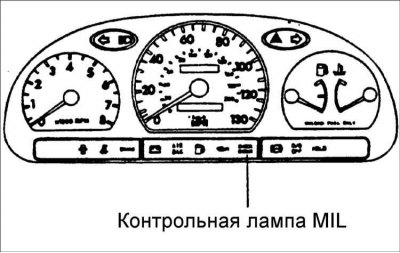
Malfunction Indicator Lamp (MIL) (Hyundai Accent LC)

0
Contents: Examination ⇓ Self-diagnosis ⇓
The MIL indicator lamp lights up when there are malfunctions in the engine management system. However, the MIL lamp will not light up after three engine starts if the previously detected malfunction does not occur again. After the ignition is turned on (before the engine is started), the indicator lamp lights up continuously, which indicates the normal operation of the diagnostic system of malfunctions. The indicator lamp with the "OBD–II" system lights up when malfunctions occur in the following system components:
  • catalytic converter;
  • fuel system;
  • air flow meter;
  • engine air temperature sensor;
  • coolant temperature sensor;
  • throttle position sensor;
  • oxygen sensor;
  • oxygen sensor heater;
  • fuel injectors;
  • misfires;
  • crankshaft angle sensor;
  • camshaft position sensor;
  • fuel vapor recovery system;
  • vehicle speed sensor;
  • idle speed control valve;
  • electrical power supply;
  • ECM;
  • malfunction of the gearbox;
  • acceleration sensor;
  • mIL signal request.

mIL signal request.


The control lamp without the "OBD-II" system lights up when faults occur in the following system elements:
  • heated oxygen sensor;
  • manifold absolute pressure sensor;
  • throttle position sensor;
  • coolant temperature sensor;
  • modulator for controlling the engine idle speed;
  • fuel injectors;
  • ECM.


Examination


1. After turning on the ignition, the control lamp lights up for 5 seconds and then goes out.

2. If the test lamp does not light, check the lamp electrical circuit, the integrity of the fuse and the serviceability of the lamp.

Self-diagnosis


The ECM constantly monitors input and output signals and other signals under certain conditions. When a malfunction is detected, the ECM stores a diagnostic trouble code (DTC) in memory and outputs the code to the diagnostic connector. DTCs can be read using the MIL or the HI-SCAN scanner. DTCs remain in memory until the battery cables are disconnected or the connector is disconnected from the ECM, or until they are cleared using the HI-SCAN scanner.

Warning! If the connector is disconnected with the ignition on, a DTC will be stored in the memory. In this case, disconnect the negative battery cable for more than 15 seconds, which will erase the diagnostic memory.
This article is available at russian, bulgarian, belarusian, ukrainian, serbian, croatian, romanian, polish, slovak, hungarian
This article has been reviewed by: Konstantin Smirnov
Add to social network:

Previous
Accent 2: Fuel system
Next

MFI injection system checks
Checking the pressure generated by the fuel pump
Checking the fuel pump
Technical data (SOHC and DOHC)
OBD-II Diagnostic Trouble Codes
Diagnostic trouble codes other than «OBD-II»
Replacing the fuel filter
Replacing the overflow limiter (two-way valve)
Replacing the fuel level sensor
We recommend other articles on the topic of Hyundai manuals:

Malfunction Indicator Lamp (MIL) Hyundai Elantra 3 (2000-2006)
Malfunction Indicator Lamp (MIL) Hyundai Getz (2002-2011)
Fuel quantity indicator Hyundai Sonata 4 (2001-2012, petrol)
Instrument cluster and indicator lights Hyundai Santa Fe 2 (2007-2012, petrol)
Autonomous operation of the airbag malfunction indicator lamp Hyundai Tucson 1 (2005-2010)
Intake Air Temperature Sensor Malfunction Indicator Lamp Hyundai Matrix (2001-2010, petrol)

Link in different formats to this article

Visitor comments
No comments yet


How much will 42 + 14 ?


Accent 3 (2005-2010) 
  • General information
  • User manual
  • Maintenance
  • Power unit
  • Engine repair
  • Cooling and lubrication system
  • Power and exhaust system
  • Engine electrical equipment
  • Engine management
  • Transmission
  • Clutch
  • Mechanical gearbox
  • Automatic gearbox
  • Chassis
  • Front suspension
  • Rear suspension
  • Wheels and tires
  • Steering
  • Brake system
  • Body
  • Exterior (external elements)
  • Interior (internal elements)
  • Heating and ventilation
  • Electrical equipment
  • Equipment and devices
  • Electrical circuits
Accent 2 (1999-2005) 
  • User manual
  • Control devices
  • Starting engine and driving
  • Troubleshooting
  • Power unit
  • SOHC engines
  • DOHC engines
  • Lubrication system
  • Cooling system
  • Decreased toxicity
  • Fuel system
  • Ignition system
  • Transmission
  • Clutch
  • Mechanical gearbox
  • Automatic gearbox
  • Axles and drive shafts
  • Chassis
  • Car suspension
  • Steering
  • Brake system
  • Body
  • Exterior (external elements)
  • Interior (internal elements)
  • Air conditioning system
  • Electrical equipment
  • Equipment and devices
  • Power devices
Accent 1 (1994-1999) 
  • General information
  • Maintenance
  • Power unit
  • SOHC engines
  • DOHC engines
  • Cooling system
  • Intake and exhaust systems
  • Fuel supply (1.3 l, injection)
  • Fuel supply (1.5 l, injection)
  • Fuel supply (carburetor)
  • Transmission
  • Clutch
  • Manual gearbox
  • Automatic gearbox
  • Drive shafts
  • Chassis
  • Car suspension
  • Steering
  • Brake system
  • Body
  • Body elements
  • Electrical equipment
  • Equipment and devices
  • Electrical circuits
HyundaiBook.ru © 2018-2026 · Mobile version · Sitemap: EN BG BY UA RS HR RO PL SK HU · Administration · Site search · Hyundai owners Accent 1 · Accent 2 · Accent 3 · Elantra 1 · Elantra 2 · Elantra 3 · Getz · Sonata 3 · Sonata 4 · Santa Fe 2 · Tucson 1 · Tucson 2 · Matrix ·
This site uses cookies to optimize its functionality. By continuing, you agree to our terms.