HyundaiBook.ru
Repair Chevrolet Repair Honda Repair Toyota Repair Land Rover Repair VAZ Repair Renault Repair Nissan
English Русский
Български
Беларускі
Український
Српски
Hrvatski
Română
Polski
Slovenský
Magyar
ArticlesSitemapContacts  


  Accent   Elantra   Getz   Grandeur   Sonata   Santa Fe   Tucson   Others
Tucson 1 (2005-2010) Tucson 2 (2009-2015)
  • Main
  • Tucson
  • LM (2009-2015)
  • Body
  • Air conditioning and heater
  • Compressor — device, removal and installation

Compressor — device, removal and installation (Hyundai Tucson LM)

0
Contents: Removal ⇓ Installation ⇓ Checking the technical condition ⇓ Disassembly ⇓
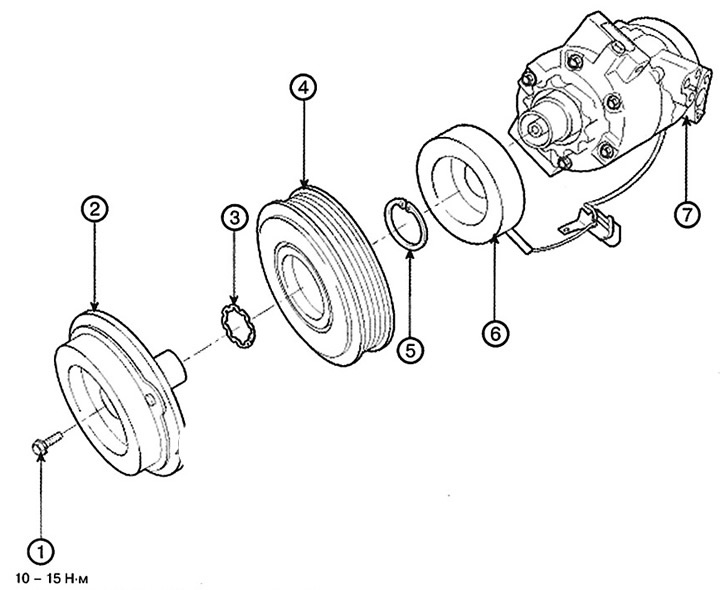
1. Bolt

1. Bolt
2. Disc and hub assembly
3. Snap ring (pulley)
4. Pulley
5. Retaining ring (excitation coils)
6. Excitation coil
7. Compressor assembly


Removal


1. If the compressor is partially open, run the engine at idle speed and turn on the air conditioning system for a few minutes, then turn off the engine.

2. Disconnect the negative terminal from the battery.

3. Extract the refrigerant using a recovery and recharging machine.

4. Loosen the drive belt.

5. Loosen the bolts, then disconnect the inlet (A) and outlet (B) lines from the compressor. Plug or close the lines immediately after disconnecting them to prevent atmospheric moisture and dust from entering them.
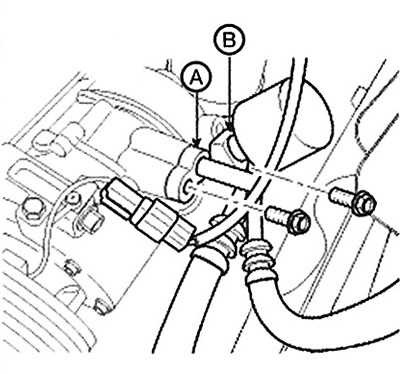
5. Loosen the bolts, then disconnect…


6. Disconnect the compressor clutch connector, unscrew the 3 mounting bolts and remove the compressor (A).
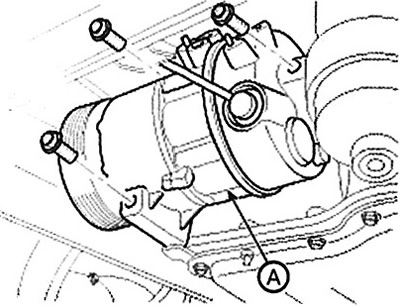


6. Disconnect the compressor clutch…


Installation


1. Check the length of the compressor mounting bolts, then tighten them in order A->IN->WITH.

Note: Tightening torque: 20.0 - 32.9 Nm.
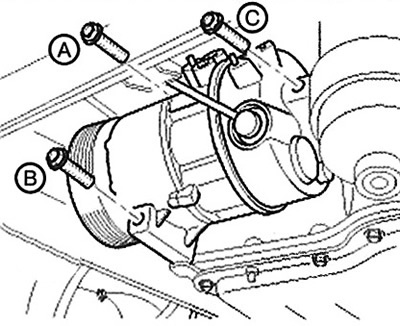

Note: Tightening torque: 20.0 - 32.9 Nm.


2. Installation is performed in the reverse order of removal. Please note the following features:

When installing a new compressor, drain all refrigerant oil from the old compressor and measure its volume. Subtract the volume of oil drained from 120 cc to obtain the volume of oil that must be drained from the new compressor (via the inlet connector).

Replace the sealing rings with new ones; apply a thin layer of refrigerant oil to them before installation. Be sure to use O-rings designed for R-134a refrigerant to prevent leaks.

To avoid contamination, do not pour drained oil back into the container, never mix it with other oils.


Immediately after using the oil, place the lid on the container and tighten it tightly to prevent moisture from getting in.

Do not allow coolant oil to come into contact with the vehicle's surfaces, as this may damage the paintwork. If coolant oil comes into contact with a painted surface, it must be washed off immediately with water.

Adjust the drive belt tension.

Prime the system and check its performance.

Checking the technical condition


1. Inspect the galvanized parts of the disc and hub assembly (A) for discoloration, peeling or other damage. If damaged, replace the clutch assembly.

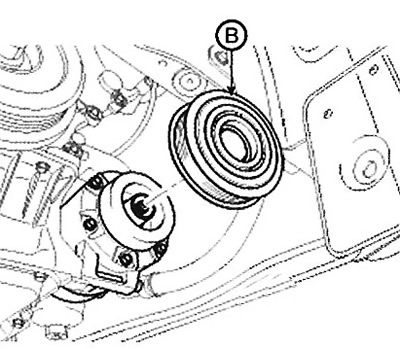
2. Check the pulley bearings (B) for play and binding by rotating the pulley by hand. If there is excessive play/binding or noise, replace the clutch assembly.
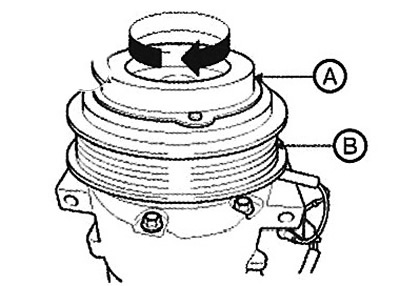
2. Check the pulley bearings (B) for…


3. Check the operation of the magnetic clutch. Connect the compressor terminals to the positive (+) terminal of the battery, and the compressor body to the negative (-) terminal. Check the noise generated by the clutch operation.
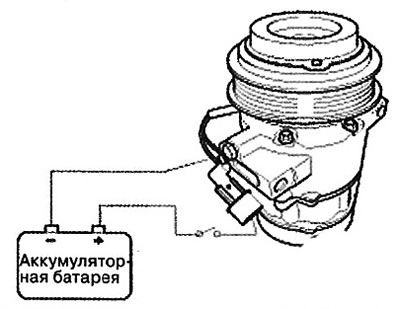
3. Check the operation of the magnetic…


Disassembly


1. Remove the front left wheel (A).
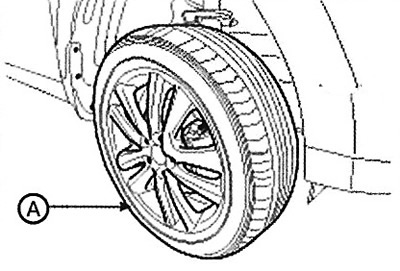
1. Remove the front left wheel (A).


2. Remove the engine side cover (A).
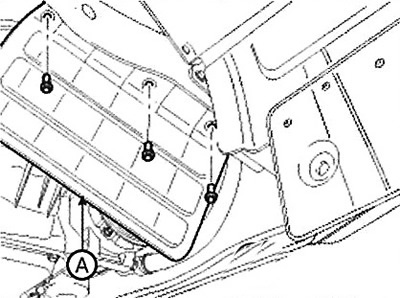
2. Remove the engine side cover (A).


3. Loosen the center bolt (A) while holding the disc and hub assembly with a special tool (09977-29000).

Note: Tightening torque: 10-15 Nm.
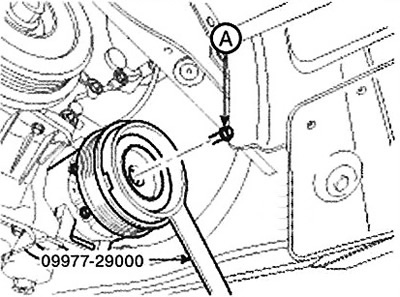

Note: Tightening torque: 10-15 Nm.


4. Remove the disc and hub assembly (A) and the adjusting shims (clearance adjusting washers). Do not lose these shims.
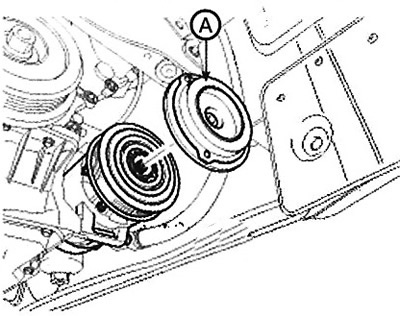


4. Remove the disc and hub assembly (A)…


5. Remove the snap ring (A), then remove the pulley (B).

Note:


Be careful not to damage the pulley (B) and compressor during removal/installation.


The removed retaining ring (A) must be replaced with a new one.
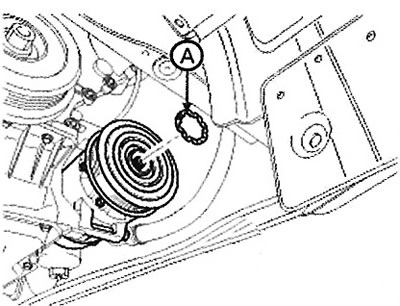

The removed retaining ring (A) must be…


6. Remove the retaining ring (B), then remove the excitation coil (C). Be careful not to damage the coil and the compressor.
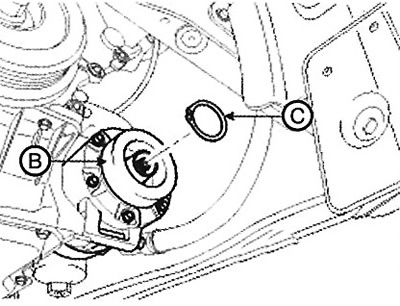


6. Remove the retaining ring (B), then…


7. Install the compressor clutch in the reverse order of removal. Please note the following features.

A. Clean the moving surfaces of the pulley and compressor with a non-petroleum based solvent.

B. Install new snap rings, making sure they are seated correctly in the groove.

C. After assembling the pulley, make sure it rotates smoothly.
This article is available at russian, bulgarian, belarusian, ukrainian, serbian, croatian, romanian, polish, slovak, hungarian
This article has been reviewed by: Konstantin Smirnov
Add to social network:

Previous
Tucson 2: Air conditioning and heater
Next

Compressor oil
Checking the tightness of the system
Filling the system with refrigerant
Creating a vacuum in the system
Draining refrigerant from the air conditioning system
Air Conditioning and Heating — General Information
Capacitor — Checking and Replacing
Air Conditioner Pressure Sensor
Refrigerant pipeline
Evaporator temperature sensor
Car interior air temperature sensor
Ambient air temperature sensor
We recommend other articles on the topic of Hyundai manuals:

Tensioning the toothed belt (when using the device) Hyundai Accent 1 (1994-1999)
Belt/chain drives of the engine — device Hyundai Elantra 1 (1990-1995, petrol)
Child restraint device (child seat) Hyundai Getz (2002-2011)
Device for maintaining the set speed (cruise control) of the car Hyundai Sonata 3 (1993-1998)
Child restraint device (child seat) Hyundai Santa Fe 2 (2007-2012, petrol)
Cooling system device Hyundai Matrix (2001-2010, petrol)
Link in different formats to this article

Visitor comments
No comments yet


How much will 43 + 12 ?


Tucson 2 (2009-2015) 
  • General information
  • Faults en route
  • User manual
  • Maintenance
  • Power unit
  • Gasoline engines
  • Diesel engines
  • Engine cooling system
  • Engine lubrication system
  • Engine power system
  • Control system
  • Intake and exhaust systems
  • Engine electrical equipment
  • Transmission
  • Clutch
  • Mechanical gearbox
  • Automatic gearbox
  • Drive shafts
  • Chassis
  • Suspension and wheels
  • Brake system
  • Steering
  • Body
  • Exterior (external elements)
  • Interior (internal elements)
  • Security systems
  • Air conditioning and heater
  • Electrical equipment
  • Electrical circuits
Tucson 1 (2005-2010) 
  • General information
  • User manual
  • Maintenance
  • Power unit
  • Gasoline engine G6BA
  • Gasoline engine G4GC
  • Diesel engine D4EA
  • Fuel system (gasoline)
  • Fuel system (diesel)
  • Engine lubrication system
  • Engine cooling system
  • Engine electrical equipment
  • Transmission
  • Clutch
  • Car gearbox
  • Drive shafts and cardan
  • Chassis
  • Car suspension
  • Steering
  • Brake system
  • Body
  • Exterior (external elements)
  • Interior (internal elements)
  • Air conditioning and heater
  • Airbags
  • Electrical equipment
  • Equipment and devices
  • Electrical circuits
HyundaiBook.ru © 2018-2026 · Mobile version · Sitemap: EN BG BY UA RS HR RO PL SK HU · Administration · Site search · Hyundai owners Accent 1 · Accent 2 · Accent 3 · Elantra 1 · Elantra 2 · Elantra 3 · Getz · Sonata 3 · Sonata 4 · Santa Fe 2 · Tucson 1 · Tucson 2 · Matrix ·
This site uses cookies to optimize its functionality. By continuing, you agree to our terms.