


In accordance with the legislation of most countries, you are required to use child restraints. When transporting young children, you must use a child restraint (child seat).
In the event of a traffic accident (crash), children may be injured if their restraint device (child seat) is not properly secured. A baby cot or child seat should be used to transport infants and small children.
Before buying a child seat (or "cradle"), check that it fits well on the back seat and is suitable for installation with your seat belts, and also check that it corresponds to the build of the child. Install the restraint device (child seat) in accordance with the instructions of the manufacturer of this device.
Warning:
- THE CHILD RESTRAINT DEVICE (CHILD SEAT) MUST BE INSTALLED IN THE REAR SEAT. It is not permitted to install a baby bassinet or child seat in the front seat. If the front passenger airbag deploys in an accident, it could fatally or seriously injure the infant or child seated in the bassinet or child seat. Therefore, use the child restraint device (child seat) only in the rear seat of your vehicle.
- Because the seat belt or child seat can become very hot in a closed vehicle, be careful to check the surface of the seat and buckles before placing your child in the child seat.
- When you are not using the child seat, store it in the trunk or fasten it with a seat belt to prevent it from being thrown forward in the event of sudden braking or an accident.
- Children who are too small to fit in child seats (child restraints) should be seated in the rear seats and secured with a combination lap/shoulder belt.
- Always make sure that the shoulder portion of the lap-shoulder side seat belt is positioned in the middle of the shoulder and does not touch the neck. Moving the child closer to the center of the car may help to position the belt better. The shoulder portion of the lap-shoulder side seat belt and the rear seat center lap belt should always be positioned as low and as tight as possible.
- If the child seat cannot be properly secured with the seat belt, it is recommended to use a child seat pad to raise the child's seat height so that the child can be properly secured with the seat belt.
- Do not allow the child to stand on the seat or be carried in your arms.
- The use of restraints or child seats that are attached to the back of the seat is not permitted; such devices do not provide the necessary safety in the event of a traffic accident.
- Holding a child in your arms while the car is moving is unacceptable, the child may suffer serious or even fatal injuries in the event of a traffic accident (crash) or sudden braking. Your hands will not replace a restraining device (child seat), even if the person holding the child is wearing a seat belt.
Using a Child Restraint
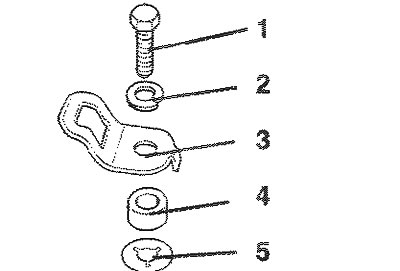
1 - Bolt, Holder (5/16" - 30 mm); 2 - Washer, Conical spring; 3 - Holder, Hook of the holding device; 4 - Distance washer (10 mm), Loop for hook of holding device; 5 - Lock washer
When transporting infants and small children, it is strongly recommended to use a child seat. This restraint device (child seat) must be appropriate for the height and weight of your child and installed correctly in accordance with the instructions of the manufacturer of this device. To ensure greater safety. THE CHILD RESTRAINT DEVICE (CHILD SEAT) SHOULD BE INSTALLED IN THE REAR SEAT. There are three holes in your vehicle for installing the mounting hardware of the restraint device (child seat).