


Contents: With on-board diagnostics (OBD)…⇓ Without on-board diagnostics (OBD) ⇓ Examination ⇓ Self-diagnosis ⇓
With on-board diagnostics (OBD) system
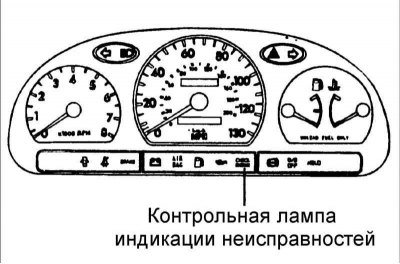
The MIL indicator lamp comes on when there is a malfunction in the engine management system. However, the MIL will not illuminate after three engine starts if the previously detected fault no longer occurs. After turning on the ignition (before starting the engine) the indicator light stays on, indicating that the fault diagnostic system is operating normally. The OBD system indicator lamp lights up when faults occur in the following system components:
- catalytic converter;
- fuel system;
- air flow meter;
- manifold absolute pressure sensor;
- engine air temperature sensor;
- coolant temperature sensor;
- throttle position sensor;
- oxygen sensor;
- oxygen sensor heater;
- fuel injectors;
- misfires;
- crankshaft angle sensor;
- camshaft position sensor;
- fuel vapor recovery system;
- vehicle speed sensor;
- idle speed control valve;
- electrical power supply;
- ECM;
- malfunction of the gearbox;
- acceleration sensor;
- mIL signal request;
- reducing power.
Without on-board diagnostics (OBD)
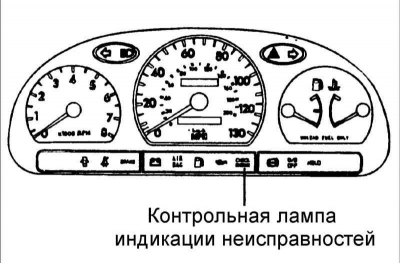
The MIL indicator lamp comes on when there is a malfunction in the engine management system. However, the MIL will not illuminate after three engine starts if the previously detected fault no longer occurs. After turning on the ignition (before starting the engine) the indicator light stays on, indicating that the fault diagnostic system is operating normally.
The control lamp without the "OBD–II" system lights up when faults occur in the following system elements:
- heated oxygen sensor;
- manifold absolute pressure sensor;
- coolant temperature sensor;
- modulator for controlling the engine idle speed;
- fuel injectors;
- ECM.
Examination
1. After turning on the ignition, the indicator lamp lights up for 5 seconds and then goes out.
2. If the indicator lamp does not light, check the electrical circuit of the lamp, the integrity of the fuse and the serviceability of the lamp.
Self-diagnosis
The ECM continuously monitors input and output signals and other signals under certain conditions. When a fault is detected, the ECM unit writes the diagnostic fault code to memory and provides the code output to the diagnostic connector.
Diagnostic trouble codes (DTC) can be read using a test lamp or the HI-SCAN scanner. Diagnostic trouble codes remain in memory until the battery cables are disconnected or the connector is disconnected from the ECM, or until they are cleared using a scanner.
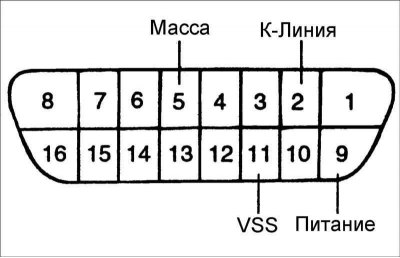
Caution! If the connector is disconnected with the ignition on, a DTC fault code will be stored in the memory. In this case, disconnect the cable from the negative terminal of the battery for more than 15 seconds, as a result of which the diagnostic memory will be erased.